Channel Insider sought nominations from IT vendors, solution providers, and partners to highlight impactful collaborations. Check out our top choices here.
Video: Deepfake Defense May Become a Core MSP Service
Delta Bear CEO Daniel Elliott joins Channel Insider: Partner POV to discuss deepfake attacks, AI impersonation risks, cyber insurance gaps, and MSP opportunities.
Video: Harbor IT on NENS Acquisition and Why the Generalist MSP Model Is Dying
Leaders from Harbor IT explain why the traditional generalist MSP model is fading and how specialization, cybersecurity expertise, and vertical industry focus are shaping the future of managed services.
Channel Insider sought nominations from IT vendors, solution providers, and partners to highlight impactful collaborations. Check out our top choices here.
Video: Deepfake Defense May Become a Core MSP Service
Delta Bear CEO Daniel Elliott joins Channel Insider: Partner POV to discuss deepfake attacks, AI impersonation risks, cyber insurance gaps, and MSP opportunities.
Video: Harbor IT on NENS Acquisition and Why the Generalist MSP Model Is Dying
Leaders from Harbor IT explain why the traditional generalist MSP model is fading and how specialization, cybersecurity expertise, and vertical industry focus are shaping the future of managed services.
Channel Insider content and product recommendations are editorially independent. We may make money when you click on links to our partners. Learn More
MSSP software is a tool or platform that enables managed security service providers (MSSPs) to deliver outsourced cybersecurity services to organizations.
Unlike traditional MSP software, MSSP tools focus specifically on security functions such as threat detection, access control, vulnerability management, and infrastructure protection.
MSSPs support organizations ranging from small businesses to enterprises and play a critical role in securing increasingly complex hybrid and cloud-based IT environments.
For established MSSPs and MSPs expanding into cybersecurity services, the platforms below are among the top tools for delivering modern managed security services in 2026.
Featured Partners: Managed Service Provider (MSP) Software
We are able to offer our services for free because some vendors may pay us for web traffic or other sales opportunities. Our mission is to help technology buyers make better purchasing decisions, so we provide you with information for all vendors — even those that don't pay us.
Infrastructure security tools: Best for managing and securing IT infrastructures
Infrastructure security software is designed to protect IT infrastructure from a range of physical and virtual security threats. These tools and software enable MSSPs to secure hardware, software, networks, and data from actions and events that could cause serious loss or damage to their customers.
Palo Alto Networks offers MSSPs the tools and services to drive revenue growth and explore new market opportunities through natively integrated, easy-to-deploy, cloud-delivered innovations.
MSSPs can deliver cybersecurity experiences based on Palo Alto’s global threat intelligence and AI, and security orchestration and auto-remediation that integrate with hundreds of services and tools.
Palo Alto also offers its users automated workflows that are easy to replicate, accelerating the customer onboarding process.
Cisco offers its MSSP customers a vast catalog of security solutions that enhance their visibility and control of their customers’ networks and endpoints.
Their cloud-based approach allows MSPs to implement comprehensive security measures across IT environments without additional hardware, easing deployment and management.
This gives customers a more agile security posture, enabling rapid threat response while protecting critical infrastructure components.
Fortinet aligns its portfolio to accelerate digital innovation for both providers and their customers, with core offerings including managed firewalls and monitoring services that can generate significant managed security service revenue.
Fortinet supports MSPs in including services such as managed SD-WAN, managed SASE, SOC-based services, and cloud security solutions in their service offerings and aligning with today’s market and customer expectations.
Network security tools: Best for managing large networks
Network security software and tools help protect the usability and integrity of your networks. They are essential for detecting and preventing threats against network infrastructure. Even though network security is part of infrastructure security, it is a cornerstone of any robust cybersecurity strategy.
Key features include:
Secure VPN and encrypted remote access
Firewalls
Intrusion detection and prevention (IDPS)
Data loss prevention (DLP)
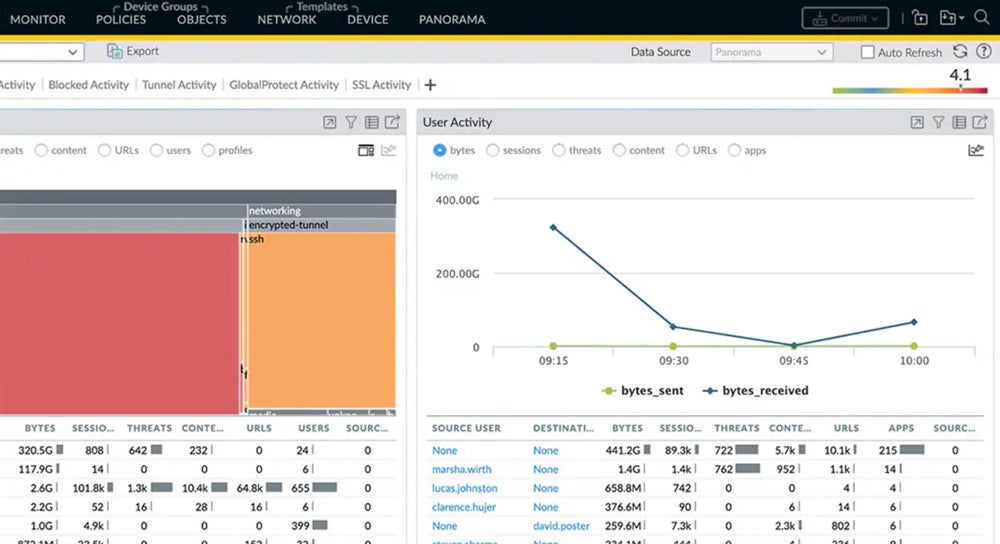
Monitoring user activity via Palo Alto. Image: Palo Alto
Best network security software providers
Palo Alto Networks
Palo Alto Networks enables MSSPs to offer advanced network security services by leveraging cloud-delivered, easy-to-deploy, natively integrated solutions.
MSPs and MSSPs gain access to global threat intelligence powered by AI, security orchestration, automated remediation, and streamlined onboarding.
These features enable MSPs to deliver differentiated services that meet their clients’ security needs and enhance their overall cybersecurity experience.
Fortinet’s Secure Networking provides AI-powered defense across dynamic environments, including LAN and WAN, 5G, remote work setups, and cloud integrations.
This enables MSSPs to enhance the productivity and user experience of their customers and teams, as well as ensure client networks are resilient, agile, and secure.
It also offers a secure SD-WAN solution that empowers MSSPs to deliver secure, high-speed, scalable, and flexible WAN connectivity both on-premises and in the cloud.
Cisco provides MSPs and MSSPs with a comprehensive network security framework that includes firewall protection, intrusion prevention systems (IPS), secure access, and endpoint protection.
It leverages cloud-based technologies to deliver scalable, flexible security without additional hardware, reducing complexity and operational overhead for MSPs. Additionally, Cisco’s solutions are flexible and scalable as they are designed to integrate seamlessly into existing infrastructures.
Cloud security software: Best for securing cloud-based services
Cloud security software is crucial for any MSP that offers cloud-based services, as it helps identify and respond to threats, control access to cloud resources, ensure compliance with regulatory standards, and protect sensitive data from unauthorized access.
With the right cloud security software, you can ensure your clients leverage the benefits of the cloud while minimizing security risks.
Key features include:
Data protection (encryption, tokenization, key management)
Real-time threat detection and monitoring
Compliance management and policy enforcement
Secure access controls and multi-factor authentication (MFA)
Threat intelligence sweeping and summary using Trend Micro. Image: Trend Micro
Best cloud security software providers
Microsoft Azure
Microsoft Azure offers a suite of cloud protection services, including Azure Defender for Cloud, which provides advanced security management and threat protection for hybrid cloud workloads, helping MSPs and MSSPs secure them.
Another service is Microsoft Sentinel, Azure’s cloud-native SIEM, which extends intelligent security analytics and threat intelligence to enable MSPs to identify, respond to, and mitigate threats swiftly.
Additionally, Azure Key Vault helps manage secrets, keys, and certificates.
AWS empowers MSSPs with services to monitor and protect AWS resources. AWS’s security suite includes features like Amazon GuardDuty for threat detection, Amazon Inspector for automated security assessment, and AWS Shield for DDoS protection.
These services collectively enable MSSPs to offer advanced threat detection, continuous compliance monitoring, and resilient protection against a wide range of cyber threats, ensuring the security and integrity of their clients’ cloud deployments.
Trend Micro offers MSSPs Trend Vision One, a comprehensive security platform with features such as XDR (Extended Detection and Response) and advanced threat protection.
MSSPs can proactively detect and respond to threats across multiple layers, including email, endpoints, servers, cloud workloads, and networks. By integrating AI and expert-driven insights, Trend Vision One empowers MSSPs to deliver a layered security approach that optimizes their customers’ defenses against threats.
Data security tools: Best for monitoring and securing sensitive client data
Data security software ensures that your data is protected, accessible only to authorized users, and not compromised. It involves solutions that protect data from deliberate or unintentional destruction, modification, or disclosure. Data security can be applied using a range of techniques, including encryption, data masking, and data erasure.
Key features include:
Data encryption for sensitive and regulated information
Data backup and recovery
Data masking for sensitive information
Data loss prevention (DLP) and breach protection
Imperva’s security insights. Image: Imperva
Best data security software providers
Varonis
Varonis offers MSSPs advanced data protection capabilities through its suite of services. Their Data Classification Framework automatically categorizes sensitive and regulated data across an organization’s digital environment for effective data governance.
Its DataPrivilege module streamlines access governance by implementing a least-privilege model to ensure data is accessible only to authorized personnel. Additionally, DatAlert provides anomaly detection and real-time alerts for suspicious activities.
Imperva provides MSPs and MSSPs with multiple data security and compliance tools, including Data Risk Analytics, which uses machine learning to detect and prioritize risky user behaviors and reduce the risk of data leaks.
Imperva also offers Database Activity Monitoring (DAM), which continuously monitors database activity and alerts on policy violations and unusual actions. Furthermore, Imperva’s Data Masking solution anonymizes sensitive information in non-production environments.
Formerly known as Micro Focus, OpenText equips MSPs and MSSPs with a broad cybersecurity portfolio, including Voltage SecureData, which provides data encryption and tokenization to secure data across various platforms and applications.
Its Enterprise SIEM system enables real-time threat detection and response, sharpening security operations through its analytical capabilities.
Identity and access management (IAM) tools: Best for controlling user access to critical data
Overview
Features (SSO, MFA, PAM)
Vendors
Who should use it
IAM software facilitates the management of electronic identities. MSSPs can use these tools to automate the initiation, capturing, recording, and management of user identities and their access permissions.
With IAM, access privileges are granted via policies, and all individuals and services are correctly authenticated, authorized, and audited.
Key features include:
Single sign-on (SSO) for centralized access management
Multi-factor authentication (MFA)
User activity and access monitoring
Identity lifecycle management and provisioning
Okta IAM’s system status pane. Image: Okta
Best IAM providers
Okta
Okta empowers MSSPs with a comprehensive access management platform, securing critical resources from the cloud to the ground for workforces and their customers.
The platform offers Single Sign-On (SSO) to streamline access across applications with a single set of credentials, enhancing user convenience and security. Okta offers a Universal Directory that centralizes user information and eases identity management across systems.
CyberArk’s MSSPs IAM solutions feature Privileged Access Management (PAM), which secures privileged credentials and sessions to reduce internal and external security risks.
Endpoint Privilege Manager helps MSSPs control applications and scripts on endpoints, thereby minimizing the attack surface for their customers. CyberArk’s Identity Security offers a robust approach for protecting against credential theft and privilege abuse.
Ping Identity focuses on enhancing customer experiences without compromising security. The platform includes flow templates for standard IAM processes, drag-and-drop integrations for ease of use, and features to optimize user journeys with A/B testing.
Ping’s implementation accelerators expedite deployment, helping MSSPs to quickly deliver secure, seamless access to applications and services.
Risk and vulnerability management tools: Best for assessing and managing security risks
Risk and vulnerability management software helps identify, classify, remediate, and mitigate vulnerabilities. It provides a systematic approach to managing security risks arising from exposure to threats, vulnerabilities, and impacts. This type of software will help you identify and prioritize vulnerabilities in a system, and it’ll provide the tools necessary to take corrective action.
Key features include:
Risk assessment and vulnerability scanning
Remediation guidance and patch tracking
Reporting, analytics, and risk visibility
Compliance management and security control monitoring
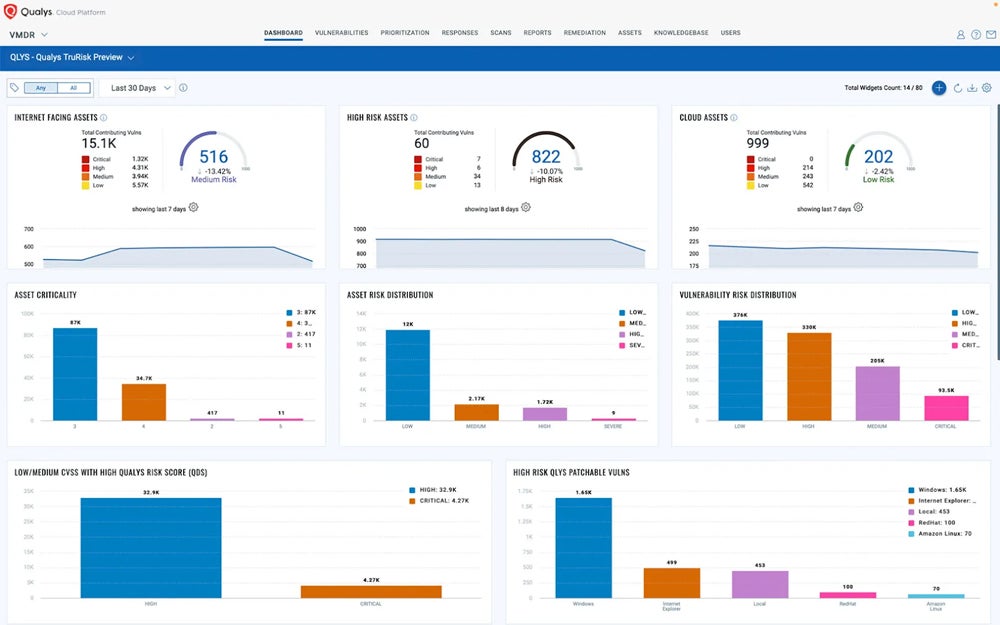
Qualys’ VMDR dashboard. Image: Qualys
Best risk and vulnerability management providers
Qualys
Qualys gives MSPs and MSSPs a security and compliance platform that’s adaptable for branding and customized reporting.
The platform has extensible APIs for easy integration with internal tools and customer portals, with its key offerings including on-demand vulnerability assessments, continuous monitoring, and threat protection services that can be easily integrated into an MSP’s existing security operations.
Rapid7 InsightVM improves MSPs’ security operations centers (SOCs) with multi-tenancy, ensuring customer data segregation while maintaining operational efficiency. MSSPs can enjoy the platform’s self-service deployment options and single-view multi-customer management.
Additionally, Rapid7’s unified platform includes detection and response (XDR/SIEM/MDR), vulnerability management, cloud security, and more.
Tenable’s cyber exposure platform offers increased automation and a user-friendly interface. It has a multi-tenant architecture for data security while enabling MSSPs to manage multiple clients effectively.
Tenable’s offerings include web application scanning as part of the Tenable One Exposure Management platform, which accurately scans for vulnerabilities in online portfolios without disrupting critical web applications.
Monitoring and threat detection tools: Best for managing complex IT environments
Monitoring, modeling, and microsegmentation software provide real-time monitoring and predictive modeling to enhance network security. This exhaustive approach to security combines traditional network security practices with additional micro-level layers.
Clients with complex, distributed IT environments, in particular, will benefit from these tools.
Key features include:
Real-time network and system monitoring
Predictive analytics and threat modeling
Microsegmentation for network isolation
Behavior analytics and anomaly detection using AI/ML
Darktrace’s main user interface. Image: Darktrace
Best monitoring and threat detection providers
Datadog
Datadog offers a scalable, full-stack monitoring platform that integrates with over 600 technologies, providing real-time visibility into IT infrastructure. This helps MSPs and MSSPs deliver monitoring services, such as real-time performance tracking, predictive modeling, and behavior analytics.
The platform enables MSSPs to provide a unified view of their clients’ entire tech stacks and to enhance their ability to manage their IT environments.
Illumio offers a solution that focuses on Zero Trust segmentation to prevent the spread of breaches across clouds, data centers, and endpoints. By incorporating Illumio into their security stack, MSSPs can offer their clients a reliable strategy to safeguard their digital infrastructures.
Illumio emphasizes microsegmentation, which allows MSSPs to create controlled, monitored, and secure segments within their clients’ networks.
Darktrace leverages AI-driven cyber defense to give MSSPs an extensive solution for real-time monitoring and behavior analytics. The platform’s ability to provide complete visibility across the digital estate, including cloud and on-premises systems, helps MSSPs detect and respond to threats swiftly.
Darktrace’s self-learning AI analyzes every device and user to enable MSSPs to identify and neutralize emerging threats before they escalate.
Bottom line: MSSP tooling is about the holistic solution, not individual tools
Choosing the right MSSP software requires a holistic approach rather than focusing solely on individual tools. Before exploring demos or free trials, MSSPs should first identify their clients’ biggest security gaps, operational needs, and long-term service goals.
From there, evaluate how well different platforms integrate with your existing tech stack, how they can support scalability, and how they can strengthen your overall security operations.
The best MSSP tools are the ones that not only address today’s threats but also evolve alongside your business and client environments.
How we evaluated the best MSSP software
To determine the best MSSP tools, we scored solutions against weighted criteria that users value. We then assigned weighted subcriteria to each criterion to score each product’s performance in each category.
The crown for our overall winner went to the software with the highest collective score.
Below is a brief summary of our criteria:
Core features (50%): We assessed each tool’s core capabilities according to the type of security problem it addressed.
Cost (20%): Our cost evaluation was based on whether the software offers free trials, transparent pricing, or flexible pricing models, and whether it comes with additional costs for certain features or capabilities.
Partner support (10%): Our assessment covered the range of support options available for the tools. We evaluated the availability and quality of live chat, phone, and email support, as well as the quality of support as rated by users on review platforms.
Ease of use (10%): We looked at how verified users rated each software’s ease of use on review platforms. This criterion assessed the overall user experience, ease of setup, and availability of resources such as knowledge bases and tutorials.
Overall user feedback (10%): We evaluated tools based on publicly available user reviews and partner feedback to determine satisfaction with the product’s holistic offering.
Frequently asked questions
MSSPs use a wide range of security tools to protect client environments, including infrastructure, network, and cloud security, IAM, vulnerability management, and monitoring and threat detection platforms. These tools help providers secure networks, endpoints, cloud workloads, data, and user access.
MSP tools are generally designed to manage and maintain IT systems, while MSSP tools focus specifically on cybersecurity functions such as threat detection, access management, compliance, and risk mitigation. MSSP platforms typically provide deeper security visibility and protection capabilities.
MSSPs typically choose tools based on their clients’ security needs, infrastructure complexity, compliance requirements, and scalability goals. Many providers also prioritize platforms with automation, centralized management, AI-driven analytics, and multi-tenant support.
MSSP tool pricing varies by vendor, deployment size, features, and the number of users or assets being protected. While many providers require custom quotes, some platforms offer free trials, free plans, or subscription-based pricing models.
This article was originally published by Collins Ayuya in April 2024 and updated by Luis Millares in May 2026.
Collins is a writer for Channel Insider with over seven years of experience in tech industry. His tech and channel articles reflect his specialties in AI, cybersecurity, cloud computing, embedded systems, and the Internet of things (IoT). Collins has a bachelor’s degree in telecommunications and IT and is currently earning his master’s in computer science. He also has a particular interest in the startup world, having worked as a head of product overseeing sales and eventually founding his own tech startup.
Channel Insider combines news and technology recommendations to keep channel partners, value-added resellers, IT solution providers, MSPs, and SaaS providers informed on the changing IT landscape. These resources provide product comparisons, in-depth analysis of vendors, and interviews with subject matter experts to provide vendors with critical information for their operations.
Advertiser Disclosure: Some of the products that appear on this site are from companies from which TechnologyAdvice receives compensation. This compensation may impact how and where products appear on this site including, for example, the order in which they appear. TechnologyAdvice does not include all companies or all types of products available in the marketplace.