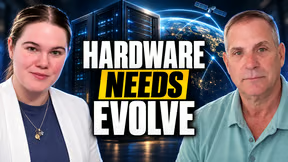
What do you think broke that generalist model? What do you think broke the break fix model? Was it the complexity of the IT, the speed of innovation, artificial intelligence? Honestly, where do you think the actual moment happened where we went, we can't just go with any any Joe MSP anymore? We need to specialize. We need to verticalize. >> Yes. >> Okay. Hey channel insiders, welcome back to channel insider partner POV. I'm your host Katie Bavoso and I'm joined today by the CFO and new CRO of Harbor IT, Hannah Paige and Michael Corkalocus.
Harbor IT, a national platform MSP, acquired New England Network Solutions, better known as Nens, in November 2025 and has been focused on integrating the two companies ever since. We dig into what made this acquisition a great fit, why focusing on hard to serve verticals differentiates Harbor IT, and why Michael says the generalist MSP model is a dying one. I'd now like to welcome my two very special guests today. We have Hannah Paige, CFO of Harbor IT.
Hannah, thank you so much for joining us. >> Thanks for having us, Katie. >> Absolutely. And joining you is Michael Corkalakis, former CEO of New England Network Solutions, better known as NENS, and brand new appointed CRO of Harbor IT. Welcome, Michael. >> Thank you for having me, Katie. >> Thank you so much for being here. Congratulations on the new title. Congratulations to both of you, actually, for everything that's been going on as we'll dig into throughout this entire interview.
I know it's been a crazy couple of months, but I'm very excited now to be on the other side of it getting to learn more. So why don't we actually start from there? Now as I mentioned there was an acquisition. So Harbor acquired Nens and now we are one big happy family in this cyber first world. I first want to get to know each company individually. That way I can kind of draw them together and explain why they work so well together. So let's start with you Hannah if you don't mind.
Harbor IT made that acquisition in November. So it's still very recent, very new. Talk to me a little bit about Harbor IT. primary mission and the customers that you serve and their verticals. Tell me a little bit about them. >> Yeah, of course. Happy to. Harbor IT was established formally in name, although prior to that in concept all the way back in 2021. The whole mission of Harbor IT was to bring a cyber first offering to the upper SMB, lower mid-market end customer.
And as our CEO Johnny likes to say, we like to do the hard stuff. Um, we go after customers that are hard to serve. We primarily focus on verticals such as private equity and rollup solutions, life sciences, oil and gas, critical infrastructure, industries where it's not easy. They have OT environments, complicated uh they're bringing different businesses together that have different infrastructure that needs to speak to each other, become aligned, and we want to be their partner in that.
We want to make the IT side of the house easy and we want to take a cyber first mindset to everything that we do. The first acquisition we made actually was on the cyber security side. A business called Quadrant Information Security that has a solution called Sean. It is a proprietary MDRXTR offering that coordinates so closely inhouse with our IT offering IT staff MSP services um that we really believe it's a wholesome solution for the upper SMB lower mid-market end customer.
We started in 2024 really making a name for ourselves in the Boston area. Our founder and CEO is actually from there. So it's it's like a full circle journey coming home. I've been lucky that I've been able to spend a lot of time in the area and we we got to meet Mike and Josh and Dan on the NEN side. Um you know it just felt really meant to be beyond the business which we'll delve into, right? Um getting to know Mike and Josh's people and the people that they've surrounded themselves with.
All I can say is I've had a lot of fun over the last year getting to know them, getting to know the business, and working with them. >> Oh, amazing. Thank you so much. And I know I I ribbed you a little bit before we came on, but of course you're rooting for the Patriots, and so is everybody else on this call, right? So, yeah, we know those Zah. >> Well, thank you so much. >> A Giants fan in room for the Patriots. It's like >> I hope Johnny's listening.
I hope Johnny's listening. Michael, let's move on to you after we got to know Harbor IT a little bit. Tell me about Nens and the core mission that you had there, your types of customers because there is a lot of blending that I saw between the verticals the two serve. So, first of all, tell me about Nens just in general and why was Harbor the right place for you to land. >> Sure. So, Nens was founded in 1993 by Dan Adams. He was a uh Berkeley grad, musical savant, and uh decided that making money in computers was easier than making money in in music.
I joined in uh mid 2011. Um uh Dan and I headed off right away. I mean, he's a brilliant guy, visionary, you know, we had we had a lot in common of just like how we looked at the business and things we wanted to accomplish. And then Josh joined a year later who uh I've had the pleasure of working with since 2001, right? So, it's been a long long long business relationship between Josh and I. It's been it's been great. super super uh successful where there's a ton of synergy.
You know, Hannah is like, "Oh, you know, uh Harbor's a cyber security focused first firm." Well, we have been since like 2013, right? So, we took it really seriously back then and we've really leaned into it. Um you know, we've been doing like MFA and SSO and AI and machine learning EDR way back before you know, you know, I would say 90 plus% of the MSPs even maybe knew what it knew what it was. And that was also partially driven by the uh the types of organizations that we served.
So we serve financial services uh life sciences predominantly. So when you work with organizations that are uh you know regulated they have a high bar for what security is supposed to be. So you know when we started talking about like how we approach it and how they approach it there was just a ton of syn there's a ton of synergy there. And uh as far as you know other things that that made that made a ton of sense is actually really quick funny story.
So when I first started out as a system administrator in 1999 I hired a company called Harbor. I'm sorry. It was Boston Wireless to uh manage my Nortell meridian PBX system which today is Harbor. So it's the same organization. So talking about coming back full circle uh you know the uh I knew the family that started uh Boston Wireless which the Birchman's and uh we did a ton of business together over the years and then when uh you know they became part of you know the harbor mission and they had reached out to us over course of a couple years of trying to get us to come over and combine you know our superpowers right the 1 plus 1 equals 4.
Uh, you know, it just really made a lot of sense after having that history with them as well. >> Oh, I love that. And I should stress that you you mentioned talking about Nens and talking about way back in the 1900s, uh, how that company was started and how you when you came in, but you you were employee number eight, I believe, at Nens. Is that correct? So this this is a company that means a lot to you and knowing that it it wraps under another company now.
I'm sure there had to be a lot going through your mind about what criteria that the culture needed to meet, the people needed to meet. Tell me a little bit about what it's like now working with Hannah and the team over at Harbor IT every day. >> I've been through a couple different companies. I've had the uh pleasure of seeing companies do it right and I've also also seen companies do it not well. Right. uh with all the companies as an engineer. I should have mentioned you know growing up as an engineer uh and and and uh serving a ton of clients.
Um having a true like vision and mission uh having a strong culture uh that helped back that you know was crit critical to our success like surrounding ourselves with really great people that had the work hard play hard mentality. Um so yeah so when I when I joined in 2011 we were you know we were eight people you know we reached out to all of our friends that were like-minded that were in the industry and had them come join us. you know, some of them took huge leaps of faith, left, you know, very, you know, nice, maybe even slightly cushy positions in areas that they were in to come to come help us build what we were building.
And then by the time we transacted, we were just shy of 60 people. Um, you know, 14x increase in and revenue at at at NZ from the time that we had joined in 2011. So, it was an awesome ride, great great great story and surrounded by great people. Um, and to answer the other question, uh, that was critical for us is trying to find the right partner because our success was, you know, not because I was there or Josh was there or Dan was there is because of all the people that worked there.
So, um, I never wanted to get into a partnership with an organization where they wouldn't be rewarded, right? They wouldn't have additional opportunities as they looked forward. Uh, that we weren't able to carry on our traditions of having a ton of fun. As Hannah said, she's had a lot of fun getting to know us in the last year. Uh we can get into some of those stories in a little bit, but uh that was super important for for Josh, Dan, and I, right, is to make sure that uh we were with an organization that shared the same values, like to have some fun, but really wanted to succeed as well, right?
I mean, put all those things together. Uh and it's hard to not have a good time while you work. >> I love the way you put that. Hard to not have a good time while you work. Well, Hannah, to bring you back into the conversation, I I'd also like to really talk about the customers and what now each customer set from both companies are going to get. Obviously as Michael was explaining life sciences and and that category some of the more regulated hard to serve as you call them industries and verticals are a specialty of nens they also are bringing in their own sock as well.
So what are your customers now going to get that perhaps they didn't have before or what are they going to get that's now even even better than what they had before? Tell me a little bit about the customer benefit. >> 100%. Um, Mike, you have full reign to cut me off as I go into a pod deep dive. And Katie, you'll you also have free reign to cut me off. I think one of the really interesting ways Harbor approaches M&A acquisitions is we're really not trying to buy the same company 17 times.
We're trying to find buy companies and bring them under the Harbor IT umbrella that really have a unique specialization. And the reason why is we've really built this concept of practices which is implemented via pod model to service our customers. and what we believe creates the most intimacy at scale at our size. What does that really mean? At the end of the day, we're really building the business around practices. So, if we use life sciences for example, kind of the nens specialty, we'll build an entire practice within the business largely made up of uh formerly NEN's employees, now Harbor IT employees to go to market, service that customer to the best of our ability.
So that really means it starts all the way from sales having a concept of a practice lead that knows the life sciences space comes from the life sciences space speaks the same language bringing them into the fold onboarding them onto the harbor IT systems and then having a pod model of dedicated technicians that really only focus on the life sciences space knows the specific technology that that customer needs knows the specific tickets that typically tend to come up and that can really handle a lot within that pod outside of the pod there's obviously escalation points s and shared services that come into the fold and then an entire professional services organization that can offer things like HIPPA compliance, CMC compliance, etc., etc., depending on the industry that all center around this practice and this organization of people within the larger organization that really know that end vertical.
The benefit that Harbor IT customers get is now we really have the resources to build out a life sciences practice. you know, we had life sciences customers of our own that will benefit from the NEN staff and expertise coming into the fold. And I think vice versa, right, Mike mentioned they have a lot of financial services customers as well. We already have um a financial services pod that's built out and pretty well established. So, they'll benefit from all the investment we've already made on that side of the front.
Really trying to bring together a full solution across cyber, IT, cloud, voice, network. I mean, the list goes on and on. >> So, Michael, same question for you. So, I'd love to know that now that you've been brought into the Harbor IT fold, what your customers are going to get as a Harbor IT customer because I should also mention this is Hannah and Harbor's eighth acquisition, their largest one yet with NENS. So, I imagine that there is a much broader uh spectrum of solutions and people to help because you've been now become part of a platform MSP.
So, what do your customers in the New England area now get because they're Harbor IT customers? Now, >> one of the things that really stuck out right away is, you know, we have some really brilliant people on staff, right? Super high level engineers in specific categories, you know, from Cisco to Palo Alto, of course, Microsoft and so forth. And, you know, there's just, like I said, roughly just uh shy of 60 people in the organization. We serve over 150 clients.
And although we believe that we had enough capacity to be able to handle tough things when they came up, you know, we just went from being a group of just shy of 60 to just shy of 400, right? With now h instead of having, you know, three or four palo experts, having 8 to 10 palo experts and then on the Cisco side, right, having CCIEs and just the the capabilities that we now have at our fingertips, um, you know, will of course help our clients. You know, one of the things I'd mentioned to our staff is after having an opportunity to meet some of the people at Harbor, you know, I said to my to myself and to the staff, I'm like, there's no way we could have hired some of these people.
Like, I don't even know where to find them, right? So, now we have now that's what I said earlier, like the 1 plus 1 equals four, right? It's like how do you get these like really awesome, brilliant people, very like-minded, uh, to come in to affect change across the whole organization. So now customers have you know have that uh and then as well as as Hannah mentioned you know they have a whole advisory practice um they have certified auditors they have CI additional CISSPs to stack on top of the ones that we have you know oftent times and one of the things like for us as character is huge for our part we had no problem going to a client saying you don't want to hire us to do that right it's just not it's not something you want us to do right uh and uh I don't have to say that as much anymore hopefully if not at all right I can just be like oh yeah we can now cover that.
I have this whole other team here that can that can help. >> Amazing. I love the expansion of services that you talk about. The fact that I I don't think you were saying too often before that we wouldn't be the right fit for you, but it's good to know that you were that transparent with your customers and now you could say this is how I know we're great for you because we do have the ability. Um, I think both of your answers dot really nicely into the next question I have, which is Michael, you and I previously spoke on on a prep call before we got on today talking about the MSP model in general.
And you actually called the MSP generalist model a losing recipe. First of all, I'd love to have you kind of define what you mean by that in your opinion and what is the definition of a successful modern MSP now in 2026. >> All right, so here's the first question. The MSP generalist is uh hire a bunch of, you know, really good engineers and technicians that can solve technical problems and they go after anybody that's looking for help in technology.
That's a generalist, right? It doesn't matter what business they're in or how much money they want to spend with them or how operationally mature the organization is that they're that they're serving. Um that's the generalist part and I think it's a it's a losing recipe for we don't have enough time to go through all of it but you know a couple a couple of key points is that so uh think of it like this so when we engage with the customer and like hey help me understand where you are in your journey as an organization right what is your budget this year you know what are the goals for the next 3 to 5 years how is the leadership team look at the look at the organization is everybody aligned um and if they can't answer what I consider somewhat just Those are very very basic questions.
Then we call them, you know, that they have a low operational maturity level, right? Because there is no budget. It's just kind of day-to-day, you know, fires putting out. There's no real strategic vision or mission as to how they're how they're going to accomplish things. The way that we approach it, which is very methodical, right? And coming up with plans and trying to our goal at the end of the day is to accelerate the business, right? But if you don't know where you're going, then it's impossible for us to help you do that, right?
So, so the IT generalists, they'll just support anybody that has a has a problem, right? And just trying to try to help them out. What I think the winning recipe is is today is I call it going up the value chain, right? So, is is how do we really affect change in a business as an organization, right? As an IT partner. Um, as I mentioned before, our job is to accelerate the organization, not slow it down. You know, quick quick, you know, madeup story. uh you know we walk into a prospect meeting we're talking to them you know they have high operational maturity level the other organization that's in the mix with us same engineers same certifications the difference is that I'm finishing that organization sentences for them oh you're at this stage today you need to get to this stage then you're going to need a b and c correct and they're like oh my god yes right so they don't have to slow down to tell us what the business needs and in fact we can leverage our experience over many many years and working across hundreds of clients to help to share best practices with them that maybe they weren't aware of, right?
And help them improve their business in a way that they didn't know that that they could before. So, I think that's going to be the real special sauce back to what Hannah had mentioned before, right? Having these practice areas being, you know, being aligned and for us to have that level of knowledge and experience where, you know, we're in lock step with that with that client and we're just again, they don't have to teach us the business. We're presenting things in the way that makes sense to them.
We know exactly what they're trying to accomplish. We know how to help them accomplish it. We can serve up different options for them. It's just a very very different relationship, right? It's a real trusted partner as opposed to somebody that just fixes your computer. >> What do you think broke that generalist model? What do you think broke the break fix model? Was it the complexity of the IT, the speed of innovation, artificial intelligence? Honestly, where do you think the actual moment happened where we went, we can't just go with any any Joe MSP anymore?
We need to specialize. We need to verticalize. Yes. >> Okay. >> Uh, you know, of course, of course, it's not one thing, right? It's a definitely a combination of things. Uh, you know, when you think about how it has transformed over the last, you know, we'll say 15 years, right? You know, the the move from onrem to cloud to SASbased applications, you know, it's definitely definitely changed. There's also, you know, when I originally started uh in this business in in 2000, there weren't a lot of MSPs, and I think we talked about this before, Katie, right?
You know, when did MSP actually become a thing? Like when was that the acronym that that came out with, right? So, you know, before there was uh you know, there weren't a lot of us out there. So, then there's a flood of market. One of my favorite books is called the E-Myth uh revisited and it says a lot of organizations are built from engineers having an entrepreneurial seizure, right? So it's just a bunch of engineers out there just like pretending to run a business and you know the trunk slammers and going out there and doing that.
So you know in those early days you know there are a lot of people that didn't understand technology. Um and now what's also has changed is just looking at the generations of people that have come up right like technology is just like yeah it's just something I touch every day where before they needed a lot more help. So where they need the help now just like I said goes up the value chain. And so I think that's been a a big shift. AI has been a big shift.
Cyber security's been been a big shift. So unless you are specialized in a particular area, um, you know, I just don't think the same value is there for customers just to hire somebody that can fix a computer, do a Google search, an AI search to try to fix a computer if they really wanted to do it on their own, but to have a real partner by their side to help show that to make sure that they're making the right decisions, you know, that's that that's the thing that's the most important, I think, today.
What do you think is the risk of somebody who doesn't verticalize and specialize? Because as we've spoken about so many times during this interview between the three of us, obviously those hard to serve businesses, those very regulated businesses where there could be a lot of changes, a lot of geopolitical impact even, those are where you focus and where you're staying. You're not just taking on anything just because there's money in it, which you know, people do that.
So, what do you think the risk is for an MSP who doesn't verticalize, who doesn't focus in on a niche or at least a specific section of industry? >> I think they have a hard time growing. They'll have a hard time staying alive, right? You know, if you know, if you're not growing, you're dying, right? As the old adage says. So, I think that's probably the biggest the biggest risk. Are there enough, you know, startup lower OML companies out there so that they can survive?
There's probably something out there for for everybody, right? Um, but I think that's the biggest risk is it's just like there's a ceiling, right? You're not going to be able to grow the business that that much. And you know who you attract as prospective clients and who you get to keep by client retention. I'll tell you one of the things that we often hear when we take over a customer. I think I've just outgrown them. That's I hear that all the time when we take over a new customer, right?
And what that means is that the client is maturing, but the MSP that's supporting them is not maturing at the same rate as they are. Um, so I again that's the that's how I see the biggest risk. >> That's a great breakup line in general for a lot of ways. Uh, when you think about it, so we can all use that whether it be with our hairdresser, our partner. So I think I've just outgrown you. >> Well, Hannah, let me bring you back in. So with Michael's answers in mind for that, how are it and nens and I should refer to you just now as Harbor together, uh, staying competitive in today's market?
And of course, how will this combination of the two organizations continue that momentum through 2026 and beyond? >> Yeah, I think it really comes full circle and touches on everything we spoke about, Katie, right? I think it's really positioning ourselves, but also actually being a partner for the customers we serve. You know, we have uh strategic business reviews every quarter. We have created this practice model where we actually know the industry and we can speak to it and we've hired people and have the best and the brightest on our team across the board and we have people that can speak the same language as the customer.
They they want to call us. They want to be on the phone with us. We are adding value for them and I think that's how you stay relevant in this industry. I think, you know, as uh Michael spoke about uh I think for the general MSP, there are customers out there for you, but I think a lot of them are more price sensitive and it's a little bit of a race to the bottom. And I think if you actually are a strategic partner to your customer and you're adding real insightful uh guidance and vision for how the business is going to grow next quarter, next year, next five years, there's value in that.
Uh even me, like I I come from the uh financial services world. Um, I think about how many times I wanted to take my computer and throw it out the window. Um, and I think about like if I had an MSP and a partner for the companies I was working for, like how much value that would have provided me back then >> because then you wouldn't have to spend that time focused on how do I fix this IT problem and focus on your job. So, I agree. >> Yeah, >> I think we all can feel that way sometimes with wanting to chuck the computer for those reasons. continuing that down that path.
Uh Hannah, what does it take to integrate two companies like this as quickly as you have or is that process still ongoing? What does that look like? >> The process is still ongoing. Um it's a process. Uh I would say we have a playbook. Um Alex Vanlet, who runs our integration team, is a brilliant genius and thinks of everything that people like Mike and I don't always think of. To me, the number one thing when it comes to integration is people. Um, and at the end of the day, an MSP is a is a people business and people are complicated and you want to provide them clarity and transparency and give them as much information you can while you're still getting to know each other, right?
You're to some degree you're married, but you're also still dating, right? Like I had the pleasure of meeting Mike and Josh and Dan and a few other folks throughout, you know, the the process, but until the deal closes, you know, there's 60 other people on their team that are bright and and a key part of the story that I had never met. So the I think the first stage is really like taking the time to get to know each other. Um dating a little bit if you will.
Um but then from there right it's a it's a process. Um there are systems that have to be merged over. The connectwise instances have to be combined. There's a lot of planning that goes into it. We create a SWAT team. You know we kind of have our internal integration team and key stakeholders for each department. And then the folks at Nens have kind of established their own SWAT team that mimics a similar structure. and we slowly work through it. You know, we have a plan, we have the tools, we know what needs to be uh brought over and it's done in a way that I believe is incredibly thoughtful, all kind of culminating and what we call role mapping here at Harbor IT and doing our very best to ensure that everyone on the NEN side has a role within Harbor IT that they're happy with.
And I think that comes full circle to kind of how I started speaking about Harbor IT and that we're really trying to buy companies that each bring their own specialization so that every single person has a role here. Our our angle is not cost cutting. Our angle is how can we bring in different unique specializations to really grow the business across the board. >> It's funny that you talk about dating and marriage and compare that to the combining.
Uh but truly it works because Michael, you actually use a term that you've used it with me. I've seen you talk about it with other publications. Intimacy at scale. It is something that you talk about where it's not just making the customers essentially feel like they're just being passed back and forth. You want them to feel like they can still get to you, Michael, still talk to you and your team directly. Um, without putting words in your mouth like I'm doing, would you mind defining intimacy at scale for me?
And just talk to me about what that's going to look like now that NES is harbor. >> You know, Hannah was talking about the pod model. uh you know as we talked about there was a lot of synergies as to how we looked at the business as we were scaling our business you know that was the ultimate plan you know we do our three to five year behags and planning and we build org charts and structures and so we had this whole pod model already like ready to go and that intimacy at scale is when a customer calls in they really don't want to call into this nameless faceless organization right they want to be able to be on a firstname basis with the people that they talk to have familiarity with them so by creating a pod structure with 8 to 10 people, you know, it's totally manageable.
When the customer calls in, they're calling into that practice that they're that they're that they're tied to. So, you know, for focus on life sciences. So, whoever they talk to has a life science technology background. It's the same people that they call into. And what we found over time even in our organization is that sometimes they're willing to wait for a particular person. It's like, hey, you know, they're tied up. I have somebody that can help you, you know, in 15 minutes or they can call you back in 2 hours.
And sometimes clients just choose for the 2-hour call back because they're like, I just really enjoy working with that particular particular engineer. So that's the intimacy at scale is just making sure that they still feel that they're they have the the love from a smaller team. They have that firstname basis type type relationship that the engineers have familiarity with them and what's important to them and how the systems operate to get to aer quicker resolution.
And that's that's the whole uh you know thought behind it. You know what I found incredibly, you know, helpful, insightful, not that surprising is when I first talked to Johnny, um, and we were talking about the pod structure. You know, he had done a tremendous amount of research as to how other MSPs had scale, very large ones, um, and there were a couple that made that same mistake of like, you know, hey, we're going to shift all of this to a really lowcost call center that is going to take the tickets.
And they saw a tremendous amount of client attrition because clients are like, this isn't what I want. like, you know, you know, I call in, I'm not getting the results I want. I have to wait. They don't know who I am. It just doesn't it doesn't feel right, right? And and that's all you have to do, right? Like we're humans, right? if it just doesn't feel right to you anymore, like you're you're thinking about moving on and trying to do something different.
Even if they do have a pretty good, you know, model and they have some really smart people, if they that first touch or the touches that happen most of the time don't feel right, you're going to probably get a frustrated end user base and then they're going to be looking elsewhere for for IT partner. >> Hannah, I want to talk about artificial intelligence because we can't have a podcast without bringing it up at least like six times. So uh I I know obviously by this point that hybrid AT is very focused on cyber security and compliance especially considering the industries and verticals that you serve.
So how has AI impacted your customer cyber security and how have your offerings and services had to change to stay ahead of bad actors and uh maybe even bad decisions happening within those customer workplaces? Oh, Katie, I feel like you were at our executive offsite last week and you just knew exactly what the right question was to ask. Um, no, it's such a good question. Um, I think we spent a lot of time talking about AI across the board. We we did just leave our executive offsite last week with a brand new AI strategy and tools we're going to roll out and each of us kind of taking ownership within our own departments to define exactly what that strategy is for a department.
When I think about our customers and how they're experiencing AI, I look at it two ways, right? Like what is the risk to them and how can our cyber offerings and compliance offerings become stronger as a result of that? We spend a lot of time with our squadron cyber security solution kind of tuning alerts, tuning the way that the system flows to make sure we're accounting for kind of this uptick in AI based fishing and uh email uh security, etc., etc., etc.
And then I think about is like how can we create an offering for our customers so they actually can utilize AI to their benefit. And I think um I won't speak too much. Mike has kind of been tasked with this uh this project over the course of the year of of really how can we deliver an AI solution to our customers so they can take advantage of everything that um you know is out there these days. >> Michael, are you able to talk about that a little bit?
What is that what does that solution look like? >> I I can I can touch upon a little bit but I'm not giving up all the trade secrets. uh at an early like simple uh level um customers that are in the Office 365 and like they're totally consumed as office consuming Office 365 ecosystem. Microsoft Copilot is super powerful tool right because it looks across your everything that you have in SharePoint and in one drive and of course in in Office 365 again across the whole the whole ecosystem.
So it's also run by the latest engine of of OpenAI chat GPT which is currently 5.2. So there's really no difference in going to chat GPT in a sense, right? And trying to like do work there. But the thing is like chatgbt by itself isn't aware of everything that you have and all of the knowledge that you have inside the organization. So so if you're again in that Microsoft ecosystem, you have the power of chat GBT, but also the knowledge of everything that's going on within within your your email and your calendar and your contacts and your interactions, SOPs and process documents.
I can go on and on and on and on. So, so you have all of that power and like okay, so to get access to information to make make use of that information. Uh, what we're doing with customers is uh is helping them realize that uh the first step in this is doing what we call a co-pilot readiness assessment. Unfortunately, not every Microsoft 365 tenant is created equal because depending on who set it up, uh, it could vary greatly. And um and what I mean by that is if you didn't pay attention to permissioning and structure and governance within your 365, people can get access to you know salary information, healthcare information, right?
So if you haven't done a really good job there of making sure that you know that you know now you have this super powerful tool that can find anything you want like faster than you could have ever on your own, you know, like how do you make sure that there's governance around that particular thing? We always start there of just, you know, enlightening the client of like, hey, you know, now that we're on board, let me show you what this looks like, you know, and some people were absolutely horrified by the fact that like if people actually went to go find this information, like what they had access to because it wasn't gated or governed properly.
So, we start there first. Um, and then after that, you know, we will dig in. Uh, Hannah had mentioned our advisory practice of, of course, we understand the business because, you know, they're within a particular practice. So we talked to them about how do we automate specific things that are specific to their business, right? How can we improve workflows? Um so for us again back to the acceleration of the business like how do we get them to get more done with us?
Um so that's like the very early like dipping the toe in offering that we're that we like to you know talk talk about with our uh with our with our AI AI offering. If you're not in the Microsoft ecosystem then there's of course other things that we could you know we can look at. you know if you're in Google of course there's Gemini right you know kind of similar model in that in that sense if you built your own thing like say with box.com and slack and all this other stuff well you know now we have to take a look and figure out what is the right solution for you right uh you know where are there strong APIs you know but still you get to govern your own data uh and then there's uh also use cases for everybody knows the term LLM like large language model but there's also uh small language models as well so models that are built for a very specific task uh within an organization and that's all that language model is built to do.
Uh so if there are customers that are um concerned about going to one of these platforms um and even though they sign up for a corporate account which says their data is going to be guarded and protected if they just still don't feel good about it you know then we could create a private cloud upload one of these small language models for a very specific task for that for that organization and then they can you know run their own their own AI if you will as it pertains to you know what their what their special sauce is as a business.
So, you know, there's a couple more things that that we've that we've chatted about. Uh, but, you know, those are a couple things that are just fresh off the docket. >> Knowing that you just had this conversation as a company, I'm curious to know from both of you, is there anything that you absolutely would not allow AI to integrate with, to be launched in as either a tool uh for a certain business unit or even for a full vertical? Is there is there any line that you draw in the sand to say this is absolutely not where we're going to cross where when it comes to artificial intelligence?
Um, Michael, we just ended with you. I'd love for you to start that off. >> Yeah. So the the first thing is just educating people on what are the different tools are out there and then what happens with the data if somebody was to upload the data, right? So there was an instance a couple of years ago where somebody at Samsung, you know, uploaded a bunch of source code into the open AI and it was like oh my god, like we can't get that back. Like that data is now in there forever.
So uh so things that are the absolute like no nos is uh as we sit down with them and ask the client hey you know uh do you want us just to shut down you know these particular websites from inside your organization like we can shut it down we can lock it down to the laptop so that they you know can't accidentally you know upload stuff into into this particular you know AI you know name it right I'm not trying to pick on any on any particular one so that's the first thing that we would do is just work with the client just to be like hey you know you know it our it is our recommendation that we do lock it down until you have a policy um around how it's supposed to be governed.
Um, and that way, you know, again, you just can't have that accidental of like, uh, you know, I was just talking to a customer the other day and we had this exact discussion because, uh, they have, you know, they get certain pricing from their vendors and there's people doing analysis and and spreadsheets and and they were talking about uploading that into one of the, you know, AI. Uh, and I was like, "Well, you realize that once that goes up there, somebody can now go search for your customer list and the pricing that you give them and what you buy for, right?" And he and the guy was just like, "Oh my god, we have to shut that down immediately." So, that's the first step that we would go, you know, that's an absolute no no, right?
Like, we just have to figure out how to just make sure that none of you the uh IP trade secrets or, you know, you know, uh, protected information get out of the organization because they're going to be liable for it, right? even if it is a silly mistake, they just they'll still be liable. >> Really good points there. Hannah, I'm curious to hear your opinion on where you draw the line in the sand on AI because considering considering the financial aspects that you handle, I can only imagine what they are.
But for you, where where is your no line as I can kind of use a phrase that Michael was saying? >> Yeah. No, it's it's I agree with everything Michael said and it it matters internally too, right? It's making sure everyone's trained on what does this actually mean by using this tool or putting this data there? Like what are we actually doing? Have we lost it completely? Is it just out there for everyone or have we done it in a secure way? So I spent a lot of time with my team talking about that, educating them on AI before we roll out any vendor that claims to be using AI even though half of them really aren't.
You know, we do a deep dive to understand, you know, exactly what the offering is. Like for me personally uh our ERP of choice is Netswuite. So I like to kind of stay within ecosystems rather than start bringing in a bunch of new stuff. Uh try and use what we have first. Um I also oversee our HR team today. So that almost gives me more heartburn than the client side depending on the day. Yeah, I think as long as uh the people internally and on our teams in addition to our clients are are trained and understand the implications of what they're uploading and what they're using and where the data is going, there's a chance that there's no no line, so to speak, as long as you're really smart about it. >> So no no actions within that use.
So it's not necessarily about not using it, it's about knowing not what to dump into it. >> Exactly. Exactly. It's all about training. Yeah, one one other thing I failed to mention earlier, right, is that I think that people really should should think about is every tool is trying to develop its own AI portion within the tool itself. And uh it is imperative that you do a long form like due diligence questionnaire, right? Uh and and talk to the vendor about where is this data going?
You know, are you are you SOCK 2 type2 compliant? you know, just understanding what types of controls that they have in place and and if you're not comfortable with what they're doing, you know, is there an option to turn it off or is it just inherently always on uh so it's uh that's a really critical point is just looking across your entire technology and tool stack and figure out you know I just mentioned Microsoft only earlier but like looking across all of it like Adobe as an example right you know they have an AI component right you know making sure you understand exactly how that functions in the organization where that data goes so again another critical piece that I think people should be aware Hannah, for other organizations that are looking to become a part of a larger MSP, perhaps becoming a part of a platform, is the door still open at Harbor IT to take on those acquisitions?
And how should that process get started if you have a business, an MSP business that's listening and is interested in talking to you about it? >> Almost definitely 100% the door is still open. Um, the easiest way is I'm going to give you all my email right here, right now. hannah.page@harborit.com. shoot me a note. But if you go to our website, worklandpartners.com, there's a way to submit a form. You can message me on LinkedIn. Really, any any way you try and get into contact with me, I promise I will find a way to receive that message.
I think our our M&A approach is kind of twofold. I look at it in two different dimensions. The first is um we really do listen to our customers, right? If they say they want an offering, they want a solution that we don't provide today or they're in a geographic location where we don't have boots on the ground, like we hear that and we'll look for acquisitions or businesses to acquire in those regions with those specializations to really be that one-stop shop for the end customer and give them everything they need from an IT and cyber security perspective.
I would say on the other side, right, there are certain regions and certain businesses that do focus on hard to service regulated and verticals that have culture and people that really meld with what we're doing here today. So, we both look opportunistically and you know, we're listening to what our customers are telling us that they need. But really anywhere in the in the continental US uh the the door is open and um at the end of the day like to me any conversation I can have with a business owner in this space is is something that uh I learn a lot from and and hopefully they learn a lot from as well. >> If we go down memory lane.
So the the first time I was contacted by by Workland was by Hannah in 2021. I actually went back to go like find it. She said, "Hey, I'd love to talk." And I was coming back from skiing and I was like, "Well, I have a 2-hour car ride." So, you know, I'm happy to just throw you throw you on the speaker phone. So, you know, we chatted for like over an hour about just, you know, how they were thinking about the space. Hannah asked a lot of, you know, really great insightful questions.
We had a great conversation around um the MSP space. And actually, I remember the question I asked her. I was like, do you know what you're asking for? Like, you know, be careful what you wish for. Like the MSP space, it's a hard game, right? So, like, are you ready for this? Right? It's not it's, you know, it's not for the weary. Uh, but it was a really great conversation. So, you know, we transacted in 2025. So, it was, you know, four years later after the original conversation that we had.
So, what I will tell people as well is, you know, is, you know, if I go back to the married and dating thing, right? Um, Katie, you asked me a question about, you know, you know, making that decision. It's one of the most difficult decisions, you know, we've ever had to make as a as a group, you know, Josh, Dan, and I. But being able to have a relationship, you know, with Hannah, with Johnny, you know, over the years, having great conversations, uh, getting a chance to meet some of the people that became part of the organization, how thoughtful they are about building it, you know, it's very different than, uh, some of the processes that people go through, which is, you know, they hire a banker, they do speed dating, and then they have to pick really fast to who they want to marry, right?
It's a it's a it's a very different kind of transaction. Um so I would just say if you know if our experience um you know can help anybody it's uh you know we took a lot of time over many years before before we made a decision as to who we wanted to partner with. Um and uh I would just uh say that anybody that's looking to do it I would caution them to do something similar right just really take the time build a list of things that are critically important to them. um you know and I'm sure anybody that's looking to do this is going to have a process by which they go through, right?
But just making sure that they have non-negotiables that are talked about really early on and how they think about their business and making sure there's true alignment. You know, there is such thing as a messy marriage, right? So, you got to be really careful before you get into it. But, uh I just really appreciated like the the years of interaction and the thoughtful conversation we had along the way before we uh we made the decision. >> I love that you had that conversation on the way back from skiing.
I don't know if we call it operay ski or opay acquisition at that point. >> Well, folks, I know we're coming to the end here of our time together. So, I'd love to have the opportunity to learn for myself and for our audience where we can find out more. So, if we want to learn more about Harbor IT, learn more about the the melding of the two companies right now as we go forward, where can we go to explore more and potentially even sign up to start becoming a customer?
So for if you want to become a a client, you know, come to hoverit.com, you know, do a form fill. We'll be back in touch with you in very short order. Uh we have a lot of people waiting waiting by the phone, as they say, uh to be able to get back to the a prospective client. We continually do a lot of press releases for just uh making updates as to where we are in our in our journey in the integration process, what other acquisitions are being made.
We keep our LinkedIn um pretty active of where we are, what events we're at, where we're sponsoring, reposting things. So, if you're ever wondering where in the world is Michael Corgalis, just check our LinkedIn. And I'll actually give you the last word here. For those listening who are going, hm, maybe this is something I need. How would you just say this is the right place to be as a home? If you're if you're a customer business looking for an MSP that's going to be there for them, why should they consider Harbor It? >> Yeah.
Um, it's actually one of our core values and it I think it reigns true throughout the entire organization and everything we do. We really care. Uh, every employee from our CEO to our help desk one cares deeply about the customer, about the employee, about their experience, about each other internally and what we're doing. They care to learn more. They're curious. And I think like at the end of the day, if I were to be choosing an MSP for my business, like all I would really want to know is that they care and that they want my business to be just as successful as theirs, which is without a doubt 100% confidently can I can say is true here.
Um, we will if we don't know the answer, as Mike said, we will tell you, but we will also try and bring a team of experts across the board to ensure that we can't solve it for you. and every single person throughout the organization will be doing 100% of what they're able to do to support you and your business needs. >> Hannah, Michael, thank you both so much. Congratulations on all the success of the acquisition and good luck at uh in the future with all of these these now much bigger company retreats and company meetings that you'll be having. >> Thanks so much, Katie.
Appreciate you having us. >> Thank you, Katie. >> Thanks so much to Hannah and Michael for joining me today. And thank you for watching or listening. You can check out every episode of Channel Insider Partner POV on channelinsider.com or watch us on YouTube at youtube.com/ channelinssider_news and trends. You can also listen to us as a podcast wherever you get your podcast from. Don't forget to like, subscribe, and follow wherever possible so you never miss an episode.
You can come connect with us on LinkedIn and x channels or with me Katie Bavoso. Once again, I'm your host, Katie Bavoso, and I'll see you next time.
This transcript was generated automatically from the
video's captions and may contain errors.