












Remote desktop software enables businesses and IT professionals to access and manage computers and devices from remote locations, ensuring seamless operations from anywhere.
The most effective solutions offer features like unattended access, secure file transfer, multi-monitor support, cross-platform compatibility, and real-time collaboration.
To help you find the best fit, we’ve compared the leading options on the market today.
- Top remote desktop software at a glance
- TeamViewer: Best overall
- RealVNC Connect: Best for a mix of cost efficiency and customizability
- RemotePC: Best for user support options
- Zoho Assist: Best for Zoho ecosystem integration
- Splashtop: Best for cross-platform compatibility
- ConnectWise ScreenConnect: Best for advanced session control options
- Key features of remote desktop software
- Bottom Line: Choosing the best remote desktop software
- How I evaluated the best remote desktop software
- Frequently asked questions (FAQs)
Top remote desktop software at a glance
For a quick look at some of the top capabilities to expect in the best remote desktop software, here’s a table comparing the top six solutions, with features and starting prices.
| File transfer compatibility | Multi-monitor support | Unattended access | Session usage recording | Starting price (annually) | |
| TeamViewer | Yes | Yes | Yes | Yes | $24.90 per user month |
| RealVNC Connect | Yes | Yes | Yes | Limited | $8.25 per month |
| RemotePC | Yes | Yes | Yes | Yes | $2.95 per month, for 1 user, for 1 computer |
| Zoho Assist | Yes | Limited | Yes | Yes | $10 per month per technician |
| Splashtop | Yes | Yes | Yes | Yes | $6 per user, per month |
| ConnectWise ScreenConnect | Limited | Yes | Yes | Yes | $30 per month, billed annually |

TeamViewer: Best overall
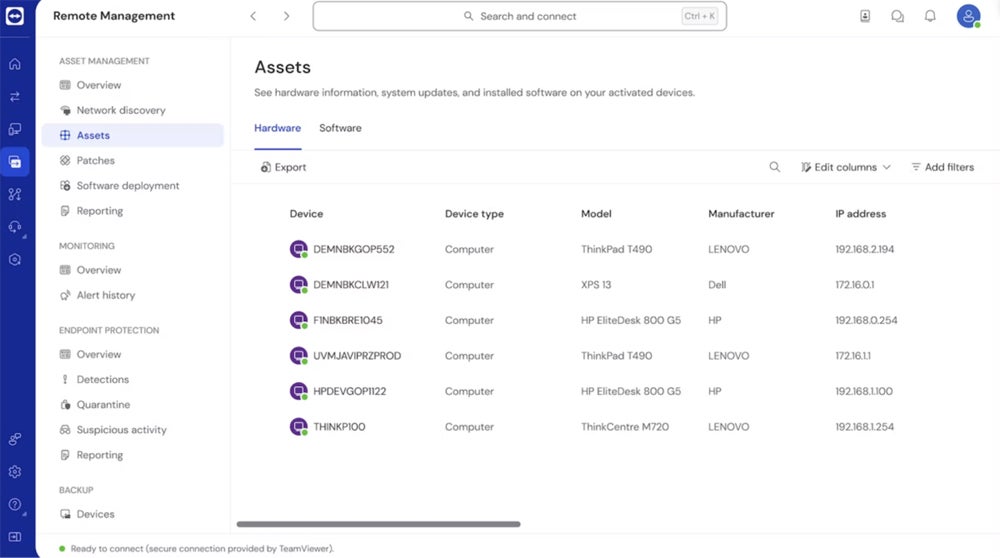
TeamViewer is our top pick for remote desktop software due to its extensive features and robust security. These features include file transfer, multi-monitor support, remote sound, proxy support, and wake-on-LAN, among many others.
It also offers secure remote access with advanced encryption, two-factor authentication, and granular access management to safeguard user data. TeamViewer also has a user-friendly interface, making it easy to use for new users.
While TeamViewer’s core features offer quantity and quality, it might be overkill for users seeking cost-effective solutions. I found RemotePC to be a viable alternative, especially for those looking for reliable remote access at a lower cost as it offers better value for money for small to medium-sized businesses without the higher cost of TeamViewer.
TeamViewer key features
- Remote multi-device control: Quickly fix your users’ issues by remotely controlling a computer, tablet, or smartphone.
- Secure unattended access: Allow approved users to securely access unattended devices without needing approval.
- Cross-platform access: Provide access to other devices via PC, mobile, or tablet for seamless connectivity.
- iOS and iPad OS screen sharing: Mirror iPhone and iPad screens to a remote device to enhance your remote support.
TeamViewer pricing
- Remote Access: $24.90 per user month; up to 3 unattended devices.
- Business plan: $50.90 per month; up to 200 unattended devices.
- Premium plan: $120.90 for 300 unattended devices.
- Corporate plan: $245.90 for 500 unattended devices.
- Enterprise plan: Contact for quote.
TeamViewer pros and cons
| Pros | Cons |
|---|---|
| Advanced security features | Higher cost for commercial use |
| User-friendly interface | Performance issues on low bandwidth |
| Extensive remote access features | Limited free version |

RealVNC Connect: Best for a mix of cost efficiency and customizability
RealVNC Connect is a versatile solution that offers remote support features at an affordable price. It approaches pricing as either per device or per user, offering flexibility to choose plans that provide the most value. RealVNC Connect is also highly customizable, offering instant granular control, including the ability to set permissions at individual, role, or group levels.
Plus, it supports platforms like Windows, macOS, Linux, Raspberry Pi, Solaris, HP-UX, and AIX.
Though RealVNC Connect stands out for its cost efficiency and customization, I felt it lacked some advanced features. Zoho Assist is worth considering as it offers a variety of features and can be easier to use, especially for those already using Zoho’s ecosystem.
RealVNC Connect key features
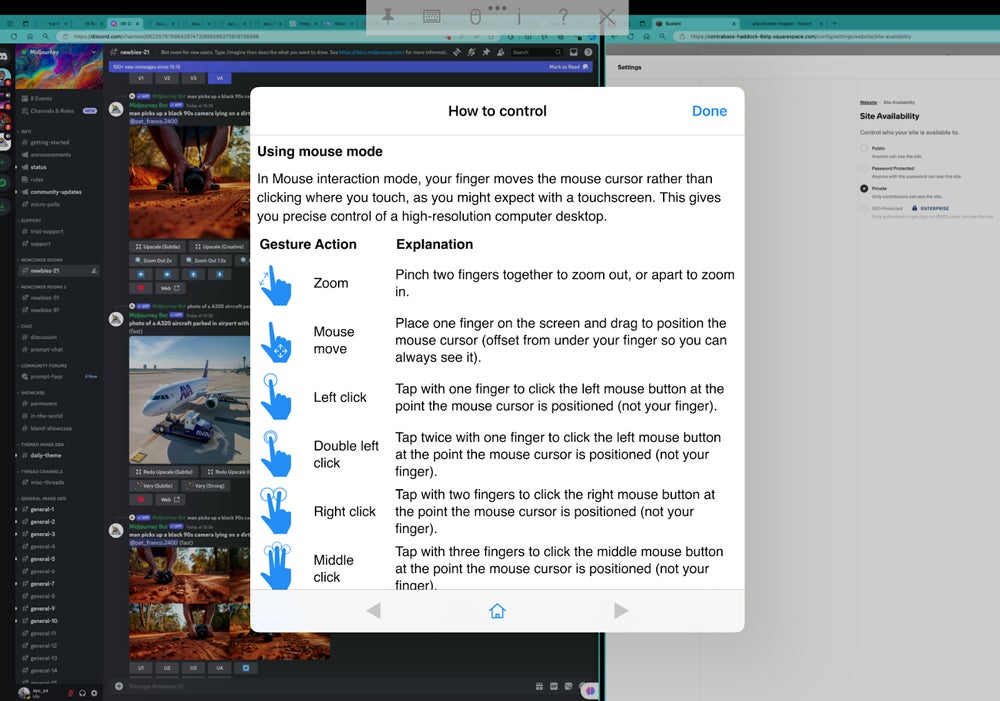
- Various connectivity options: Offer your users both cloud-brokered and direct (IP) connectivity.
- Multi-platform support: Provide your devices with support for all major desktop and mobile operating systems.
- True Zero Trust: Ensure your devices are securely accessed with multifactor authentication and granular user permissions.
- On-Demand Assist: Grant your users rapid remote support without requiring user-side configuration or installation.
RealVNC Connect pricing
- Essentials: $8.25 per month, for 3 devices.
- Plus: $16.50 per month, for 50 devices.
- Premium: $29.75 per month, for 150 devices.
- Enterprise: Contact sales for a quote.
- Free trial: 14 days.
RealVNC Connect pros and cons
| Pros | Cons |
|---|---|
| Cost-effective solution | Limited free version |
| Broad platform support | Limited advanced features |
| Highly customizable | Basic user interface |

RemotePC: Best for user support options
RemotePC stands out for its user support options: dedicated technical support lines available 24/7, and billing and sales support available Monday through Friday from 6 am to 6 pm. They offer email support for those who prefer email to calls, alongside 24/7 live chat.
Additionally, RemotePC provides a support form for RemotePC users or partners to correctly categorize a customer’s support needs.
Even though RemotePC’s support options are impressive, I felt that it wouldn’t be the right fit for users looking for something with a gentle learning curve. For an option that offers effective customer support and that’s easier to use than RemotePC, RealVNC Connect is worth considering.
RemotePC key features
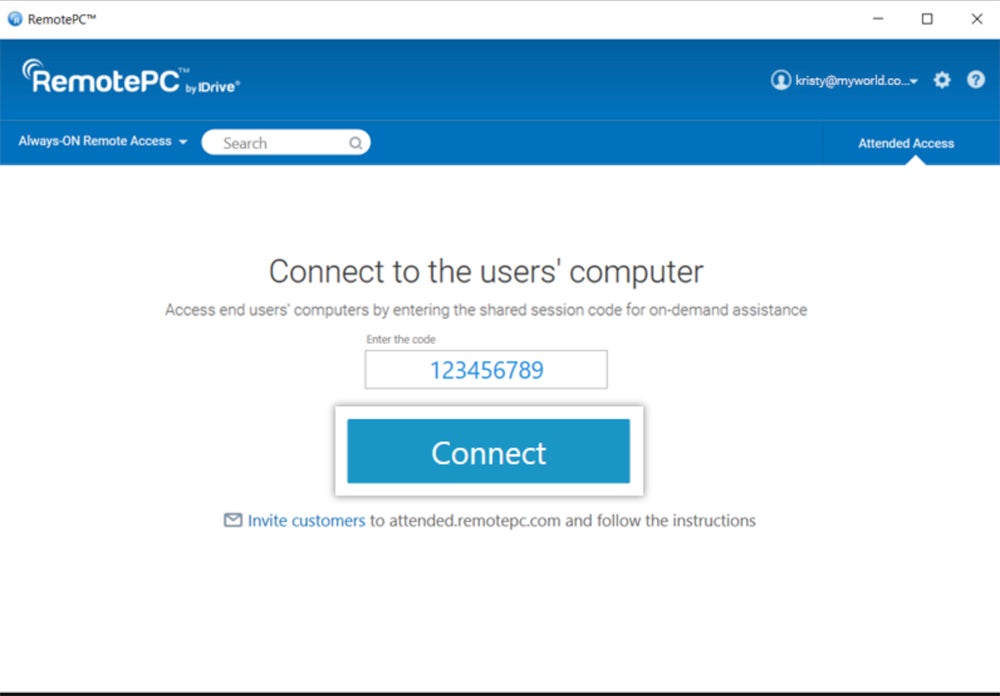
- Always-ON Remote Access: Set up your computers for remote access anytime for complete control of your PCs.
- Attended access: Share session codes to facilitate secure and instant access to your computers.
- File transfer: Seamlessly move files and folders, even from mapped drives, across your computers.
- Remote reboot: Reboot your remote computers in normal or safe mode from your desktop app or web dashboard.
RemotePC pricing
- Free: For personal use to access one computer
- Solo: $2.95 per month, for 1 user, for 1 computer.
- Pro: $9.95 per month, for 1 user, for 10 computers.
- Team: $29.95 per month, for unlimited users, for 50 computers.
- Enterprise: $59.95 per month, for unlimited users, for 100 computers.
- Free trial: 7 days.
RemotePC pros and cons
| Pros | Cons |
|---|---|
| Effective customer support | Limited advanced features |
| Transparent pricing options | Basic interface |
| High customizability | Can feel complex |

Zoho Assist: Best for Zoho ecosystem integration
Zoho Assist is an effective choice for users who are already in the Zoho ecosystem. It provides a unified experience by seamlessly integrating with other Zoho products, such as Zoho Desk, Zoho SalesIQ, and Zoho CRM.
Its integrations don’t end there, however, as it also integrates with applications like Slack, Jira, Microsoft Teams, and Google Suite to ease concerns that you should consider Zoho Assist only if you use other Zoho products.
Zoho Assist is great within the Zoho ecosystem, but it may lack the number of integrations. For a tool with a wider variety of integrations, TeamViewer is a worthy consideration.
Zoho Assist key features
- Unattended access: Raise the efficiency of your devices by accessing remote computers without user intervention.
- Remote printing: Print documents from a remote computer to a local printer without initiating a file transfer.
- Wake-on-LAN: Improve accessibility of your devices by powering on remote devices that are turned off.
- Rebranding options: Customize the application with your logo and branding for a personalized experience.
Zoho Assist pricing
- Free: Supports 1 technician and 5 unattended computers.
- Standard: $10 per month per technician.
- Professional: $15 per month per technician.
- Enterprise: $24 per month per technician.
- Standard Unattended Access: $10 for 25 computers.
- Professional Unattended Access: $15 for 25 computers.
- Free trial: 15 days.
Zoho Assist pros and cons
| Pros | Cons |
|---|---|
| Seamless integration with Zoho ecosystem | Limited advanced features |
| User-friendly interface | Basic customer support |
| Competitive pricing | Few integration options |

Splashtop: Best for cross-platform compatibility
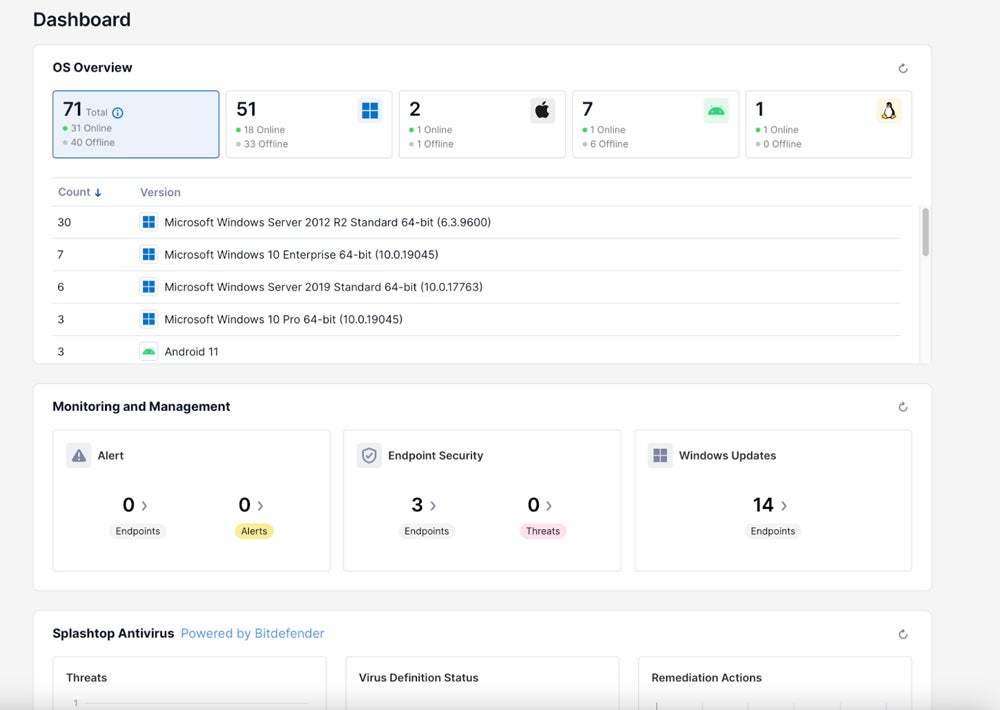
Splashtop excels in high-performance cross-platform compatibility. It’s quite adaptable across a variety of environments, supporting Windows, Mac, Linux, iOS, Android, and even virtual machines. This makes it very flexible as users can access their desktops from virtually any device alongside high-performance connections ranging between 60fps for 1080p resolution and 40 to 60fps for 4K.
While Splashtop offers excellent cross-platform compatibility, I noticed it might not be the easiest tool to use. For an option that feels easier to use and offers high performance, have a look at TeamViewer.
Splashtop key features
- USB device redirection: Use USB devices from your local computer on the remote computer as if they were physically connected.
- High-performance streaming: Leverage 4K streaming at 60fps and 4:4:4 color mode for accurate colors and high-fidelity audio.
- Broad device support: Access your remote devices from any Windows, Mac, iOS, Android, or Chromebook device.
- Secure managed access: Manage access permissions for your team members directly from the web console.
Splashtop pricing
- Solo: $6 per user, per month.
- Pro: $8.25 per user, per month.
- Performance: $13 per user, per month.
- Enterprise: Custom pricing.
- Remote Support SOS: $22 per month, per concurrent user license.
- Remote Support Enterprise: Custom pricing.
Splashtop pros and cons
| Pros | Cons |
|---|---|
| Extensive cross-platform support | Basic user interface |
| Thorough security features | Limited advanced features in lower-tier plans |
| Transparent pricing | Occasional connectivity issue |

ConnectWise ScreenConnect: Best for advanced session control options
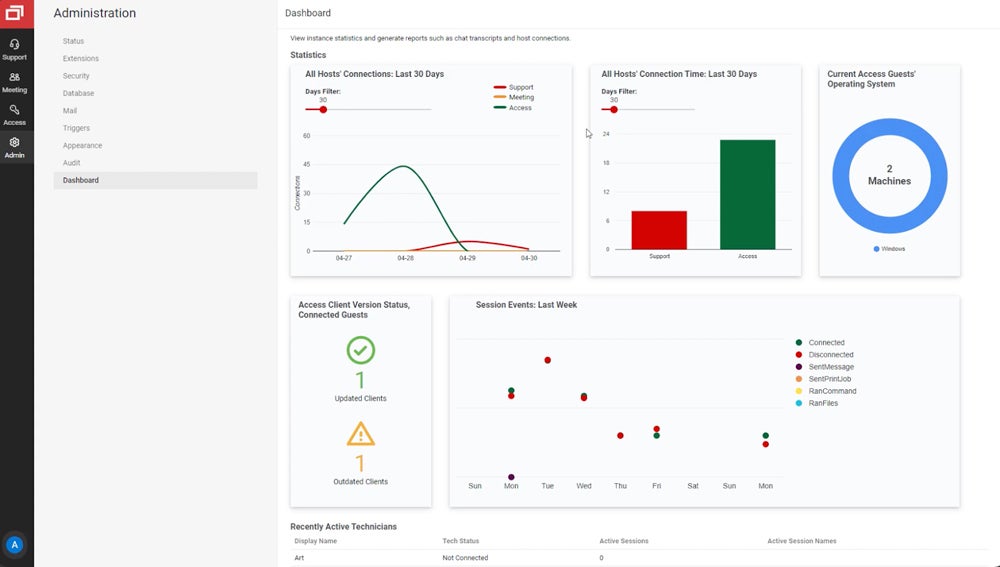
ConnectWise ScreenConnect delivers extensive customization and management capabilities during remote sessions. They include advanced machine management for administrators to monitor and maintain remote devices and script execution, which lets technicians run scripts to automate tasks and resolve issues efficiently.
Additionally, it offers comprehensive session recording and a backstage feature that lets technicians resolve issues without interrupting users.
Despite its comprehensive session control options, ConnectWise ScreenConnect comes across as a complex tool, with its capabilities leaning toward advanced remote support use cases and its pricing tiers being complicated. For those seeking a simpler solution with straightforward pricing, check out Zoho Assist.
ConnectWise key features
- Advanced machine management: Remotely monitor, maintain, and view system information of your remote devices.
- Backstage: Solve your users’ issues discreetly by executing scripts and commands from a command center.
- Session recording: Record your remote sessions and generate detailed reports for training and compliance purposes.
- Drag & drop file transfer: Easily transfer files by dragging and dropping them into the client window.
ConnectWise pricing
- One: $30 per month, billed annually.
- Standard: $45 per month, billed annually.
- Premium: $55 per month, billed annually.
- Free trial: 14 days.
ConnectWise pros and cons
| Pros | Cons |
|---|---|
| Powerful session control options | Complex to use |
| Strong security features | Complex pricing structure |
| Seamless integration with IT management tools | Requires setup and configuration expertise |
Key features of remote desktop software
Remote desktop software solutions are feature-rich, designed to enhance remote access and management. Regardless of how many features a solution offers, some must-haves include file transfer, multi-monitor support, unattended access, real-time collaboration, and high performance and speed.
File transfer capability
Efficient file transfer is key in remote work environments. It’s typical of advanced remote desktop solutions to offer seamless transfer of large and multiple files without restrictions, as this is one of the pillars of smooth and productive workflows in the work environment today.
Multi-monitor support
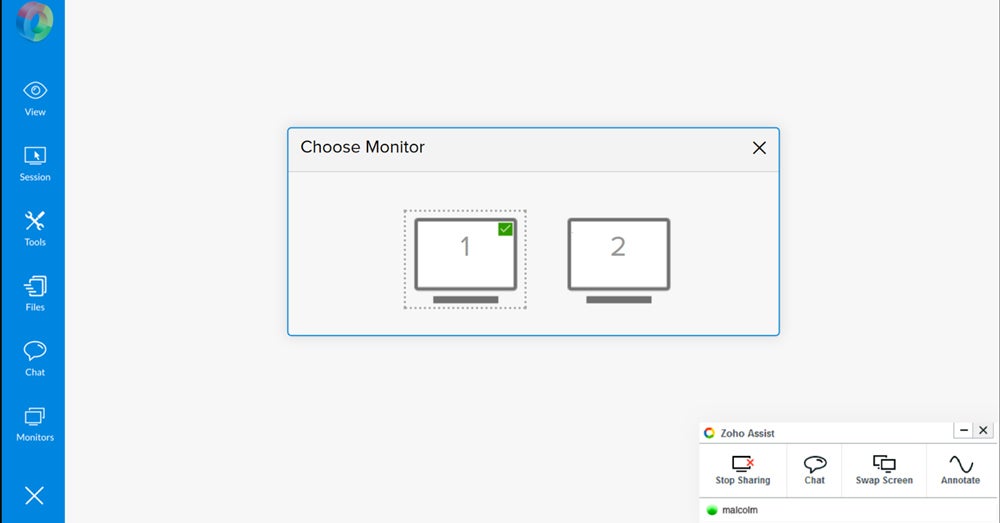
Support for multiple monitors enhances productivity by allowing users to manage multiple screens simultaneously. A robust remote desktop solution will provide full multi-monitor support, seamless switching, and minimal limitations.
Unattended access
With unattended access, a remote user, often an IT professional, can control devices remotely without having a user on the other end intervening. This feature is essential for performing maintenance, updates, and troubleshooting outside regular working hours to ensure users experience minimal disruptions.
Real-time collaboration tools
Collaboration tools set the conditions for effective communication and teamwork. Features such as chat, video conferencing, and annotation enable real-time collaboration. This makes remote work more interactive and efficient.
Performance and speed
Performance is non-negotiable for remote desktop software. The top solutions strive to offer seamless connections without delays or interruptions.
They provide low-latency and high-speed connections for a smooth, responsive remote access experience, especially for tasks that require real-time responses.
Bottom Line: Choosing the best remote desktop software
Selecting the right remote desktop software depends on your needs and environment. Sign up for free trials of the tools that appeal to you most across features, cost, and your use case to get a hands-on feel that’ll heavily influence your choice.
Also, make sure the features available in the trial are available in the product tier you’re considering. Only after both these steps should you subscribe to a remote software solution.
Should your use case go beyond remote desktop tools to need remote monitoring and management (RMM), see our best RMM tools for MSPs.
How I evaluated the best remote desktop software
To shortlist the top remote desktop software, I assessed several options using six weighted categories. I chose the provider with the highest cumulative score across all categories as my top pick. Additionally, I identified the unique features each product offered to determine a use case.
Evaluation criteria
I prioritized core features as they define the kind of remote desktop software a user will get, and their quality determines how effective remote access and management will be.
Cost was the next significant criterion as price instantly tells you whether or not that tool is within your budget, followed by equal emphasis on ease of use, security, customization, and compatibility, and then by customer support, as these tools are straightforward to use, especially for technical users.
- Core features (25%): I assessed file transfer capability, multi-monitor support, unattended access, real-time collaboration tools, and performance and speed.
- Cost (20%): My consideration was affordability, including free trials, flexible pricing plans, pricing transparency, additional costs, starting cost per user, and license types.
- Ease of use (15%): I evaluated user-friendliness, ease of setup, and the availability of knowledge base resources and user training.
- Security (15%): This criterion covered encryption standards, two-factor authentication, secure remote access protocols, access controls and permissions, and compliance certifications.
- Customization and compatibility (15%): My focus was on mobile device access, cross-platform compatibility, branding options, deployment flexibility, and third-party integrations.
- Customer support (10%): I examined the availability and quality of support options, including live chat, phone, and email.
Frequently asked questions (FAQs)
What is remote desktop software?
Remote desktop software is a technology that enables users to access and control a computer or network from a remote location. It’s commonly used for technical support, remote work, and accessing files and applications on a different device.
Are there free remote desktop software solutions?
Yes, several remote desktop software solutions offer free versions with basic features. Examples include TeamViewer and Zoho Assist. However, these free versions may have limitations compared to their paid counterparts.
Are remote desktop solutions safe and secure?
Remote desktop solutions can be safe and secure if they use robust encryption, secure access protocols, and multi-factor authentication. As this depends on the provider, it’s essential to choose a reputable one and follow best security practices to protect your data and privacy.
This article was originally published by Collins Ayuya in June 2024 and updated by Luis Millares in April 2026 to reflect light updates in terms of pricing and other relevant changes.