














Many managed service providers (MSPs) know which services they want to offer but struggle to determine how to package, price, and present those services to clients.
Managed services pricing templates provide a framework for organizing service offerings, comparing pricing models, and communicating value more clearly.
Whether you’re building your first service packages or refining an existing pricing strategy, the right template can help standardize pricing and simplify the sales process.This guide includes 10 free managed services pricing templates and tips for creating pricing models that align with your services, customers, and business goals.
What is managed services pricing?
Managed services pricing refers to how MSPs package and price recurring services such as IT support, monitoring, and security. Common pricing models include per-user, per-device, tiered, bundled, and all-inclusive.
Pricing templates help standardize service offerings, simplify pricing decisions, and support consistent growth and profitability.
MSP pricing models to use with your template
Your pricing structure should align with your MSP’s business model, service offerings, and target market. Some of the most common MSP pricing models include:
| Pricing model | How it works | When it works best | Common pitfalls |
| All-you-can-eat | Customers receive a comprehensive set of managed services for a fixed monthly fee. | Predictable monthly IT support | Scope creep and overutilization |
| Bundled pricing | Multiple services are grouped into a package and sold for a set monthly price. | Cross-selling related services | Unused services reduce value |
| Tiered pricing | Services are organized into multiple levels (e.g., Basic, Professional, Premium) with increasing features and pricing. | Diverse client needs and budgets | Poor tier differentiation |
| Per-user pricing | Charges are based on the number of supported users, regardless of how many devices they use. | Multi-device workforces | Uneven user support demands |
| Per-device pricing | Pricing is based on the number of managed devices, such as workstations, servers, and network equipment. | Stable device environments | Ignores support complexity |
| À la carte pricing | Customers select and pay only for the individual services they need. | Customized client requirements | Inconsistent recurring revenue |
What to include in an MSP pricing template
Regardless of the pricing model you use, a strong MSP pricing template should help clients understand what services they’re receiving, how they’ll be billed, and the value they can expect.
Most pricing templates include the following elements:
- Service Offerings: Clearly outline the managed services you provide. Organize and group services logically so prospective clients can easily understand your offerings.
- Service Descriptions: Clearly explain what each service includes. Provide concise descriptions that outline key tasks, deliverables, and expected outcomes.
- Pricing Structure: Your pricing structure should align with your business model, services, and target market. While per-user and per-device pricing are common, you can also use tiered, flat-rate, bundled, or customized pricing models depending on your offerings.
- Levels: Consider adding service tiers to accommodate clients with different needs and budgets. Tiers can help customers compare options and choose the package that best fits their requirements.
- Totals: Include a section summarizing all service costs and presenting the final total. This helps clients quickly understand the total investment for their selected services.
While every MSP’s pricing strategy is different, the templates below provide practical starting points for packaging and presenting a variety of managed services.
Free managed services pricing templates for different MSPs
1. General Managed Services Pricing Template
Who it’s right for: MSPs looking for a customizable starting point for building and presenting their pricing models.
We created a free managed services pricing template that any MSP can use and customize to communicate their services and pricing to their clients.
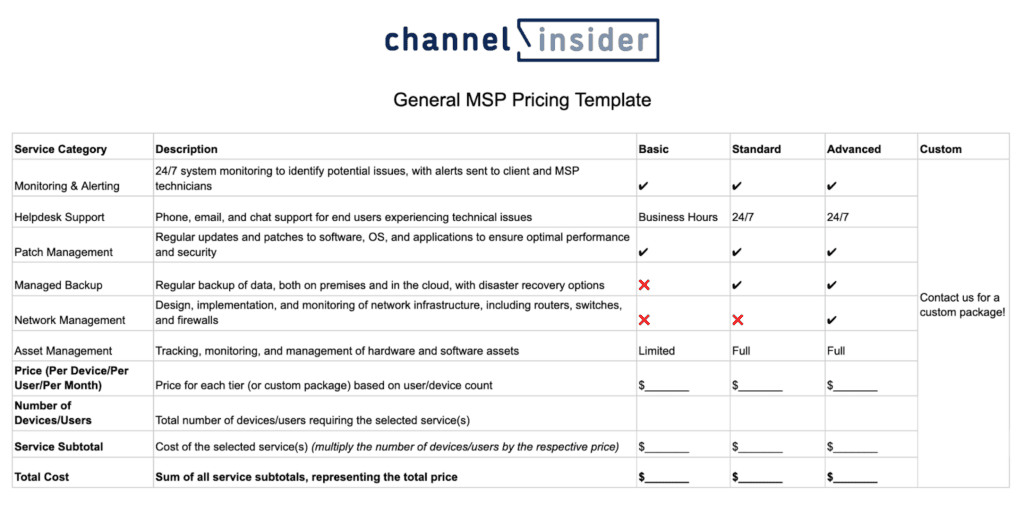
You can customize the prices in these templates according to your offerings, target market, regional factors, and more. This gives you a flexible and easy starting point from which to build your unique pricing models.
2. Managed Security Services Pricing Template
Who it’s right for: Managed security service providers (MSSPs) who specialize in providing robust cybersecurity solutions to protect their clients’ digital assets.
The MSSP template is tailored to emphasize the key components of cybersecurity management, such as threat monitoring.

If your MSP specializes in security, you can use this approach to showcase your expertise and the importance of your services in the ever-evolving cybersecurity landscape. You can expect threat monitoring, vulnerability scanning, security consulting, incident response, firewall management, and similar services to feature in this template.
3. Managed Cloud Services Pricing Template
Who it’s right for: MSPs offering cloud-based services, including migration, management, and support for their clients.
If your MSP focuses on cloud solutions such as migration, infrastructure setup, monitoring, security, and backup, this template is ideal for you.
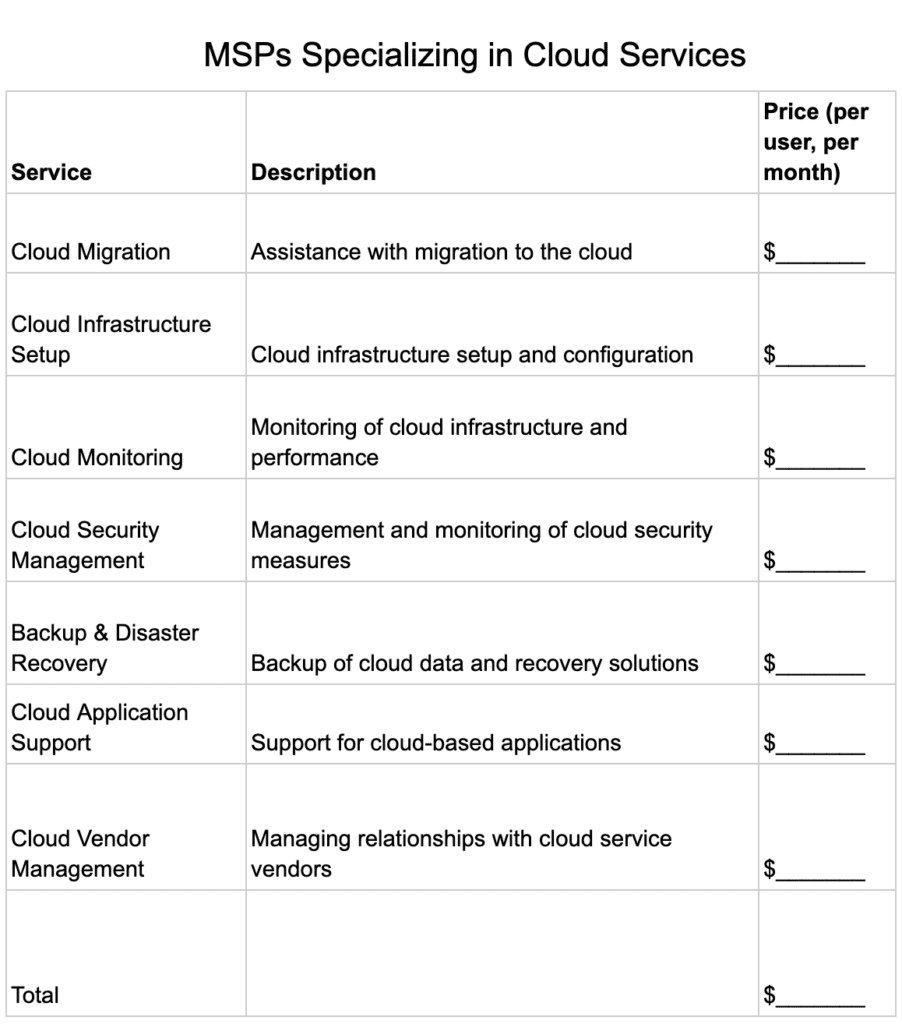
It’s designed to cater to businesses looking to leverage cloud benefits while ensuring smooth, secure operations. In addition to the services above, the template includes services such as cloud vendor management and cloud application support.
4. Premium Managed Services Pricing Template
Who it’s right for: MSPs offering higher-level IT support services, including priority response and enhanced service level agreements (SLAs).
The premium services template contains advanced offerings such as faster response times, dedicated account management, and comprehensive reporting.
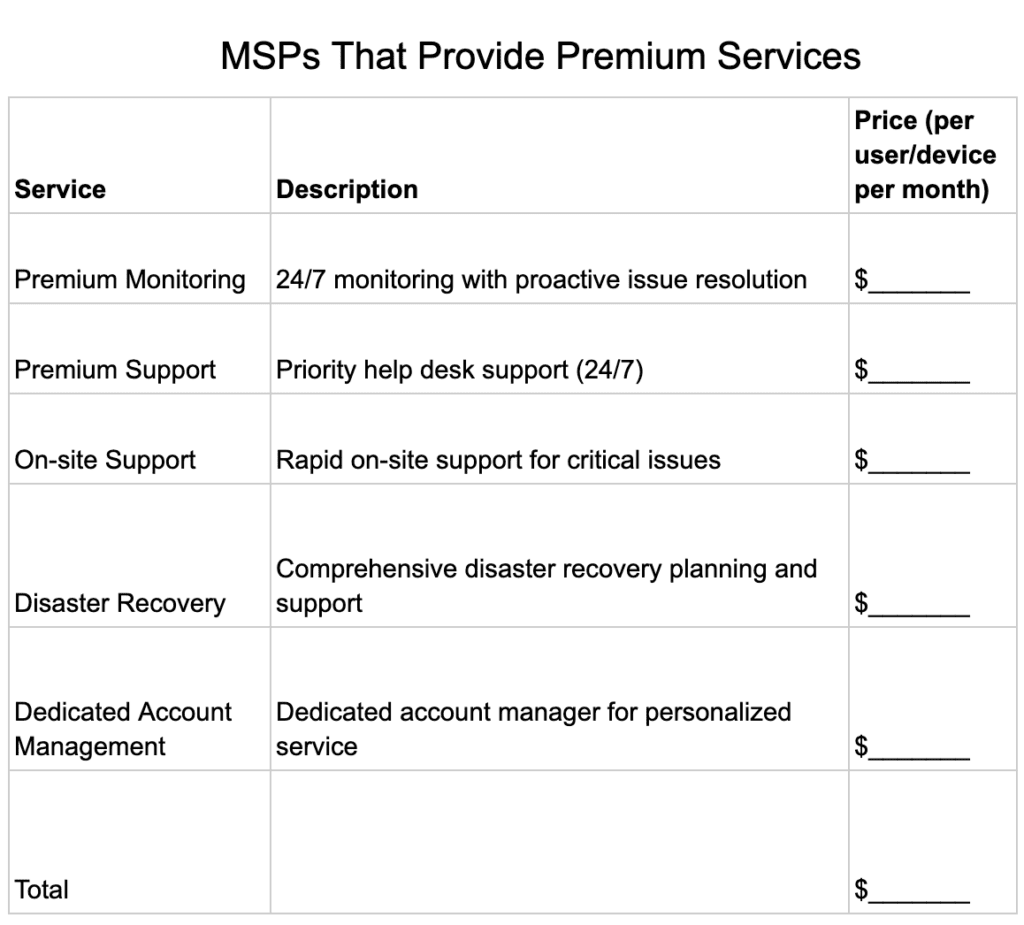
These additional features cater to clients looking for a superior level of service and support. By emphasizing the higher quality and attention you provide, you can attract clients willing to invest in top-tier IT management services with this template.
5. Managed On-Site Services Pricing Template
Who it’s right for: MSPs that deliver services that require physical presence at the client’s location.
The on-site services template focuses on field support services to customers. These include hardware installations, network management, and troubleshooting.
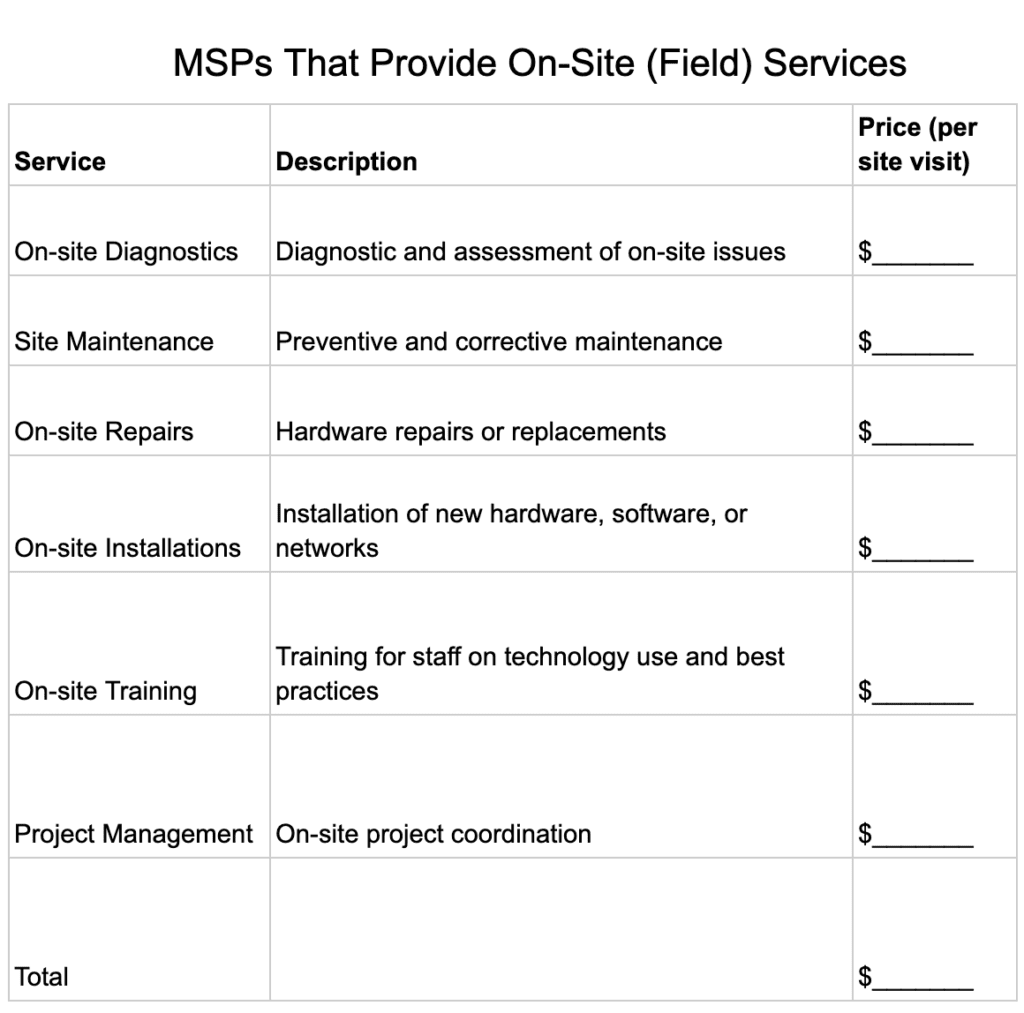
With this template, you can clearly highlight your MSP’s expertise in offering on-site services and enable clients to understand the value and convenience of having a dedicated team available for on-site support. You can include services such as training, repairs, on-site management, and more.
6. Collaboration services pricing template
Who it’s right for: MSPs that provide communication and collaboration tools, including email, VoIP, and video conferencing.
Effective communication and collaboration are key to the success of any business. MSPs in this domain ensure their clients have access to reliable, secure, and user-friendly tools.
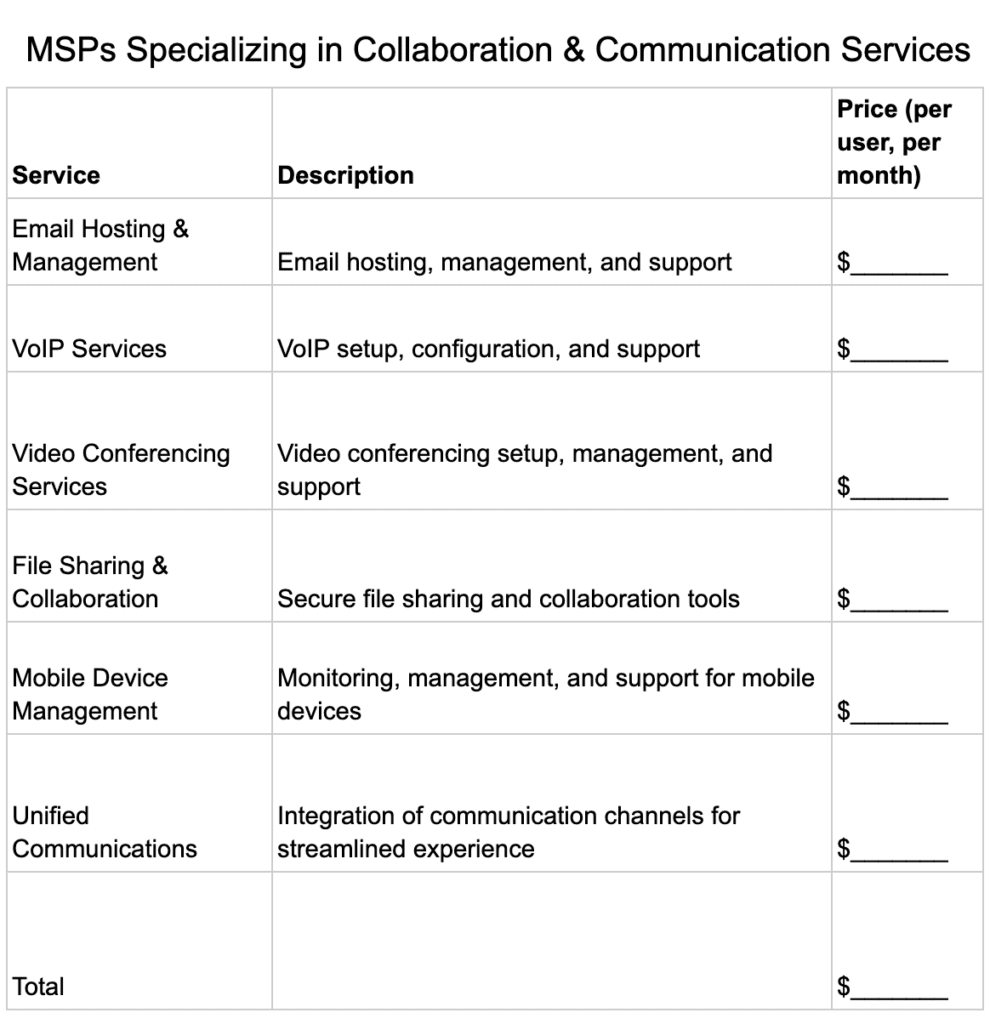
From email hosting and VoIP services to video conferencing and mobile device management, this pricing template covers a range of essential services to help you create comprehensive, customized packages for clients.
7. Software Services Pricing Template
Who it’s right for: MSPs that specialize in software-related services like software monitoring, license management, and software updates.
This template is effective for software-focused MSPs because it focuses on the key services that help businesses optimize software performance, maintain compliance, and improve overall efficiency.
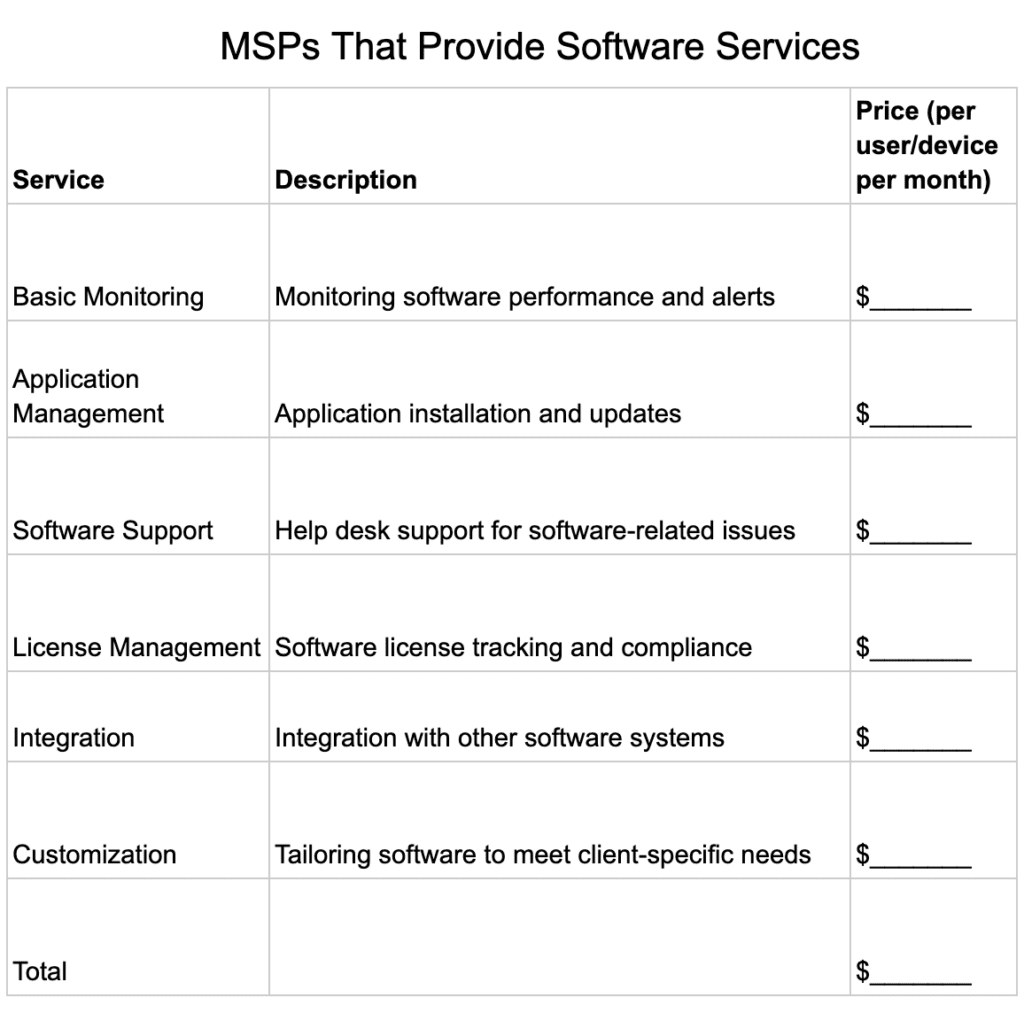
By customizing this template, you can emphasize your software expertise and tailor pricing to reflect the unique value you deliver to clients. You can include basic software services such as application management, software support, and integration.
8. Managed Hardware Services Pricing Template
Who it’s right for: MSPs that focus on hardware-related services such as hardware monitoring, maintenance, and asset management.
The template is effective for hardware-centric MSPs, as it addresses the primary concerns of businesses seeking support with maintaining, upgrading, and managing their physical IT assets.

By focusing on these core hardware services, you can tailor your offerings to clients with unique hardware needs and provide specialized support. More core services to expect from this template include hardware installation, support, and management.
9. Database services pricing template
Who it’s right for: Managed service providers with a focus on providing database management, optimization, and security services for their customers.
Databases are critical components of any organization’s IT infrastructure. MSPs specializing in database management help clients set up, monitor, optimize, and secure their database instances.

This pricing template includes services such as database setup, monitoring, security management, backup and disaster recovery, optimization, and more to show that you can maintain and improve the performance, security, and reliability of clients’ databases.
10. Virtualization services pricing template
Who it’s right for: MSPs that focus on implementing and managing virtualization technologies for their clients.
Virtualization technology has revolutionized the way businesses utilize their IT resources.

If your MSP specializes in virtualization, you’ve helped clients set up, manage, and secure their virtual infrastructure, including virtual machines and networks. This pricing template highlights some of the virtualization services clients would find useful and aligned with their business operations. They include virtual machine setup, management, and backup and recovery.
Final thoughts: use an MSP pricing strategy that works for you
Managed services pricing templates are essential tools for effectively showcasing your offerings and meeting the needs of your leads and clients. By including key components like service offerings and pricing structures, you can appeal to a diverse range of customers.
With that being said, you should tailor your pricing templates to your MSP category to better serve your clients and optimize your revenue streams. You can also combine multiple templates to better communicate your value if your services span multiple templates.
As you refine your pricing strategy, adapt these templates to your services and business goals. The most effective pricing models are clear, transparent, and flexible enough to evolve alongside your clients’ needs, allowing you to build a pricing strategy that works best for your business.
Frequently asked questions about MSP pricing
1. How much do managed services typically cost?
MSP pricing varies based on the services provided, business size, and support requirements. Most providers use recurring monthly pricing models, often charging per user, per device, or through tiered service packages.
2. What is the most common MSP pricing model?
Per-user pricing is one of the most common MSP pricing models because it scales easily and provides predictable costs for both providers and clients. Many MSPs also combine it with tiered or bundled service packages.
3. How do MSPs determine their pricing?
MSPs typically base pricing on factors such as service scope, support requirements, security needs, service-level agreements (SLAs), and the number of users or devices being managed. Many providers also evaluate operating costs and target profit margins when setting rates.
4. What are common MSP pricing mistakes?
Common mistakes include underpricing services, failing to clearly define service scope, using the same pricing model for every client, and not updating pricing as service offerings evolve.
These issues can reduce profitability and create misunderstandings with customers.
This article was originally published by Collins Ayuya in May 2023 and updated by Luis Millares in June 2026.