












An MSP data breach response plan is a detailed blueprint that outlines how to reduce the risk of a security incident and what actions to take in the event of a suspected or confirmed breach.
Besides disrupting a managed service provider’s operations, a successful breach would put all of its customers at risk, especially if the intruders gained access to the service’s professional services automation (PSA) and remote monitoring and management (RMM) platforms.
MSPs that provide cybersecurity protection services should be creating data breach response plans for their customers. Every MSP should also have a thorough, regularly updated plan for its own operations, since it is the primary target of threat actors.
- Free data breach response plan for MSPs
- What is an incident response plan?
- How susceptible are MSPs to cyberattacks?
- How MSPs can avoid data breaches
- How MSPs should respond to security breaches
- Can MSPs be held liable for data breaches?
- How MSPs can display a strong security posture with clients
- Bottom line: Establish a data breach protection plan
Free data breach response plan for MSPs
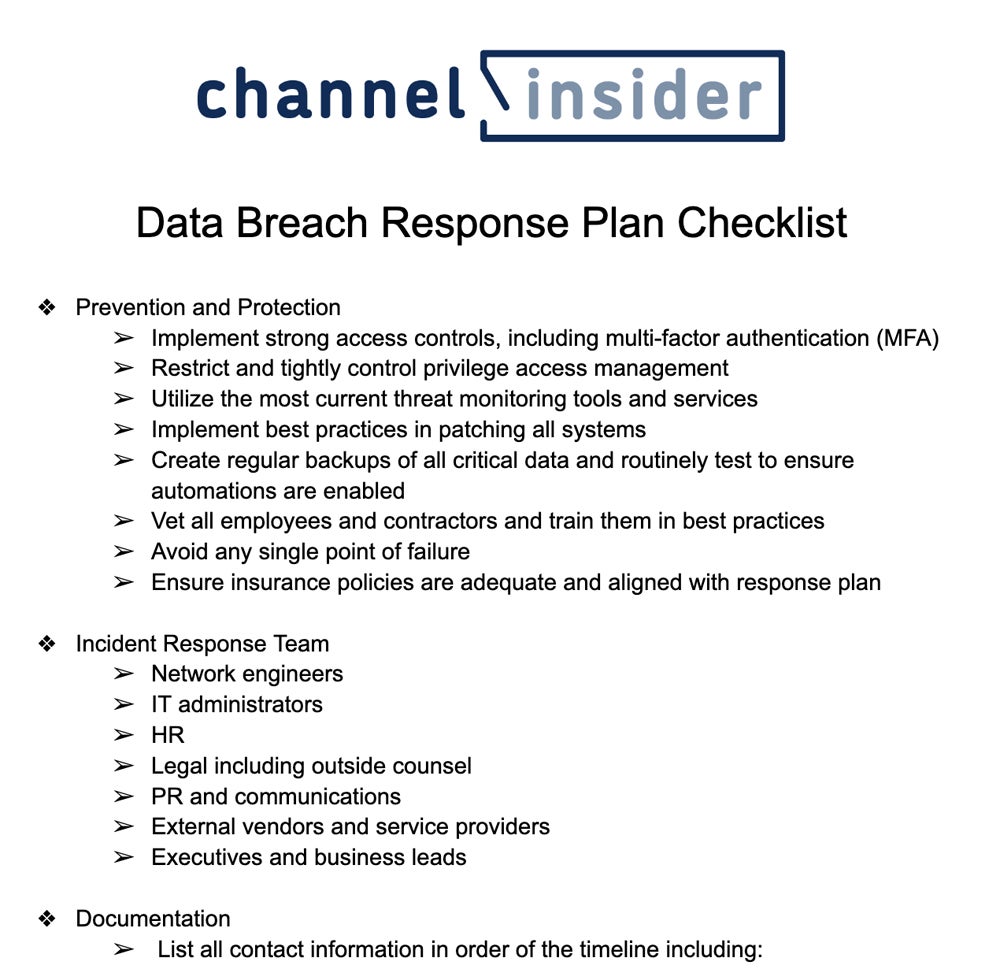
We’ve drafted a data breach response plan checklist that MSPs can use to finalize their own plans. Click the image below to view and download the entire checklist, then make a copy to modify it per your unique business needs.
What is an incident response plan?
An incident response plan is a documented course of action that outlines specific steps and procedures to follow when a major attack occurs. Every MSP should have an incident response plan for its organization and create one for its customers. It should be part of a business continuity and disaster recovery (BCDR) strategy.
The Cybersecurity and Infrastructure Security Agency (CISA) advises MSPs to clearly define stakeholder roles and responsibilities, including key executives, IT leaders, legal counsel, and procurement teams. MSPs should also regularly test their plans through exercises and encourage customers to do the same.
CISA further recommends that MSPs proactively assess and manage supply chain risks, recognizing both the risks they face from vendors and the downstream risks they may introduce to customers.
Every incident response plan should include:
- Documentation of steps to take upon discovery of a breach, outlined in phases
- Identification of roles, responsibilities, and contingencies
- List of people to initially contact within the organization
- Plan for communicating the breach to clients, particularly those most vulnerable
- Review by the organization’s legal counsel and insurers
- Copies that are easily accessible, including printouts
How susceptible are MSPs to cyberattacks?
MSPs have become prime targets of sophisticated attackers and ransomware gangs because they provide a natural path to their customers. An MSP has privileged administrator access to core systems, applications, and databases, which means a successful breach of a single vulnerable service provider can enable attackers to access many organizations.
Attackers frequently target remote monitoring and management (RMM) tools, professional services automation (PSA) platforms, identity systems, and other technologies that MSPs rely on to manage client environments. Because these tools often have elevated privileges, a compromise can have widespread consequences.
High-profile incidents involving SolarWinds and Kaseya demonstrated how attacks against trusted service providers can ripple through thousands of organizations, underscoring the importance of strong security controls in MSP environments.
In addition, MSPs often present a larger and more attractive attack surface than the average small business. Attackers may only need to compromise a single system, credential, or management platform to gain access to multiple customer environments.
As a result, MSPs operate under higher stakes, not only because of the sensitive data they manage but also because a single breach can have cascading effects across their customer base.
How MSPs can avoid data breaches
An incident response plan is critical, but avoiding incidents will reduce the likelihood of needing to use it. According to CISA’s advisory, MSPs can avoid data breaches by using appropriate VPN settings, maintaining a vulnerability management program, identifying and tracking all internet-facing assets, implementing strategies to prevent authentication-based attacks, and protecting against credential stuffing.
Let’s examine those approaches more closely:
- Internet assets: Identify and track web or API services, and ensure that protocols and ports in use are gathered from known and baselined configuration settings (such as firewall rules).
- Vulnerability management programs: Leverage system discovery tools to identify and classify assets, find and validate vulnerabilities, prioritize vulnerabilities based on technical and business objectives, have a plan for fixing identified issues, and create a vulnerability disclosure playbook.
- Backup and recovery readiness: Regularly test backup and recovery processes to ensure critical systems and customer data can be restored quickly following a security incident.
- Authentication-based attack prevention: Prevent attacks such as brute-force, dictionary, and password-spraying attacks, phishing campaigns, social engineering, and system vulnerabilities.
- VPN configurations: Use the longest supported encryption keys and follow other best practices; run only the necessary features to reduce the risk of exploitation; and monitor access to and from the VPN.
- AI governance and shadow AI management: Establish policies and visibility into approved AI platforms, and prevent employees from submitting sensitive client or business information to unauthorized AI applications.
How MSPs should respond to security breaches
Unfortunately, no one is immune to falling victim to intruders, who engage in sophisticated and well-orchestrated campaigns often backed with significant funding. Taking the actions above will reduce the risk of a breach, but no MSP is impervious to attack, which is why it’s so critical to have an incident response plan.
Having and adhering to a plan of action from the moment a breach is suspected promises to reduce the impact of an intrusion. Take these steps once a breach has been detected or confirmed:
- Immediately isolate affected systems, accounts, and network connections
- Mobilize key incident response team stakeholders, including business and IT stakeholders, legal counsel, insurance carriers, and law enforcement
- Assess and document the data breached
- Notify affected clients and stakeholders in accordance with contractual, legal, and regulatory requirements.
- Determine the root cause of the breach and steps to mitigate future occurrences
- Preserve logs and forensic evidence for investigation
- Review your incident response plan to ensure you’ve completed all actions
MSPs should also leverage threat intelligence resources and information-sharing communities to stay informed about emerging threats and attacker tactics.
Access to timely threat intelligence can help security teams validate indicators of compromise and strengthen response efforts during an active security incident.
Why are MSPs easy targets?
The unfortunate reality is that many MSPs get so caught up in putting out fires for their customers that they neglect their own infrastructure. Yet failing to secure their own environment can put both the MSP and its clients at risk.
Common factors that increase MSP risk include:
- Delayed patching of internal systems and management platforms
- Excessive privileged access across tools and environments
- Weak identity and access controls
- Insufficient monitoring of internal infrastructure
- Overreliance on trusted remote management tools
- Insufficient security training for employees
Maintaining strong internal security practices is critical. MSPs that apply the same security standards to their own environments that they recommend to customers are better positioned to reduce risk and strengthen their overall security posture.
Can MSPs be held liable for data breaches?
Yes, MSPs can face legal, contractual, and regulatory liability following a data breach, including incidents involving malware infections, phishing attacks, data loss, downtime, failed backups, and noncompliance with regulations such as HIPAA, GDPR, and FINRA.
An MSP can be held liable even if those failures are inadvertent or originate from a client or a third party within the client’s supply chain.
To help limit liability, MSPs should clearly define responsibilities, disclaimers, and service expectations in client contracts and service level agreements (SLAs). However, even a well-written contract does not guarantee that clients will not pursue legal action if a security incident occurs.
How MSPs can display a strong security posture with clients
As threat vectors continue to change, with more malicious actors able to wage attacks with fewer skills, MSPs and MSSPs must have a broad set of tools and capabilities to provide comprehensive protection.
MSPs should communicate and demonstrate their security expertise to clients. Capabilities to emphasize should include tools to secure infrastructure, networks, cloud environments, and data.
Equally important are identity and access management (IAM), including providing multi-factor authentication (MFA), infrastructure and application monitoring, and risk and vulnerability management.
Bottom line: Establish a data breach protection plan
Everyone is a target of a cyberattack, but MSPs are prime targets because they are the gateway to their clients’ systems and data. That being said, maintaining strong internal security controls, regularly testing incident response plans, and proactively addressing emerging risks can help reduce the likelihood and impact of a breach.
If you’re evangelizing to your customers that they should patch their systems and have incident response plans, don’t be the cobbler who wears broken shoes. The same practices that protect your clients should also serve as the foundation of your own security strategy.
MSPs that take the necessary steps to maintain a strong security posture can significantly reduce their liability if they experience a data breach, and their customers will be better protected as a result.
This article was originally written by Jeffrey Schwartz in 2024 and updated by Luis Millares in June 2026.