














Check Point Email Security is our top overall email security solution for MSPs in 2026 because of its combination of phishing protection, account takeover detection, DLP, sandboxing, and integrations with Microsoft 365 and other collaboration platforms. Barracuda is a stronger fit for MSPs prioritizing email continuity, while Proofpoint stands out for BEC and targeted attack protection.
The best choice ultimately depends on your clients’ environments, security requirements, deployment model, and the ease with which your team can manage protection across multiple customers.
- Why do MSPs need email security software?
- Top email security providers: Comparison
- Check Point Email Security: Best overall
- Barracuda Email Protection: Best for email security and continuity
- Sophos Email: Best for Sophos ecosystems
- Cisco Secure Email: Best for flexible deployment
- Trend Micro
- Pricing
- Mimecast: Best for comprehensive email security
- Proofpoint: Best for BEC and targeted attacks
- How we evaluated the best email security solutions for MSPs
- What should MSPs look for in an email security platform?
- Bottom line: Choose an email security provider that fits your clients’ needs
- Frequently asked questions (FAQs)
Why do MSPs need email security software?
Email security software for MSPs helps protect client environments from phishing, malware, and other email-based threats. Modern solutions can combine threat detection, AI-powered analysis, sandboxing, encryption, URL protection, and other security controls to identify and block increasingly sophisticated attacks.
With so many email security solutions available, choosing the right one can be challenging, particularly for MSPs that need to protect multiple client environments and manage security at scale.
To help you choose the best option for your clients, we’ve shortlisted the top email security solutions for MSPs and highlighted what each one does best.
Top email security providers: Comparison
| Provider | Best for | Key strengths | Deployment & compatibility | Pricing |
| Check Point Email Security (formerly Avanan) | Best overall | AI-powered phishing protection, malware detection, URL protection, DLP, encryption, anomaly detection | Cloud-based protection with integrations for Microsoft 365, Google Workspace and other collaboration platforms | Custom quote |
| Barracuda Email Protection | Best for email security and continuity | Advanced threat protection, phishing and impersonation protection, email continuity, DLP, encryption, automated incident response | Cloud, gateway and API-based options; supports Microsoft 365 and Google Workspace | Starts at $5 per user, per month |
| Sophos Email | Best for Sophos ecosystems | Anti-phishing protection, advanced threat protection, DLP, encryption and integration with the broader Sophos security ecosystem | Cloud-based email security with Microsoft 365 and other common business email environments | Custom quote |
| Cisco Secure Email | Best for flexible deployment | Threat intelligence, malware and phishing protection, URL analysis, DLP, encryption and centralized management | Cloud, virtual, on-premises and hybrid deployment options; supports Microsoft 365 and other mail environments | Custom quote |
| Trend Micro Email Security | Best for advanced threat protection | Protection against phishing, BEC, ransomware and malicious files, plus threat intelligence and email filtering | Cloud-based email security supporting Microsoft 365, Gmail and other mail environments | Custom quote |
| Mimecast | Best for comprehensive email security | Secure email gateway, phishing and social engineering protection, DLP, email continuity and advanced threat detection | Cloud-based protection for Microsoft 365, Google Workspace and other email environments | Custom quote |
| Proofpoint | Best for BEC and targeted attacks | AI/ML-powered threat detection, behavioral analysis, BEC protection, email fraud defense and targeted attack protection | Cloud-based email security designed to protect modern business email environments | Custom quote |
Check Point Email Security: Best overall

Check Point Email Security, formerly known as Avanan, offers a broad range of email and collaboration security capabilities designed to protect cloud-based business environments.
Its tools include AI-powered phishing protection, malicious URL and file detection, data loss prevention, encryption, and account takeover protection. The solution integrates with cloud services such as Microsoft 365, Gmail, Microsoft Teams, OneDrive, SharePoint, Slack, Dropbox, Box, and ShareFile.
Features
- Inline email security: Integrate directly with clients’ cloud email environments to inspect and protect email using Check Point’s inline or detect-and-remediate protection modes.
- Phishing protection: Use AI-powered analysis and behavioral signals to identify and prevent phishing, impersonation, and other sophisticated email threats.
- Anomaly detection: Use behavioral analysis to identify unusual activity and potential account-takeover threats.
- Data loss prevention: Apply DLP policies to protect sensitive information and control how data is shared through email and other collaboration applications. DLP is available with Check Point’s Complete Protect package.

Pricing
Check Point does not publicly list standard pricing for Email Security and instead offers customized quotes based on an organization’s requirements. The provider currently offers a 14-day free trial.
| PROS | CONS |
|---|---|
| Direct integration with cloud email and collaboration platforms | Pricing is not publicly listed |
| Broad AI-powered threat protection capabilities | Advanced capabilities may require higher-tier packages |
| Supports phishing protection, DLP, sandboxing, CDR, and malicious URL detection | Some advanced capabilities require specific packages or add-ons |

Barracuda Email Protection: Best for email security and continuity
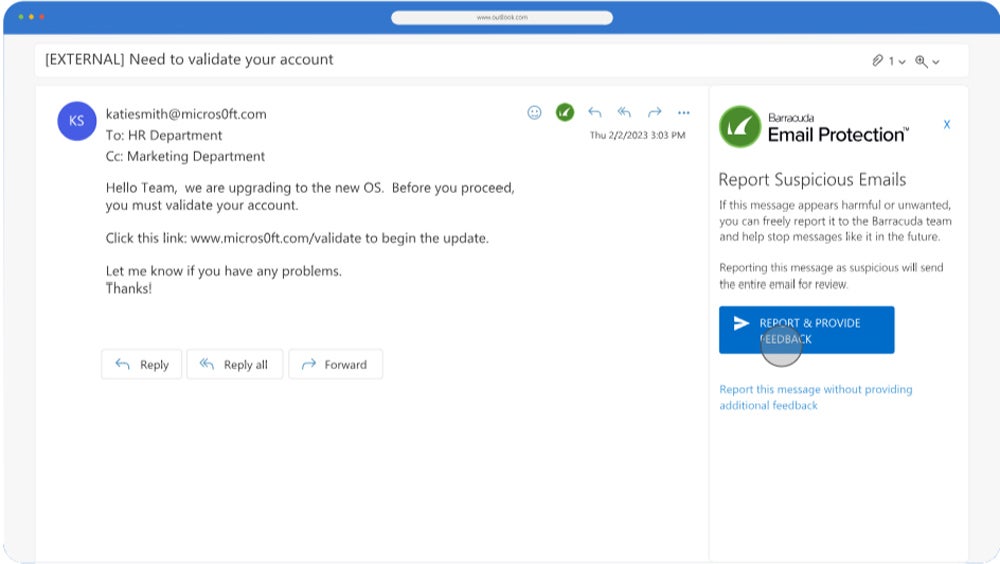
Barracuda Email Protection combines email security and continuity capabilities to protect organizations against phishing, malware, impersonation, and other email-based threats. It also provides email continuity capabilities designed to keep users connected during service disruptions.
For MSPs, Barracuda offers a range of deployment and management options for protecting multiple client environments.
Features
- AI-driven protection: Leverage Barracuda’s AI solutions for real-time defense against spear phishing and cyber fraud, complementing the gateway’s capabilities.
- Inbound malware defense: Secure your users’ email systems against incoming malware, spam, and phishing attempts, maintaining operational integrity and productivity.
- Customizable policies: Implement detailed email security policies tailored to your clients’ needs, enhancing the overall security framework and compliance.
Pricing
Barracuda Email Protection starts at $5 per user per month (MSRP), though pricing varies by plan, number of users, and contract duration.
| Pros | Cons |
|---|---|
| Comprehensive customer support | Occasional false positives may require manual review |
| Strong phishing and malware defense | Setup process can be complex |
| Email security and continuity capabilities | Some advanced capabilities may require higher-tier plans |
Sophos Email: Best for Sophos ecosystems

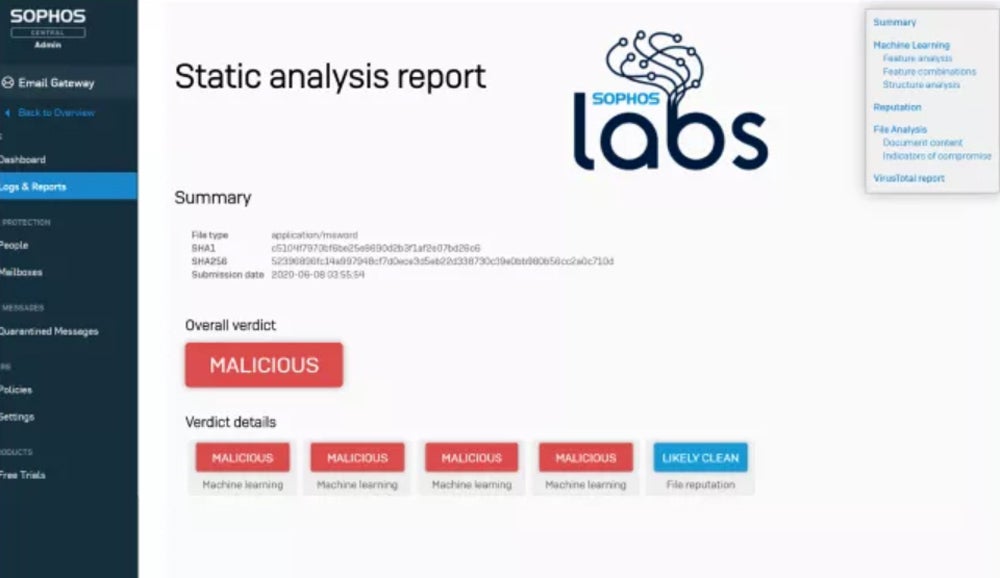
Sophos Email provides email security capabilities that integrate with the broader Sophos security ecosystem. It protects against spam, phishing, malware, and other email-based threats while offering features such as data loss prevention and email encryption.
For MSPs already using Sophos security products, its ecosystem integration can make it a convenient option for managing protection across client environments.
Features
- Data loss prevention: Implement DLP policies to protect sensitive information across all emails and attachments and ensure the integrity of your clients’ data.
- Encryption and authentication: Enhance security with message encryption options like S/MIME for digital signature verification, TLS, and customizable encryption.
- Advanced threat protection: Utilize Sophos’ threat detection capabilities to guard against emerging email threats and keep your users’ inboxes safe.
- Phishing defense: Secure your customers’ sensitive information by deploying anti-phishing technologies to detect and neutralize phishing attempts.
Pricing
Sophos offers a 30-day free trial but does not publicly list standard pricing, so you’ll need to request a quote.
| Pros | Cons |
|---|---|
| Strong integration with the Sophos security ecosystem | Pricing information isn’t transparent |
| Robust email threat protection | Best suited to organizations already using or considering the Sophos ecosystem |
| Data loss prevention and encryption capabilities | Some advanced capabilities may require additional licensing |
Cisco Secure Email: Best for flexible deployment

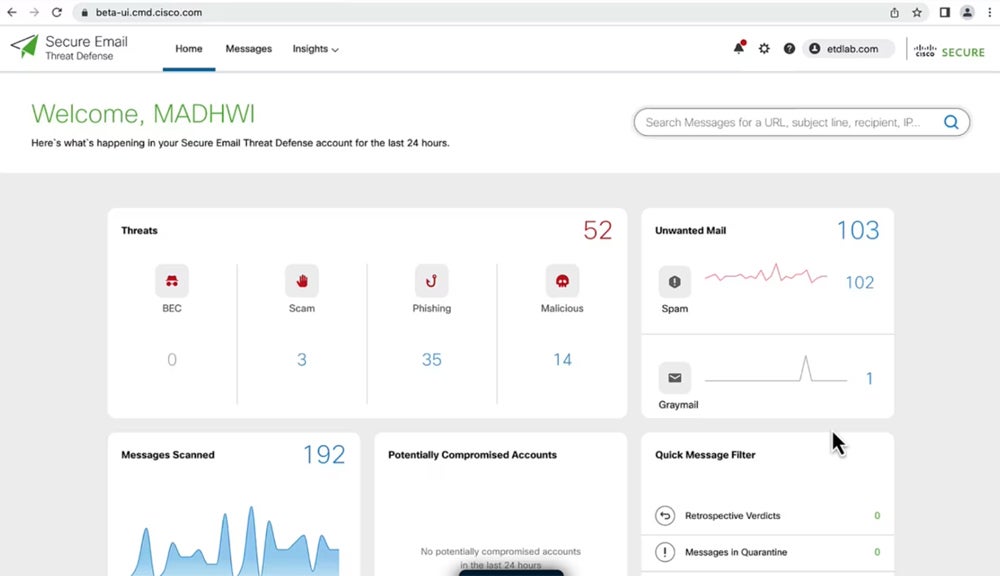
Cisco Secure Email provides flexible deployment options for organizations with diverse IT environments. With cloud, virtual, on-premises, and hybrid deployment options, Cisco can accommodate businesses that need to maintain existing infrastructure while strengthening their email security. This flexibility can make it particularly useful for MSPs managing clients with different IT environments.
Features
- Integrated incident response: Use automated incident response capabilities to help investigate and remediate email threats more efficiently.
- Global threat intelligence: Use extensive threat intelligence to identify and help block known and emerging email threats.
- Advanced malware protection: Use comprehensive defenses against malware, ransomware, and emerging threats to secure your customers.
- Email encryption: Secure your users’ email communications end-to-end and safeguard data in transit and at rest.
Pricing
Cisco does not publicly list standard pricing for Secure Email, so organizations need to contact the provider for a customized quote. Trial availability may vary by product and deployment.
| Pros | Cons |
|---|---|
| Extensive deployment and integration options | Complex setup for some |
| Vast threat protection | May require technical expertise to configure and manage |
| Supports cloud, on-premises, and hybrid environments | Pricing is not publicly listed |
Trend Micro

Trend Micro Email Security stands out for its advanced threat protection, including defenses against business email compromise, ransomware, phishing, and sophisticated targeted attacks. It combines threat intelligence and detection technologies to help identify malicious messages, files, and links before they reach users. Other capabilities include file password extraction and document exploit protection.
Features
- Continuous updates: Stay ahead of emerging threats with up-to-date security measures that handle challenges as they arise.
- BEC protection: Shield your customers from Business Email Compromise by using Trend Micro’s targeted defense mechanisms.
- Ransomware defense: Fortify user email systems against ransomware attacks to ensure data integrity and accessibility.
- Spam and phishing prevention: Intercept spam and sophisticated phishing attempts before they compromise your inboxes.

Pricing
Trend Micro does not publicly disclose standard pricing, but it does offer a 30-day free trial for its services.
| Pros | Cons |
|---|---|
| Wide roster of advanced features | Opaque pricing |
| Scalable to organizational needs | Some advanced capabilities may require additional licensing |
| Highly compatible solution | Configuration may require IT expertise |
Mimecast: Best for comprehensive email security

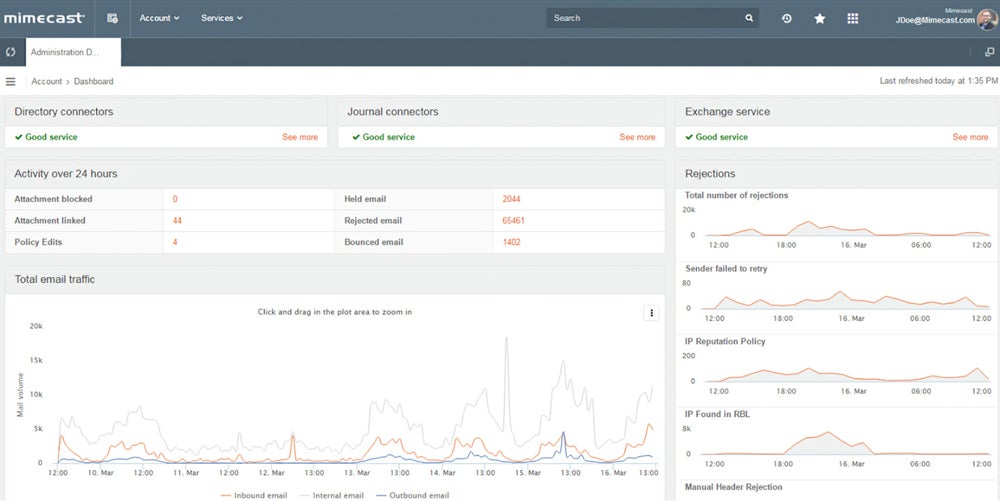
Mimecast provides comprehensive, cloud-based email security designed to protect organizations against spam, malware, phishing, social engineering, and other email-based threats. Its platform combines secure email gateway protection with capabilities such as data loss prevention, email continuity, and advanced threat detection, making it a broad option for MSPs managing diverse client environments.
Features
- Email continuity: Ensure your teams and customers have uninterrupted email services, even during outages or cyber attacks, using continuity solutions.way that fortifies email ecosystems against all kinds of cyber threats. As an advanced, cloud-based protection solution, Mimecast is adept at guarding against spam, viruses, malware, and more. It takes an all-rounded approach to email security with aspects such as social engineering defense, risk protection, browser isolation and dynamic bannering to ensure that MSPs’ email gateways are protected on all sides.
- Secure email gateway: Enhance your customers’ email security posture with gateway protection to prevent unwanted and harmful emails.
- Phishing defense: Utilize advanced algorithms to detect and neutralize phishing attempts on your users and safeguard sensitive information.
- Data loss prevention: Implement DLP capabilities to prevent breaches of your users’ communications and ensure regulatory compliance.
Pricing
Mimecast pricing varies by product, package, and client requirements. Contact Mimecast for current pricing and customized quotes. Trial or demo availability may vary by product.
| Pros | Cons |
|---|---|
| Advanced email gateway security | Complexity in configuration for some setups |
| Effective spam and malware blocking | Limited support hours outside business times |
| Strong AI and ML capabilities | Customization options can be overwhelming |
Proofpoint: Best for BEC and targeted attacks

Proofpoint excels in leveraging artificial intelligence (AI) and machine learning (ML) technologies to combat business email compromise (BEC) attacks. Its BEC Defense uses NexusAI to analyze email attributes, including message headers, sender IP addresses, content, urgency cues, and suspicious phrases. It goes beyond traditional payload detection to identify subtle BEC threats through behavioral and contextual analysis.
Features
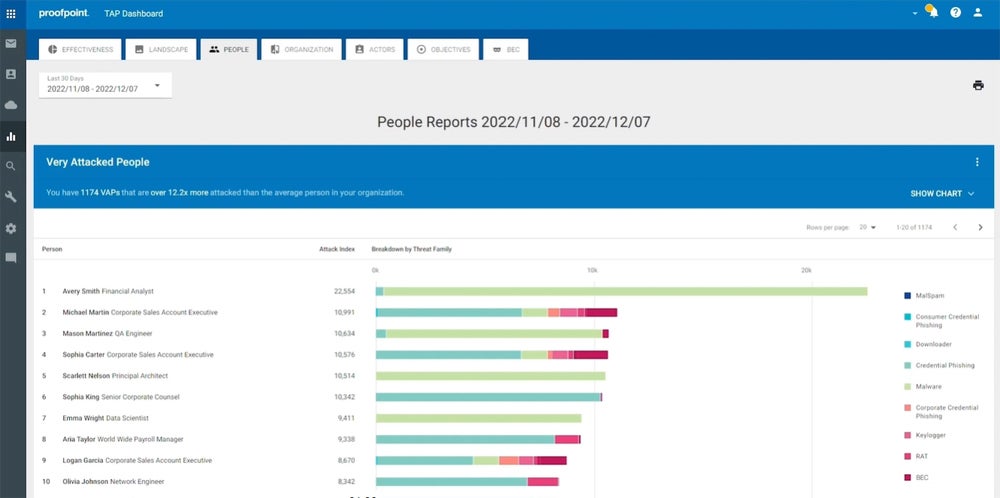
- Targeted attack protection (TAP): Implement TAP to give clients layered defenses against advanced threats targeting their email communications.
- Behavioral engine: Deploy an advanced engine to analyze language, relationships, cadence, and context for detecting and preventing threats using AI/ML.
- Advanced BEC defense: Utilize sophisticated defenses against business email compromise (BEC) attacks and use machine learning to identify and block these threats.
- Email fraud defense: Protect your users against email fraud with advanced analysis and verification to prevent impersonation and phishing.
Pricing
Contact Proofpoint for detailed pricing since that information isn’t publicly available. Trial and demo availability may vary by product.
| Pros | Cons |
|---|---|
| Advanced AI/ML threat detection | Pricing is opaque |
| Extensive behavioral analysis engine | May need technical expertise for optimization |
| Strong protection against BEC and targeted attacks | Customer support has room for improvement |
How we evaluated the best email security solutions for MSPs
We evaluated email security software based on the capabilities and purchasing considerations most relevant to MSPs protecting multiple client environments.
Our evaluation focused on core email security features, threat detection and prevention, compatibility and integrations, ease of use, pricing, customer support, and suitability for managing multiple clients.
Product information was gathered from vendor product pages, documentation, pricing pages, and other publicly available materials. Because pricing and available features can vary by deployment, licensing, and client requirements, MSPs should assess their specific needs and request customized pricing where necessary.
What should MSPs look for in an email security platform?
Email security providers can offer a wide range of capabilities to help protect organizations from spam, phishing, malware, data loss, and other email-based threats. While the specific features available vary by provider, MSPs should look for solutions that offer a strong combination of threat prevention, email protection, and post-delivery remediation.
Spam quarantine
Spam quarantine functions as a secure holding area, isolating emails suspected of being spam away from users’ primary inboxes. This feature helps maintain clean, manageable inboxes and prevents users from inadvertently interacting with potentially harmful content.
Whitelisting and blacklisting
Whitelisting and blacklisting allow MSPs to control which emails are permitted or blocked. Whitelisting ensures messages from trusted sources can bypass certain security checks when appropriate, while blacklisting blocks known malicious senders, domains, or IP addresses to help reduce phishing, spam, and malware risks. Modern solutions may supplement these lists with threat intelligence and reputation-based filtering to avoid relying solely on manually maintained rules.
Content disarm and reconstruction (CDR)
CDR is a security mechanism that scans potentially risky files, removes active or malicious elements, and reconstructs them into a safer version for delivery. This can help defend against malware, ransomware, and other threats hidden within email attachments, including previously unknown or evasive threats.
Clawback
The clawback feature allows administrators to retract or quarantine an email after delivery if it is later identified as malicious. This is crucial for mitigating phishing, malware, and business email compromise (BEC) attacks that bypass initial security checks. It provides a safety net that allows administrators to remove threats from users’ inboxes before they can cause further damage.
Data encryption
Data encryption in email security helps keep sensitive information confidential and protected from unauthorized access. This is important for meeting data protection and industry-specific requirements while maintaining the privacy of business communications. Depending on the solution, encryption can protect email content in transit or at rest and may support standards and protocols such as TLS and S/MIME.
Fraud detection
Fraud detection uses techniques such as machine learning, behavioral analysis, threat intelligence, and email authentication checks to identify suspicious messages. This can include detecting spoofing attempts, phishing, business email compromise (BEC), impersonation, and unusual communication patterns. Modern email security platforms increasingly combine these capabilities to identify threats that may not contain traditional malware or other obvious indicators of compromise.
Sandboxing
Sandboxing isolates and executes potentially dangerous attachments, files, or URLs in a controlled environment separate from the user’s device and network. This allows an email security system to analyze the behavior of a file or link before it reaches the user. If the analysis identifies malicious activity, the content can be blocked or quarantined, helping prevent malware and ransomware from reaching the endpoint.
Bottom line: Choose an email security provider that fits your clients’ needs
The best email security provider will go beyond basic threat and breach prevention to offer comprehensive protection against phishing, malware, business email compromise (BEC), and other evolving email threats, while integrating smoothly with your clients’ existing environments and providing reliable support.
For MSPs, it’s also important to consider how easily a solution can scale across multiple client environments and fit into your existing security stack.
When choosing a provider, take advantage of free trials to determine whether a shortlisted solution meets your needs in practice. Where free trials aren’t available, you can sign up for a free demo to evaluate the platform’s features, integrations, and ease of use before committing.
Frequently asked questions (FAQs)
What is the best email security software for MSPs?
Check Point Email Security is our best overall email security solution for MSPs in 2026 because it combines AI-powered phishing protection, malware and malicious URL detection, anomaly detection, DLP, encryption, and account takeover protection. It also integrates with Microsoft 365, Gmail, Teams, OneDrive, SharePoint, Slack, and other collaboration platforms.
The best platform will still depend on your client base. Barracuda is a strong option for MSPs that prioritize email continuity, while Proofpoint stands out for protection against business email compromise and targeted attacks.
What features should MSPs look for in email security software?
MSPs should look for a combination of threat prevention, phishing and BEC protection, malware detection, malicious URL analysis, sandboxing, post-delivery remediation, DLP, and encryption. Multi-client scalability, broad compatibility, centralized administration, and integrations with common business email platforms are also important when managing security across multiple customer environments.
What is email clawback, and why does it matter for MSPs?
Email clawback allows administrators to retract or quarantine a message after it has been delivered if it is later identified as malicious. This gives MSPs an additional layer of protection against phishing, malware, and business email compromise attacks that evade initial security checks.
How much does email security software for MSPs cost?
Pricing varies significantly by vendor, licensing model, deployment, number of users, and required features. Many of the providers in this guide do not publish standard pricing and instead offer customized quotes. Barracuda Email Protection is the exception in this comparison, with pricing starting at $5 per user per month at MSRP, although actual pricing can vary by plan, contract term, and user count.
Which email security solution is best for business email compromise?
Proofpoint is our pick for MSPs primarily concerned with business email compromise and targeted attacks. Its BEC Defense uses AI and machine learning to analyze message headers, sender information, content, urgency cues, relationships, and other behavioral signals to identify threats that may not contain obvious malicious payloads.
Why do MSPs need email security beyond basic spam filtering?
Modern email threats go well beyond traditional spam. Phishing, impersonation, BEC, ransomware, malicious attachments, account takeover attempts, and fraudulent messages often require behavioral analysis, threat intelligence, sandboxing, URL inspection, and post-delivery remediation. Modern email security platforms combine these controls to detect threats that may not contain traditional malware or obvious indicators of compromise.
This article was originally published by Collins Ayuya in 2024 and updated by Luis Millares in September 2026.