











A group of former Thirdera executives has launched Naitiv, a new ServiceNow-focused consultancy designed to help enterprises operationalize AI, starting with the insurance sector.
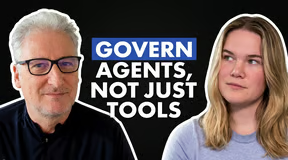
We spoke with Naitiv CEO Jon Reynolds and Managing Partner Bill Devine about the launch and why the consultancy is committed to the ServiceNow platform as it scales support.
Naitiv launches AI-native ServiceNow consultancy
Reynolds has a long career history in the ServiceNow ecosystem, including at Cloud Sherpas. Following its acquisition by Accenture in 2015, Reynolds joined the Accenture team to build its dedicated ServiceNow practice operations, scaling that business before leaving to build Thirdera.
Thirdera was then acquired by Cognizant, and Reynolds embarked on a similar journey. Now, he’s ready to address what he sees as lingering gaps in the ability of organizations to leverage the full potential of ServiceNow’s platform.
At launch, Naitiv is also expanding through acquisitions, bringing in ServiceNow partners Cloudworks and Inspira Systems. The deals add additional leadership, including Matt Farahmand and Emma Vafi, both experienced founders in the ServiceNow partner ecosystem.
They join the following leaders in rounding out the executive team at launch:
- Bill Devine, Managing Partner – Insurance, served nearly 20 years as a Senior Vice President for Travelers Insurance, leading product, strategy, digital transformation, and enterprise delivery.
- Chris Damon, COO, served as Senior Vice President of Global Sales and Offerings at Thirdera
- David Cadoff, SVP of Sales, served as AMS Sales Lead for the Banking, Financial Services, and Insurance industries at Thirdera
“Part of what makes us so special is that our team is full of people with deep expertise in this ecosystem,” Reynolds said. “We often joke that we’ve been around for so many releases that our first few weren’t yet named after cities.”
Naitiv targets insurance sector for AI transformation
Naitiv is initially targeting the property and casualty (P&C) insurance sector, where modernization efforts are often constrained by legacy systems, fragmented workflows, and regulatory complexity.
Devine has deep expertise in how businesses in the sector approach technology investments and why those projects often fall short. In his 18 years at Traveler’s he worked with service partners like Reynolds to tackle technology adoption challenges.
“Having been on the inside at organizations, I know firsthand how frustrating it is sometimes. The rate of change in technology outside of insurance is often much faster than the rate of change inside these firms,” Devine said.
To Reynolds, the market opportunity ahead for partners like Naitiv, who can marry deep experience in the ServiceNow ecosystem with the technical expertise needed to understand AI use cases in vertical-specific workloads, is vast.
Why insurers need partners to operationalize AI
The firm’s approach centers on using ServiceNow as an orchestration layer to connect core systems, data, and workflows.
The strategy reflects a broader market challenge: while AI adoption is accelerating, many insurers lack the infrastructure and governance needed to deploy it at scale.
“Something like 95 percent of all insurance carriers are already using ServiceNow in at least some of their workflows,” Devine said.
“The problem we’re trying to address actually isn’t a technology issue. It’s in whether workflows are documented and data is AI-ready, and a lot of insurance work can be very bespoke and based in the minds of one or two people,” he continued, noting that bringing workloads into AI-enabled platforms such as ServiceNow requires technical expertise in the tooling as well as data and change management guidance on the human side of the business.
Why Naitiv is betting on ServiceNow as the AI control layer
Rather than relying on point solutions, Naitiv is positioning ServiceNow as the control layer for enterprise operations, enabling unified workflows, governed decision-making, and operational visibility.
Industry stakeholders say this approach is gaining traction as organizations look to bridge the gap between AI experimentation and production deployment.
Devine told Channel Insider he’s seen many examples of AI investments not realizing a return on value in the sector because teams were not properly equipped to move projects from pilot to full-scale implementation.
Nigel Walsh, global head of insurance at ServiceNow, noted that combining technical delivery with deep industry expertise is critical to achieving meaningful transformation.
“There’s no shortage of conversation around AI in insurance right now — but making it work in practice and at scale is where most organisations start to feel the friction,” Walsh said in a statement. “Combining technology and delivery experience with deep industry understanding is where the real step change happens. That’s where partners like Naitiv come in.”
Read more: We spoke with Sankha Nagchoudhury, SVP of digital business services and experiences at ServiceNow, about the platform and the company’s roadmap towards AI deployment in November 2025.
Advisory-led model focuses on measurable AI outcomes
Naitiv’s go-to-market model emphasizes advisory-led engagements to identify high-value, repeatable use cases before deploying modular workflows.
The goal is to deliver measurable business outcomes while building toward broader operational control frameworks.
“We’re not new to this ecosystem, and we are purpose-built to the insurance sector,” Reynolds said. “We’re focusing more on the ‘micro moments,’ where maybe the action that’s being automated is smaller, but it’s being performed thousands of times a day and there’s better use of the time.”
“The aim here is to come in with one or two use cases and then expand throughout the business over time,” he added.
The launch reflects a broader shift in the ServiceNow partner ecosystem, where consultancies are increasingly aligning around AI-native delivery models and vertical specialization.
For Naitiv, the strategy hinges on combining platform expertise with industry-specific knowledge to help enterprises turn AI investments into operational results.
“Nothing we’re talking about individually is all that crazy, honestly, but the way we’re tying it all together and bringing it to this vertical is pretty disruptive,” Devine said.