














Managed detection and response services give organizations access to 24/7 threat monitoring, investigation, and incident response without requiring them to build a complete security operations center. They combine security technology, automation, and human expertise to help organizations identify and contain threats more efficiently.
We evaluated five leading MDR providers for 2026 based on threat coverage, response capabilities, integrations, service flexibility, pricing transparency, and suitability for MSPs and internal security teams.
- Top MDR services comparison
- What is Managed Detection and Response (MDR)?
- SentinelOne: Best overall
- Sophos: Best for advanced features
- CrowdStrike Falcon Complete: Best for automated threat containment and remediation
- Trend Micro: Best for automated and compatible MDR
- Arctic Wolf: Best for personalized threat intelligence
- How to choose MDR providers
- Methodology
- Bottom line: Choosing the right MDR service
- Frequently asked questions (FAQs)
Top MDR services comparison
Here’s how the top MDR providers compare based on pricing availability, threat hunting, response capabilities, and security coverage.
| MDR provider | Best for | MDR pricing | Threat hunting | Incident response and remediation | Primary coverage |
|---|---|---|---|---|---|
| SentinelOne Wayfinder MDR | Best overall | Custom quote | Yes | Managed containment based on the customer’s response policy | Endpoints and cloud; MDR Elite adds identity and supported third-party sources |
| Sophos MDR | Best for advanced features | Custom quote | Yes | Containment and remediation; full-scale incident response with MDR Complete | Sophos and supported third-party security environments |
| CrowdStrike Falcon Complete | Best for automated threat containment and remediation | Custom quote | Yes | Automated containment and full-cycle remediation | Endpoints, identities, cloud workloads, and third-party security data |
| Trend Micro | Best for automated and compatible MDR | Custom quote | Yes | Direct response, containment, cleanup tools, and remediation guidance | Email, endpoints, servers, cloud workloads, and networks |
| Arctic Wolf | Best for personalized threat intelligence | Custom quote | Yes | Active Response, security investigations, and guided remediation | Networks, endpoints, cloud environments, and ingested security telemetry |
What is Managed Detection and Response (MDR)?
Managed detection and response is an outsourced security service that combines technology with human expertise to detect, investigate, and respond to cyber threats. MDR providers typically monitor customer environments around the clock, hunt for hidden threats, investigate suspicious activity, and either perform or recommend response actions.
For MSPs and MSSPs, MDR can extend 24/7 security coverage to customers without requiring the provider to build a complete security operations center. When evaluating services, partners should consider multitenant management, customer data separation, partner pricing, response authority, escalation procedures, and ownership of the customer relationship.
Unlike EDR or XDR products that generate alerts for a security team to investigate, MDR includes analysts who help determine which alerts represent genuine threats and what should happen next. Depending on the service agreement, the provider may notify the customer, isolate affected systems, terminate malicious processes, or assist with remediation.
MDR vs EDR vs XDR
EDR and XDR are security technologies, while MDR is a managed service. An MDR provider may use EDR or XDR technology to deliver its service, but purchasing one of those platforms does not necessarily provide continuous analyst monitoring or managed response.
| Category | EDR | XDR | MDR |
|---|---|---|---|
| Category | EDR | XDR | MDR |
| What it is | Endpoint security technology | Cross-domain detection and response technology | Managed security service |
| Primary coverage | Endpoints | Multiple security domains | Depends on the provider and connected technologies |
| Human analysts included | Not inherently | Not inherently | Yes |
| Threat hunting | Conducted by the customer unless separately managed | Conducted by the customer unless separately managed | Typically provided by the MDR team |
| Response responsibility | Customer | Customer | Provider-led, collaborative, or customer-led |
| Best suited for | Teams primarily concerned with endpoint threats | Teams seeking broader security-data correlation | Organizations needing ongoing monitoring and security expertise |
Organizations with established security teams may use EDR or XDR directly and manage investigations internally. Companies that need around-the-clock coverage, analyst expertise, or assistance responding to incidents may benefit more from MDR.
SentinelOne: Best overall

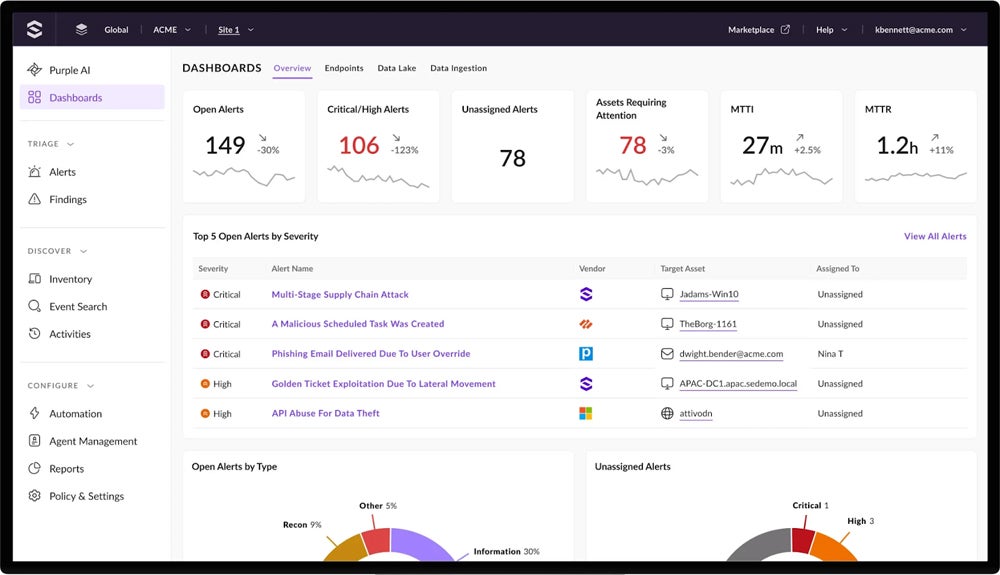
SentinelOne Wayfinder MDR combines 24/7 monitoring and analyst-led investigations with the automated detection and response capabilities of the Singularity platform. Its analysts investigate alerts, validate threats, and initiate containment actions according to each customer’s configured response policy.
Features
- 24/7 managed monitoring: Certified analysts continuously triage and investigate security alerts.
- Managed response and mitigation: Confirmed threats can be contained according to the customer’s configured response policy.
- Endpoint and cloud coverage: MDR Essentials provides core detection coverage across endpoints and cloud environments.
- Expanded MDR coverage: MDR Elite adds identity monitoring and supported third-party integrations.
- Threat hunting: Analysts conduct behavioral and intelligence-led hunts using customer telemetry.
Pricing
SentinelOne does not publicly list standalone pricing for Wayfinder MDR Essentials or MDR Elite. Organizations must contact SentinelOne or an authorized partner for a customized MDR quote.
The underlying Singularity platform has the following public annual prices for deployments of 5 to 100 workstations:
- Singularity Core: $69.99 per endpoint
- Singularity Complete: $179.99 per endpoint
- Singularity Commercial: $229.99 per endpoint
- Singularity Enterprise: Custom pricing
| Pros | Cons |
|---|---|
| AI-driven threat detection reduces false positives | No free trial |
| Comprehensive 24/7 monitoring | Limited support for smaller teams |
| Strong forensic capabilities for incident response | Setup can be complex for new users |
| Public pricing available for Singularity packages | Limited customization in lower-tier plans |
MSP and partner fit
SentinelOne supports MSSPs through its PartnerOne program and an API-first, multitenant platform for managing security across multiple customers. The company advertises consumption-based billing, sales support, and technical training. MSPs considering Wayfinder MDR should confirm how service tiers, response responsibilities, branding options, and customer ownership apply to their agreement.
Who should use SentinelOne?
SentinelOne is best for midsize and large organizations seeking an MDR service that combines analyst oversight with fast, automated containment. It is particularly suitable for existing Singularity customers and companies looking to consolidate endpoint, cloud, identity, and supported third-party security data.
Sophos: Best for advanced features

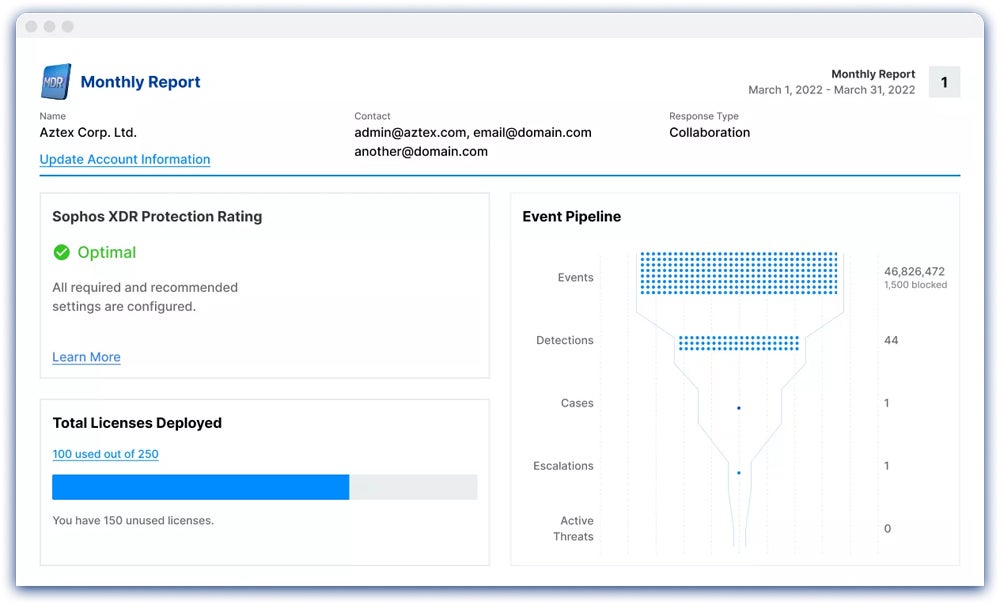
Sophos Managed Detection and Response (MDR) stands out for its wide array of advanced features. It offers 24/7 managed detection and response, with full-scale incident response available through Sophos MDR Complete.
The service includes 24/7 expert-led threat hunting and managed response, while MDR Complete adds full-scale incident response. These capabilities help organizations investigate and respond to sophisticated threats in real time. Advanced capabilities, such as root cause analysis and tailored reports on security posture, also help organizations stay ahead of rapidly evolving threats.
Features
- 24/7 threat detection and response: Provide continuous monitoring and immediate response actions for detected threats, reducing the need for manual intervention.
- Expert-led threat hunting: Leverage a team of experts for human-led threat hunting to proactively seek out advanced cyber threats.
- Customizable service levels: Tailor the MDR service to match your organization’s specific needs, from fully outsourced to co-managed services.
- Incident response: MDR Complete provides full-scale incident response, including threat containment and elimination, a dedicated incident response lead, and root-cause investigation.
Pricing
Sophos does not publish standard MDR pricing. Organizations can request a customized proposal based on their number of users, service tier, deployment, and required integrations.
| Pros | Cons |
|---|---|
| Advanced threat hunting and incident response capabilities | Pricing isn’t readily listed on their pages |
| Seamless integration with existing security tools | Some smaller organizations may find it overkill |
| 24/7 SOC support with detailed reports | Initial setup can be complex for small teams |
| High ratings for customer support and threat intelligence | Admin portal can be a challenge to navigate |
MSP and partner fit
Sophos offers MDR through its MSP programs, with Sophos Central supporting centralized customer management and MSP Flex providing monthly billing. MSP Elevate adds preferred pricing, rebates, priority support, training resources, and an MDR bundle.
Who should use Sophos?
Sophos MDR is best for medium to large enterprises that need advanced managed security solutions. Companies with existing cybersecurity tools looking for a managed service to complement their in-house IT teams will benefit the most from this service.
CrowdStrike Falcon Complete: Best for automated threat containment and remediation

CrowdStrike Falcon Complete combines the Falcon platform with 24/7 monitoring, managed threat hunting, investigation, containment, and remediation. Its analysts can isolate affected endpoints, remove malicious activity, eliminate persistence mechanisms, and help restore systems to a known-good state.
Falcon Complete stands out for combining automated response and adaptive AI agents with human oversight. It can also extend detection and response across endpoints, identities, cloud workloads, and third-party security data through the broader Falcon platform and Falcon Next-Gen SIEM.
Features
- 24/7 managed protection: CrowdStrike analysts continuously investigate security activity across connected Falcon environments.
- Managed threat hunting: Security specialists proactively search for adversary activity that may evade automated detection.
- Automated containment: Response playbooks can isolate affected systems and execute predefined actions.
- Full-cycle remediation: The Falcon Complete team can remove malicious artifacts, eliminate persistence, and restore affected systems.
- Human-supervised AI: AI agents support investigation and response while analysts validate critical decisions and remediation actions.

Pricing
CrowdStrike does not publish standard pricing for Falcon Complete. Organizations must contact CrowdStrike or an authorized partner for a quote based on their number of endpoints, required platform modules, service coverage, and contract terms.
| Pros | Cons |
|---|---|
| Responsive support with multiple tiers | Opaque pricing |
| Intuitive, user-friendly interface | Falcon Complete has a number of add-ons |
| AI-powered threat detection | No free trial for Falcon Complete |
| Comprehensive technical assistance | Firewall management requires a separate Falcon module |
MSP and partner fit
CrowdStrike offers Falcon Complete for Service Providers to help partners deliver 24/7 MDR without building their own security operations infrastructure. CrowdStrike says partners retain ownership of customer relationships and can use its brand or offer the service under their own. Prospective partners should confirm licensing, minimum commitments, escalation workflows, and management capabilities.
Who should use CrowdStrike?
CrowdStrike is best for midsize and large organizations seeking an MDR provider capable of taking direct containment and remediation actions.
Trend Micro: Best for automated and compatible MDR

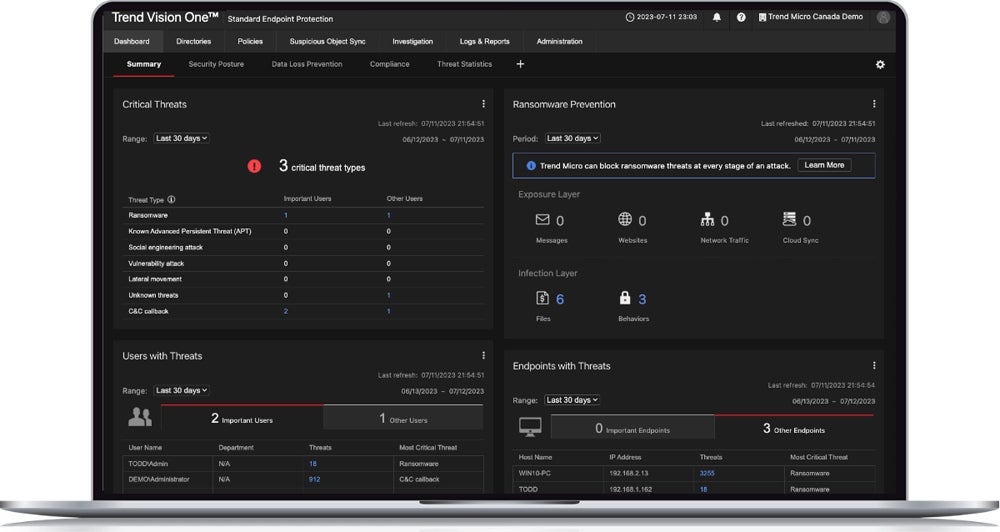
Trend Micro’s XDR (Extended Detection and Response) stands out through its AI-powered threat detection and automation that delivers real-time protection across multiple endpoints.
The solution also enables seamless deployment across various environments, as it integrates well with existing security tools, whether in the cloud or on-premises. Trend Micro’s XDR leverages automation to reduce manual workloads, improving response times and threat-hunting capabilities.
It also has an extensive roster of advanced features, qualifying it as an all-in-one MDR solution in addition to the XDR capabilities it is named for.
Features
- AI-driven automation: Deliver automated responses to detected threats, significantly reducing manual intervention.
- Cross-environment compatibility: Integrate effortlessly with both cloud and on-premises infrastructure for centralized security management.
- Automated data correlation: Enable a unified view of threats by correlating data across multiple threat vectors, improving overall visibility.
- Threat detection across endpoints: Provides continuous monitoring and protection for multiple endpoints, from servers to mobile devices.
Pricing
Trend Micro does not publish standard pricing for its MDR service. Prospective customers must contact the company for a customized quote.
| Pros | Cons |
|---|---|
| Strong AI and automation capabilities | Lacks transparent pricing |
| High compatibility across environments | Customer support needs improvement |
| Advanced threat detection features | Can be complex to configure |
| Seamless integration with security tools | Can have a steep learning curve |
MSP and partner fit
The Trend Partner Program supports resellers, service providers, and partners building managed security and SOC services around Trend Vision One. Its four tiers provide financial, sales, marketing, support, and enablement benefits, while Trend Campus offers structured training. MSPs should confirm multitenant capabilities, licensing, response responsibilities, and the managed services available for their region and program tier.
Who should use Trend Micro?
Trend Micro is best for organizations with diverse environments that need robust AI-powered automation. With its seamless integration capabilities and a long list of advanced features, anyone who wants advanced threat detection tools without managing complex security stacks should consider Trend Micro.
Arctic Wolf: Best for personalized threat intelligence

Arctic Wolf is an MDR service with a heavy emphasis on personalized threat intelligence. This makes it quite attractive to organizations in the market for tailored security solutions.
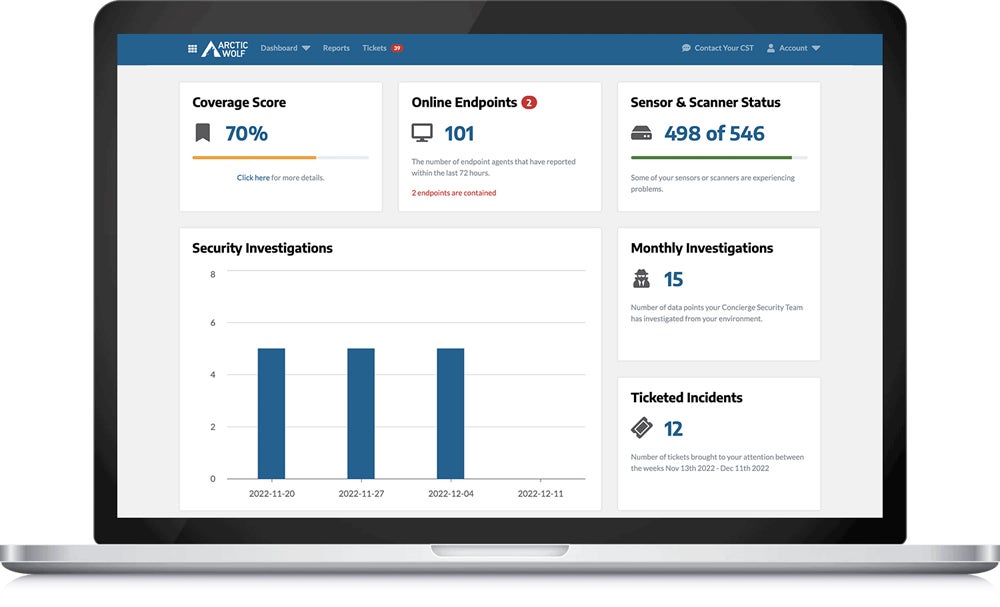
The service includes a variety of engineers, like deployment, triage, and incident engineers, but the standout is its Concierge Security Team, made up of concierge service engineers who provide hands-on support and continuous security improvement recommendations.
This team works closely with clients to reduce false positives, enhance detection efficiency, and streamline incident response.
Features
- Personalized engagement: Offer your users regular reviews of their security posture with guidance tailored to their environments.
- Log retention and search: Automate log management, enabling efficient searches and additional investigations as needed.
- Guided remediation: Collaborate with Arctic Wolf on validation of threat neutralization and ensure threats haven’t returned through collaborative detection, response, and remediation.
- Root cause analysis: Deliver deep investigations into the root causes of incidents and promote the development of customized rules and workflows.
Pricing
Contact Arctic Wolf for pricing information, as they don’t share it upfront.
| Pros | Cons |
|---|---|
| Dedicated Concierge Security Team | No upfront pricing |
| Strong focus on personalized threat intelligence | Limited transparency on pricing tiers |
| Continuous monitoring and threat-hunting | Compatibility and response support vary by integration |
| Proactive threat hunting and response recommendations | May require additional in-house resources for complex deployments |
MSP and partner fit
Arctic Wolf operates through a 100% channel go-to-market model, with its portfolio offered exclusively through partners. Its program provides training through Arctic Wolf Academy, co-brandable materials, demand-generation support, enablement tools, and sales and technical assistance.
Who should use Arctic Wolf?
Organizations that need a more hands-on approach to threat detection and response, particularly those seeking a dedicated team to help with ongoing monitoring, hunting, and personalized recommendations.
How to choose MDR providers
Selecting an MDR provider involves more than comparing feature lists. Before requesting a quote, determine what the service monitors, which actions its analysts can perform, and which responsibilities remain with your internal team.
Key considerations include:
- Security coverage: Determine whether the service monitors endpoints, identities, email systems, networks, servers, cloud workloads, and third-party security data.
- Response authority: Confirm which containment actions analysts can perform, whether they require approval, and what happens when your team cannot be reached.
- Incident response scope: Check whether remediation, digital forensics, and full-scale incident response are included, limited to certain tiers, or priced separately.
- Technology requirements and integrations: Determine whether the service requires the provider’s security platform or supports your existing EDR, SIEM, firewall, identity, cloud, and other tools.
- Service model and response targets: Compare fully managed, co-managed, and notification-only options, along with commitments for triage, notification, and initial response.
- MSP capabilities: MSPs and MSSPs should prioritize multi-tenant management, customer data separation, centralized reporting, partner pricing, and repeatable onboarding.
- Pricing and contract terms: Compare endpoint or user minimums, onboarding fees, integration costs, data-retention limits, add-ons, and contract lengths.
Methodology
We evaluated five MDR providers based on the capabilities and purchasing considerations most relevant to organizations seeking around-the-clock security monitoring and response.
Our evaluation focused on detection and response capabilities, security coverage, integrations, service flexibility, pricing transparency, and suitability for MSPs and internal security teams.
Product information was gathered from vendor product pages, documentation, pricing pages, and other publicly available materials. Because MDR pricing commonly depends on deployment size, selected coverage, and contract terms, organizations should request customized quotes before making a final decision.
Bottom line: Choosing the right MDR service
The best MDR service depends on the security tools an organization already uses, the environments it needs to monitor, and how much response authority it is willing to give an outside provider.
Before choosing a provider, organizations should compare more than detection features. Response authority, incident-response coverage, integration costs, data retention, and the division of responsibilities between the provider and customer can significantly affect the service’s overall value.
MDR does not eliminate the need for internal security ownership. Organizations still need personnel who can work with the provider, approve major response decisions, address underlying vulnerabilities, and coordinate business recovery after an incident.
However, MDR can provide monitoring and expertise that would otherwise require significant time and resources to build internally.
Frequently asked questions (FAQs)
What is MDR in simple words?
Managed detection and response is a service in which security analysts monitor an organization’s systems, investigate suspicious activity, and help respond to confirmed threats. It gives organizations access to continuous security operations without requiring them to staff an entire 24/7 SOC internally.
What is the difference between MDR and EDR?
EDR is security technology used to detect, investigate, and respond to threats on endpoints such as computers and servers. MDR is a managed service delivered by security analysts.
Meanwhile, MDR providers often use EDR technology, but they may also monitor identities, cloud workloads, networks, email systems, and other security sources.
How do MDR services benefit small businesses?
MDR services provide small businesses with access to enterprise-grade security without needing to build an in-house security operations center (SOC). These services offer 24/7 monitoring, threat detection, and incident response managed by expert analysts. This helps small businesses stay protected from sophisticated cyber threats without hiring dedicated security personnel.
Can MDR services integrate with my existing security tools?
Yes, many MDR services can integrate with supported SIEM platforms, firewalls, endpoint security products, identity tools, and cloud services. Compatibility varies by provider, and some integrations require additional licenses or fees.
This article was originally published by Collins Ayuya in 2024 and updated by Luis Millares in July 2026.