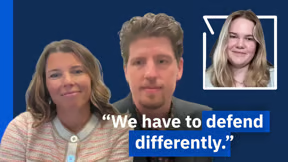
>> AI adoption can't happen in a vacuum. Enterprises don't just need the AI tooling itself to make the value worth the input. They need help with security, governance, data readiness, and the people-driven change management that are making these AI pilot programs actually turn into real production value. To talk about where the market stands and how partners are helping, I'm joined in this interview by Rima Safri. She's a PwC partner and the US data, AI, and analytics practice lead at PwC.
We dive into their relationship with OpenAI in particular, and alliance strategy more broadly speaking, and talk about what enterprise clients need from a partner like PwC to turn AI concepts into real production value. Thank you, as always, for watching, and I hope you enjoy the interview. Well, Rima, [snorts] thank you so much again for taking some time and joining me today. >> Thank you for having me, Victoria. I'm looking forward to having this conversation. >> Absolutely.
Let's kick off maybe with a conversation around what you're seeing in the AI adoption market, right? When you work with PwC customers, with businesses, what are you seeing in terms of things that are working well as these businesses implement and adopt AI solutions, and what are some of those challenges or pain points you think they're still coming up against? >> Absolutely. So, Victoria, just to start with, right? I'm seeing a major shift, especially this year, where the conversation is moving from most organizations using AI as a co-pilot to completely saying, "Hey, how does my enterprise operate leveraging AI embedded into every part of the workflow and every part of the business?" So, shifting towards deploying more enterprise-ready agent AI solutions that deliver measurable business value across every function of the organization.
And here, most of the times what we have seen is earlier the conversation was more about chat, right? How do I get my right prompt? How do I get the context right from for the prompt? Which model should I use because model choice is becoming increasingly important, too. But now, as I have more and more conversations with our client stakeholders, it's going from that to what is preventing us from scaling? How do I make sure my model is right, but there's a couple of key considerations here.
First, what about business integration? Because often times we can get a great demo in a controlled environment in a pilot, but when I talk about redesigning an end-to-end workflow, that's a much harder conversation. So, how do I make sure that business is dedicating capacity for it? They see this as something that's going to help them and make their lives better. The second is I would say trust and governance. So, we have to answer the question around security, around privacy, around controls, around how we respond to the regulatory environment as well, especially for the mission-critical workflows.
Like I said, there are a few considerations. Trust is the second one. The third is the data layer because AI has to connect safely to the enterprise data and legacy source systems as well to be able to take action. In this case, now AI is not limited to just making a recommendation. It can take an action on your behalf. So, we want to make sure there's clean quality data that is accessible and the right permissions are set in place for it to access that as well.
And then the last one I would say is people and operating model change. So, if you deploy AI but leave the underlying process, leave the roles, leave the incentives unchanged, you can only capture a fraction of the value, which is why we're seeing a lot more companies focused on what does this mean for my operating model of the future, as well. So, I would say as organizations move from pilots to true enterprise-grade production AI-driven workflows, all four of these considerations become extremely important. >> And to point, as you have these conversations with stakeholders, right, with the internal teams, what does that shift mean for the ways that you approach them in terms of making those decisions, starting to kind of turn those pilots into that production, and and how has that evolved over the past year or so? >> As we have these conversations, one of the things we've been emphasizing is we're moving from AI as a tool people use to AI as part of how the entire enterprise operates.
Whether that is the finance function and looking at how can we leverage agent AI to do revenue forecasting differently, to manage procurement processes differently, right, to do FP&A or investor relations differently, to all the way in customer service, in insurance, if a claimant is making a call to report an accident or to report an injury, how are you going to leverage AI to make that experience a lot smoother, a lot more seamless. So, across every area of the business, we're asking organizations to start with, what is the problem you're trying to solve?
Don't make it just about how do I leverage AI to do things faster, cheaper. Let's start with the business problem at hand first, and then from there, AI just becomes one of the tools in the toolkit to help solve for that problem. >> When you think about the ways that you've watched and seen that conversation evolve over the past two, two and a half years, right? I know in the early days after ChatGPT's initial launch, which feels like a lifetime ago, but it wasn't all that long ago, really, a lot of companies, to your point, were just focused on, okay, how do I use this?
What do I do? The production conversation seems much different, right? So, how has that kind of maturity curve changed over time? Do you see more clients ready to have these conversations than you did maybe this time last year? >> Absolutely. I think this time last year, people were a lot more focused on driving adoption, driving upskilling, all right, but it was very much tied to simpler patterns of leveraging AI. So, think about summarizing a very large regulatory document, right?
Making sure people feel comfortable as they are leveraging AI to draft better notes, better emails, using it in meetings. How do I get people comfortable and be able to trust the data? Now, that's shifting from that to we're helping clients apply AI across their critical business functions and drive workforce productivity and make sure there's measurable business outcomes tied to it. And when I say that, right, one of the things I'll call out is almost 88% of the companies we've spoken to have said, "Hey, we're able to drive time savings, right, leveraging AI for any particular task or even for a particular functional area." Those time savings are not necessarily turning into cost savings.
And how do we do that? Because, you know, you might save 10 minutes a day doing a task leveraging AI, but if you are not turning that into, "Okay, how do I look at this process end to end and do the entire process differently?" So, instead of just leveraging AI in pieces of it to automate it, say it's a 20-step process and you leverage AI in step 7, 10, 15, and you automate those, you're going to get some time savings, but unless you say, "Hey, I'm starting from scratch and saying, what could an AI-native process look like?" you're not going to get the same level of productivity and the measurable business outcomes from it.
In this case, even with Open AI, our relationship has evolved quite a bit. So, as we're working with Open AI on this front in terms of the collaboration, Open AI's advanced AI capabilities paired with PwC's industry expertise is becoming extremely important. Along with that, the trusted and responsible AI approach. So, it's been, you know, the next phase as we work through this partnership has been more about moving from individual productivity to completely reinventing business functions like I talked about.
And what we're building alongside OpenAI is in areas of say finance, cybersecurity, software engineering, and customer service. This latest announcement is one example that takes this further into the front office function where we're saying, "If you were to connect marketing, sales, commerce, and customer service through Agent KI, what would that look like?" So, to me, this signals an important shift in the market. Instead of enterprises asking, "Hey, how do I use How do I give employees an AI assistant to do their work better?" they're completely changing that question to "How do I redesign how work completely gets done?" And the next wave of adoption will be AI embedded directly into those workflows and operating models.
That will also change the roles and how those roles evolve as well. >> We'll come back a little bit to that industry expertise because I do want to touch on it, but let's go into that OpenAI alliance and partnership a bit more in depth. To your point, you've worked PwC and OpenAI have worked together for a while now, but that relationship continues to evolve. How important is it to have an alliance with a company like OpenAI? And and maybe that sounds like an obvious question, but given the the rate and innovation that we're seeing from a tooling perspective, from an adoption perspective, how critical has it been to have a partnership with a company like them? >> I would say it's been extremely important to have a partnership with the company like them.
And if anything, together we are force multipliers to drive the right impact in the market because OpenAI brings their advanced technology and their innovation capabilities. That paired with our industry expertise as well as our domain expertise. So, when I say that, if there was a regional banking conversation, we could bring our experts in that space. If there was a legal and compliance or HR functional conversation, we could bring that expertise as well and knowing Open AI's road map helps us to say that, you know what, here's how you could transform this area of the business and here's what's coming next that you can expect as well so that you're prepared in advance of it.
So that relationship to me is a force multiplier for any impact that we're driving in the market. >> I was actually going to ask how you balance that kind of here's what you should do now versus the future with your customers and you you teed me up pretty well for it. So maybe we'll go there right now, but to your point, right, the AI road map isn't slowing down. It's not like we have all of the AI we're going to have right now for good. So how do you talk to customers about starting to modernize those processes, change those workflows, and then also to your point have an eye to the next 6 months, 1 year, 2 years down the road to get them prepared? >> So to your point, Victoria, it's not slowing down.
If anything, the rate of change that we've seen is like anything else we've seen in history from a technology standpoint. So it's advancing as a at a very fast pace, which is why you need a really modular architecture. Most companies will need to make sure that they have the flexibility as models evolve, they have the flexibility to replace the model itself as well, but everything around it, whether it's the customer experience layer, whether it's the orchestration engine, whether there it's the data layer, they're investing in the right capabilities to evolve that as well.
And data becomes a really important a player here, right? Because AI is only as effective as the data and processes that support it. So organizations must invest in modernizing the customer data, connect it to enterprise systems. They must invest in redesigning workflows to be more AI native and establish the clear governance to unlock the full value of agent AI. Lot of the successful transformations we're seeing in this space require aligning technology investments with broader business objectives.
And here the other conversation we're having is some of the early investment and friction is going to come before you start seeing business value. So we're saying as part of the C-suite discussions, make sure you have a realistic plan. Make sure you have watch list items. So when I say watch list items for example, gone are the days where they are saying, "Hey, let's modernize the entire data estate." Typically, that would take multiple years and multi-million dollars to get there.
Right? Instead, we're saying, "Hey, if you're trying to solve for the customer servicing function or the contact center function, let's make sure the right domains related to the customer, the product are brought in into what we call the semantic layer or the context layer where the agents can access it. And now you can justify the investment tied to it, too. Let's make sure we have the watch areas identified. So if access and permissions is going to be an issue, if anything related to fraud is going to be an issue, let's make sure we identify those watch areas and get ahead of that.
And then also, what are the benefits you're trying to achieve? So when you start with the business problem at hand, is it that your net promoter score is low? Is it that you're trying to reduce fraud? Is it more that you have too many calls being handled by humans and there is no difference in the complexity of calls and there's it's taking a lot of time and there's customer dissatisfaction tied to the longer wait times and you're trying to solve for that?
Whatever the business problem is, make sure you identify the key KPIs that you're solving for. And plan ahead towards that and know how long it's going to take to solve for that as well. And what are the proof points along the way? So let me pause there, right? That's that's a little bit about like making sure your data layer is strong and you're continuing to invest in it as well as that you're starting with a business problem and the KPIs that you want to solve for. >> It's so interesting to hear you say that because I think a lot of the AI conversation, at least colloquially when you talk to peers or you're talking about the market generally up until very recently has felt like board members, CEOs saying, "We're going all in on AI." And then I've talked to many service providers, partners, etc. who go, "They don't really know what they mean when they say that." Right?
There isn't always a plan behind it. Are you sensing more companies becoming aware of the fact that they need stronger planning around their implementation, that they need the guardrails and the governance in place? Or do you think there's still a lot of educating left to do in the market around what it takes to really successfully implement this technology? >> I do think there is more education needed around it. And you know, one of the things we've said is we're operating on two clocks right now.
One is the AI in the technology evolution clock, which is moving extremely fast. Then there's the enterprise adoption clock, which is just not moving fast enough, right? In comparison to it. And the reason is there's a lot of myths around what AI can and cannot do. And the ROI associated with it. And now you're seeing a lot more companies come out and say, "Hey, I'm not seeing as much ROI." And that's not because the technology is not strong enough.
The technology is as strong as it has been, and it's only getting faster and cheaper by the day. It's more because you've tested it one in a controlled environment. When you test it in a controlled environment as part of a pilot, you don't have all the integration set up. You don't have all the data required set up, right? You still have manual interventions. When you now take it to production and you expect it to operate in production, if you haven't set up all of those guardrails, it becomes a big disconnect.
The second is leadership support from the very top in making sure that there's a CEO-level mandate on this. Because otherwise, we're seeing a huge number of chief AI officers being hired, right? Or the data officer and chief AI officer role conversion. Unless there's strong sponsorship and support from the CEO saying, "This is important for us and we're going to think and act differently in this space, it becomes very difficult to for folks to come out of their day-to-day traditional ways of working and their priority is to say, "Hey, how do I do this differently?
You know, I've been doing this the same way for the last 20 plus years. How do I think of it in a more AI native manner?" So, there is an opportunity for more education, but I think the more that we are talking to clients, the more that we're working with our alliance partners as well, we're trying to drive that change. So, for example, in working with OpenAI, right, and working with our alliance partners, we're getting many C-suite members of clients to come outside of their environment and come on site, you know, to the West Coast with one of these alliance partners to say, "Let's step out of your day-to-day world and think about this differently.
And if we were to have a blank slate, how would you do this in an AI native manner?" And it's becoming a lot more important to show rather than tell. So, we're showing them production grade demos of what others are doing in this space to drive that critical thinking and innovation as well. >> I'll ask as we start to wrap up our time here, the the crystal ball question that nobody ever can answer truly, right? But when you think about where the AI market continues to head into your point, it's now not just an AI market, it's a a business transformation conversation that AI is is impacting heavily.
What do you expect to continue to see from your clients, from those stakeholders over the next 6 months into 2027 as this adoption curve continues? >> That's a great question. Um, I would say that earlier in 2024, a lot of the conversation was around put AI in the hands of people. Let them get comfortable with it. Then, the second conversation as we moved into 2025 and even earlier half of this year, right, in 2026, it's been let's start embedding AI into existing workflows.
Let's start integrating it with existing systems as well to see how the workflow can be different. I think where we are moving towards in the future is how do we reinvent an entire organization and even an entire ecosystem with humans plus agents at the center of it. That third phase is where I think the market is going to get really interesting. Because OpenAI's latest enterprise data and models already show the leading edge of going from AI as an assistant to delegation to then actually taking the entire process and running with it, right?
And taking action on base of it. So, I do see that as a big shift where for example, if we look at the insurance sector, right? In the group insurance market. There's the insurance carrier, there's the employee who, you know, submits a claim and is looking for help. There's the employer who says that, "Hey, this employee has been with me for x amount of time, so they're eligible for so much time frame." There's the brokers who help employers find insurance.
So, there's all these in any industry, whether it's you take insurance, whether you take health care, and there's the payer, the provider, there's the pharmaceutical companies, right? There's many different players involved. With agentic AI, we're going to see those ecosystems involve evolve as well in terms of how they're interacting with each other and how they're driving ease of use for customers and more seamless interactions through that process.
AI economics has been a big conversation right now. I think as we look ahead at the future, AI economics will become a first-class CIO discipline. Because we're going from token cost almost being incidental and reactive to people having a baseline and proactively managing token economics as well. And that token economics becomes less than just the cost of the model, which is where a lot of the conversation is right now. It becomes cost of the entire unit of work that you're doing.
So, people will start thinking more and more about, "Okay, it's the model cost, but it's also the orchestration layer, it's also the MCP connections, right? It's also the governance required around it, and the human intervention required at points in time. And what is the total cost of running that process?" So, I do think as we look ahead, we're going to see AI economics become a discipline as well, just like FinOps. >> Mhm. It's a very interesting point.
As we think about that kind of future state that you've outlined between agents and humans working together, those cost implications, and just the technology itself continuing to expand, how do you see your alliance relationship with OpenAI continuing to develop, and what excites you about being able to go into market with a partnership like that? >> I'm really excited about our partnership with OpenAI. Just in this last year, we've done so much together, whether it is looking at agentifying the finance function as a whole, to completely transforming customer service, customer service interactions based on their multimodal capabilities, and most recently, also looking at our cyber partnership with their daybreak program.
Now, we're setting up a center of excellence with OpenAI as well, and that's really intended to shorten the distance between what frontier AI can do, and what enterprises can safely put into production. So, with the COE, it brings together OpenAI's capabilities with PwC specialists across AI, across engineering, customer service, and specific industry domains. And as this relationship continues to evolve, the mandate is to drive further acceleration from an innovation standpoint, and then also advance specific industry-focused solutions in partnership with OpenAI.
That matters a lot right now, Victoria, because AI is evolving incredibly quickly, and individual companies shouldn't have to rediscover what should the architecture pattern be around us. What should the controls be around us? How does this get tailored into my specific industry? That's where through through our COE, through our forward deployed engineers, we're building those capabilities at the core. We're learning from real deployments that have taken place with us.
We're creating reusable patterns and accelerators by industry and by domain area. And then we are applying them across our client base. So I think the OpenAI PwC partnership becomes almost an industrialization engine, bringing together their frontier technology with our industry expertise and our engineering and responsible AI capabilities, so that clients can take solutions to production more safely and also more economically, going back to our tokenomics conversation. >> Perfect.
Well, we'll I'm sure we could have this conversation again by the end of the year and there will be new things to talk about, but thank you for taking some time today to explain all things PwC and OpenAI. >> Happy to be here and thank you so much for the conversation. >> Absolutely. >>
This transcript was generated automatically from the
video's captions and may contain errors.