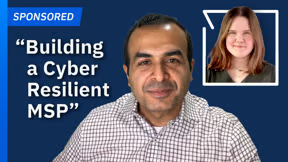
Hey channel insiders, welcome back to channel insider partner POV. I'm your host Katie Bavoso and my guest today is the new CEO of one of the largest and longest running solution providers in the channel. You'll hear from Yahi Omar, CEO of Zones. While he may be new to the company's seuite, Yahia is not new to zones. He sat on the company's board for more than three years and implemented some of its most innovative and progressive initiatives during that time.
But how does he plan to lead the company through the era of AI? We dig into that and the rest of his vision roadmap. I'd now like to welcome my guest today, the brand new CEO of Zones, Yahia Omar. Welcome, sir. Thank you so much for joining me. >> Yeah, thank you Katie and thank you for having me. >> Thank you for being here. I know that you've been a part of zones for nearly four years now. But whenever there's a title change like this, I'm sure you're you're going and reintroducing yourself to the company.
So, I hope that you've had some time to yourself finally after this probably whirlwind month for you. >> Yeah, it has been a month now. I have been a board member with Zones for a bit more than three years and I've been appointed the CEO of Zones starting September. So yeah, it's a one month of I call them uh sprints and reintroducing myself to to zones in my new capacity. But I must say people at zones and also some partners that I have met in our partner summit in Vegas uh a couple of weeks ago.
It has been great, exciting and I can only see opportunities and and and positivity and energy around. So but thank you so much. >> Oh, thank you and congratulations. I want to make sure I say that while we're recording because it's it's a wonderful opportunity. I'd like to take a moment to also get to know Zones for those audience members that maybe haven't been too familiar with you just yet. I'd like to reintroduce you to that audience. So Zones has been in business for nearly four decades now and a simple scan of your website shows the absolutely massive inventory of products, services, and expertise that Zones provides.
You do nearly everything. We're talking endtoend procurement, deployment, management, just everything. So, how do you define zones as a company in the modern channel ecosystem when you talk about zones and how do you stand out from the competition in this very crowded industry? >> Yeah, so zones is is an IT global service provider [clears throat] and as you just said it, it provides end-to-end services to our customers around the world. We have been operating more than 35 years started in United States and we have a substantial global footprint and reach in about 150 uh countries.
If you want to go a bit specific rather than the end to end, we focus on digital workplace solutions, cloud and data center, networking, cyber security and IT life cycle services. That's what we basically our main practices are offerings to our customers and we wrap around that uh very uh strong uh capability around service delivery and and professional services and managed services whether it's uh US or North America deployment or internationally we uh we do that as a very large scale as well.
So that's how I would characterize Zones and this is a good description of us as a company and what we do. >> And talk to me about your customer base a little bit. You're like you said a global company. What size businesses do you typically serve and what verticals do they typically operate in? Is there a specific vertical or is it just anybody who needs the IT services? >> Yes, we do. So u zones traditionally used to be serving the very large uh customers on enterprise and global customers with because of the company ability to uh provide services and execute at a global and at a national scale.
However, uh this have evolved over time that if we look at market segments, we serve from SMB, midm market, enterprise and global. That's from a market segment perspective. From a vertical perspective or industry perspective, we do have retail industry, we do have financial services, we serve manufacturing and we do serve sled, state, local and education as well and on manufacturing side too. So whether it's a market segment or it's an industry or a vertical, this is basically where we do.
So we cover all market segments and our expertise is around retail, healthcare, manufacturing, financial services and sled as well. >> A lot of specialties. >> Yeah. I mean when you have a company operates for more than 35 years and and carries a complete portfolio of uh technology and whether products or services you basically you start at one point and then from there you expand you expand on your market segments how you serve your customers and what kind of market segments and you expand outside of your headquarter or operation and you go into different parts [clears throat] whether in the country or in the world.
So as we speak we have the entire products, technology and services portfolio that any global IT service provider can bring to customers and on the same time we do that at a national and international scale as well globally. >> Wow. Yeah, definitely the scale is something that I'm looking forward to talking about more just the idea of what you do at that scale. But I want to take some time to get to know you a little bit more as a professional. You were appointed, as we said, CEO of Zones in September, but as you mentioned, you've sat on the board for more than three years already.
So, how did that time prepare you to lead the company and shape your priorities for what you wanted to address first as CEO? >> So, that's a very good question and thank you for asking that. So as a board member, independent board member, I have been involved on the company transformation and expansion into a a global services provider and I have been part of the business transformation, business model transformation and how the company is strategically transforming itself from at some point was having more product sales versus now diversifying more into the cloud and AI and and solutions and services at a larger scale.
Building capabilities around how a company better serve our customers uh with having delivery centers uh around the country, innovation centers that can this is where we do what we call them the solutioning ground which is basically where we put things together and make proof of concepts and we can share this with our customers and partners. So I have been part of that strategic transformation from a board perspective. The board had an oversight on how the management was doing that.
So essentially at that time I was involved with the executive management from a board perspective to make sure that the management is executing the strategic transformation the way that the board and the chairman of the board uh wanted uh them to uh to go by. This have really prepared me very well because a I know the entire executive leadership team and I know actually a good number of the senior management team. I knew the business. I know the challenges in the business.
I know the opportunities. So this have prepared me to when I have been offered this opportunity by the chairman and by the board it was a natural fit. It's just basically I'm moving from independent board non-executive board member to become the chief executive officer who would drive the execution lead the team to achieve what the company aspires to be in our business objective. So I think it couldn't be any better preparation than that in my opinion. >> So it sounds like you'll have the opportunity to continue bringing forward ideas and things that you've already set in motion as a board member.
Do you have anything new that you're hoping to do whether it be this year? There's not a lot of year left, but maybe uh in the next year 2026 or perhaps an opportunity that you are really honing in on that now you have the opportunity to follow more as the CEO. >> Yeah. So for for this year, so let's I mean the strategy for the company and the road map and milestones for the company is is more or less staying the same. It's just going to be the pace of which we execute.
Now being accountable on the execution as an executive, I'm I'm looking at to accelerate that transformation. We're almost done with even internally doing digital transformation and moving our ERP and we have done the internal organization structure, the organization design, the investments we made in coverage in capabilities. We have done all of that. Now it's time to capture the benefit of that for our customers and for us. for for our customers, we're becoming more efficient.
We're internally we will be able to better respond to the customer requirements and customer uh issues when they arise. We will come even with the uh adaption of technology. we will be be had more predictive view of the challenges and the risks that might come the way uh of our customers and we try to get ahead of them and and try to help our customers to mitigate those risks or to deal with them before they even uh happen. So this year is basically just a we need to achieve uh our goals for the year performance goals and transformational goals and then stepping into next year is is basically how we can scale and expand from there by doubling down on the cloud professional services managed services and AI.
I mean everybody you speak to today you speak about what we're going to be do about AI AI AI. Yes, there's a lot of people are still figuring out what to do with it. From our perspective, we're using it internally to become more efficient and and and improve the way we consume data and make decisions internally from a company perspective and externally as well. we have we're adapting the technology and the innovations that comes from our partners using uh AI native AI or enabled or powered AI uh whether it's products or technology or solutions.
So this is where we're working now actually on finalizing our strategy for next year which would be along the lines of what I have just described expanding more and more into the services and solution side and adapting to the technology regression that came with an AI native or AI powered uh products and services and how we can put this all together into a meaningful solution for our customer because remember one thing Katie is we look at customers as as as partners.
We position ourselves as trusted advisors to our customers. So we we want to help them focus in their core business while we take the IT burden out of their way. So it's not about the technology, it's about the utilization of this technology to help our customers do better in their work, have a a secure operational and uh functioning IT ecosystem to be able to serve their own customers as well. So that that's basically uh not in a nutshell, but I think this covers your question. >> Absolutely.
Absolutely. That was going to be actually a separate question of mine of how you're leading the company through the age of AI because as you said it's everywhere and everyone has questions about it and it sounds like you're very bullish about not only how you serve your customers better with it but using it internally as well. Is there perhaps an idea you'd be comfortable sharing with me about how you've been able to use AI internally at the company to continue that sort of journey? >> Yeah, I could give you a couple of examples.
So we basically looked at how we can use AI to improve the way we work. The way we work improving it is basically efficiency and productivity internally to be able to serve our customers better and respond to their uh needs in a faster and more efficient way. So you you from something as basic as sales proposals or service tickets or technical routing of tickets, service tickets that comes our way to help our customers solve a technical issue over there or improve something all the way to RFP responses which is basically our proposal factory would look at how we can use AI to respond faster to a request for a proposal or request for information or request for quotation and then you look at it as well as our consumption of data inside zones.
How we can use AI within finance to bring the uh analytics that we need to make decisions for the business internally and for our customers as well. So that's that's basically a lot of applications uh to to use could be as basic as co-pilot for sales or or for communication or embedded within our D365 or as sophisticated as bringing consuming financial reports and data in a ways that help us make better decisions for our company. That's internally.
Externally, it's it's in every product that comes. All products now are coming AI enabled. On the edge, most of it have AI too. And on the same time, how we can help our customers build their own strategy around AI. >> They need that. >> Yeah. So, everybody wants to do something with it. What we're trying to do is we're trying to help our customers to shape up their strategy and their utilization and use of AI tools and and AI capabilities to do better for their work.
This make sense? >> It absolutely does. Yes. Yes. So, moving on from there, you had mentioned your partners earlier and I'd love to know when it comes to an ideal partnership in the Channel 4 zones. What is your ideal definition of that and do you have any plans to adjust that under your tenure as CEO? >> So two things we have more than we have relationship with more than 3,000 >> Wow partners technology partners and we are vendor agnostic uh company being what we care is what would be the best technology and innovation for our customers.
So in in in this way we just want to make sure that we have the right mix of technologies from our partners to serve the most important part of the equation which is the customer our customer and their customer. We share customers too. So if you look at uh what would be um important for us is the partners who collaborate with us to bring the best-in-class technology and innovation uh and to align with our vision for connected secure and intelligent IT infrastructure.
We have very strategic relationships with uh with partners like Microsoft, Dell Technologies, Apple, Lenovo, Intel, Cisco, HP and they play a very pivotal part in our go to market strategy. So what we need from them, we need technology, we need innovation and more importantly is to have strategically uh collaborate on how to bring the best for our customers as well. And if you look at it, technology innovation and if we and we solution it for the best of the customer and we do the more important thing which is the delivery excellence to deliver what we solution for our customers and then using our integration capabilities, our uh ability to deliver at scale to provide end to end outcomes for our customers.
That's basically how we look at partnership. We had a very successful I believe uh partner summit where all our partners big and small strategic and mainstream partners have joined us in a 3 days summit where we shared with them what we think we we need and what our customers need. And they shared with us what they expect us uh to do strategically and tactically for their technology and innovation. and we agreed on what would be the best way moving forward in 2026 to combine our efforts their technology innovation and our solutions and ability to deliver against those solutions.
So that's that's basically uh how we're looking at it and how we're planning for 2026. So a question that I have that is more for clarification on my end would be as far as partners go, you mentioned obviously a lot of great vendors, massive vendors, but do you at all serve the the channel solution providers out there or would they turn to you for more of a procurement uh phase or are they not necessarily involved with zones at all? Again, I say this because you offer so many things that I could see an opportunity for smaller partners to reach out and strategize with zones to be able to grow themselves internally.
But that also makes competition a strange place too. >> Partners for us or or partners like OEM's vendors, >> partners for you, partners for you, not OEMs, uh more of the other solution providers of the channel. >> We we use other solution providers. We have relationships with them mostly on service delivery and some things. So we we have what we call our authorized service provider program which is if we feel like in one part of the world or in one geography we have a partner who's capable to deliver to the service standards that we offer to our customers.
We have relationships with them and they help us with some of the u of the delivery of our solutions and services. We cannot be everywhere as directly as a company. So we rely on other service provider not necessarily smaller they could be small the size is not the the thing it's a capability and the ability to provide services on our behalf to our customers or jointly with us to our partners. So we strategic we have a strategically number of uh authorized service providers.
They they partner with us to serve our customers and we use some partners for specific needs based on their credentials and their ability. So this is for the partners who work with zones. when you asking the question it came to my mind partners or vendors or OM but this is the other way remember this we partner with service providers like us but they can believe on the same standards uh if you look at those that have what they said consider it done and first choice of it we want our customers to think of us as a first choice for their IT needs and consider it done is not a phrase It's for us.
We want our customers to know that when they give a business to zones, they should consider it done and we get it done to deliver again that outcome. So to be able to do that, we work with partners who share the same philosophy of customer service. They share the same commitment to service delivery excellence and they share the same I would say DNA when it comes to everything starts and end with the customer and we need to deliver to the best level what we call fivestar services.
So this is what we use as with with other service providers. Does this answer your question Katie? >> It does. Thank you. That makes a lot of sense to me too when you talk about the consider it done mentality. you've already chosen strategic partners that when a customer works with them because as you said you can't be everywhere at once even even though you're global when they work with them they immediately feel from a cultural from an innovative perspective they're working with zones it's just seamless on that sort of relationship >> in fact we train those partners on zones service standards uh customer behavior we have contractual relationship with them to make sure that they are if they are representing us or delivering something on our behalf.
They do it with the same standards of zone. So it's not just setting expectations. We have relationships that would allow us to make sure that yes, apart from maybe they don't have the same badge, but they would look and feel and act and and perform as if they are zones and following the same standards of zones. >> Very well put. Yes. And that's definitely the intention that I got as you were explaining it, especially when saying consider it done because on the customer side, they don't want to know the difference.
They don't want to know of any sort of friction or any sort of question or confusion that might pop up for them. They just want their services completed because that's all they care about. >> Absolutely right. You said >> with that in mind, I I I'm curious to know this is an economically strange time here in the US and it is impacting the rest of the world. We have tariffs. We have some economic instability. How are you helping to guide both your clients and your partners through that time?
Yeah, with our clients when we when we design solutions, we design them in a cost effective way. Meaning most of the solutions we provide would be bringing some savings. Savings could be financial savings like doing things better or more for less which is saving from their opics operating expenses of their IT like helping them to be more efficient with their IT budget. That's one side and more importantly as well is helping be is helping them to be more efficient by increasing the productivity and the uptime and the the the ability for them to uh to to have more efficient and more productive IT infrastructure and work environment.
So economically we help them to do things in a more cost effective manner and in a better and more efficient way and both would end up by bottom line uh outcome for our clients and this is what they would expect from us for with our partners our service our service providers we have a very transparent relationship uh when we decide that we are going to deliver part of the services through uh a partner. We share with them the economics of what we're trying to achieve and they commit as much as we commit to deliver the best value for our customers and we make it a win-win relationship.
So we're in this together and we set high expectations and we pay against those high expectations as well. So economically we help I think the uh from an economic perspective everybody's trying to to to to thrive on this environment. The good news is technology is always a a way to improve cost to improve efficiency. So that's that's what happens that we we help our customers to achieve that objective as well. But obviously yes there is uncertainty around the economy.
We have went through a couple of quarters of from a supply chain perspective with the tariffs that was coming on and off. Uh but but the good news is the markets were prepared. Our great OEMs and partners were prepared for this. Our the distributors were were were prepared for this. So we smoothed it out so we had enough supply to keep things going from a product perspective. But guess what? It actually created a different thing. You know we do life cycle services.
So even if there is something short we have a complete line of business where we can uh take a a product reimage it and extend its lifetime until a new technology refresh comes in or a new product come in. So it becomes more of a services we provide to our customers even if there is a short supply in something we still kind of keep you going and provide services for you using even a technology that might that might be existing today. So we I think we've weathered that kind of turbulence to a certain extent but so far we're doing well in our first nine months of the year from a company perspective.
We're we're growing nicely on the top line and the bottom line and and we are on our way to uh to achieve our goals for this year. >> Fantastic. I have to ask because knowing your experience in this industry, you've been a pillar in the technology industry for a long time. You've seen a lot of changes and trends and as I said many times, you've been with zones for several years now. So, what do you see as the greatest growth opportunity for zones over the next 3 to 5 years?
That might be a little difficult to predict uh just with all the trends we've spoken about, but what would you think is the biggest growth opportunity for you? >> It's um the accelerated digital transformation with our customers. Cloud is something we're invested in having a a a cloud business practice with solution architects and engineering and sales force to uh grow faster in crow in cloud than the other parts of the business and more importantly the professional and managed services.
That's that's where I would see where the opportunity would be mostly uh going forward. However, with cloud comes networking and security because you get to the cloud, you need to have the the security posture as a company to be comfortable to be there. So cloud security, networking, managed service, professional services and the adoption of AI is where I think we will be uh mostly accelerating uh in the next few years to come. >> Very well put and I think that AI as you as you mentioned there's no shortage of what we're about to see with it in the future.
Uh so I think only time will tell the opportunities that we have there for sure. Another thing, zones recently committed to the United Nations Global Compact, which is the world's largest corporate sustainability initiative. What steps are you actively taking right now to invest further into that sustainability commitment? We are committed to sustainability and we have the because we I don't know if you know we have the integration center and the way we solution and manage the entire life cycle of the product we do it in a sustainable and environmental friendly way.
So we have the certification and we're trying to make sure that everything we do on our end fits that agenda. It's basically we impact the environment. Think about it acid disposal. How you do it in an environment friendly and in a safe way for the environment for the communities where we operate. We have the uh the certificates to do that. And we're committed to make sure when when we drive the end of life of a product or we drive the solution and services of a product, we do it in a way that would help the environment and and and the health and safety agenda as well. >> Beautifully put and I'm excited to see the continuation of that.
I was really excited to see that as a press release on your site. And thinking just along the lines of how long you've been at the company, you've seen some things. I'm curious to know, is there a success story that you really love to talk about when it comes to exemplifying zones as a technology provider and leader in this space? Does anything come to mind when thinking about your customers and the success stories that zones has had with them during your tenure? >> Uh, how much time you have?
I can >> we've got time. >> A national healthcare provider. It's a major network. Um we have implemented a secure teley health infrastructure spanning hundreds of facilities and that collaboration went beyond the technology itself because we believe it redefined how care was delivered through those healthcare providers. We co-created the road map and we have executed side by side with our client and the better news is we continue to manage and optimize as we go.
So this is very impactful because in healthcare it touches each and every one of us to be able to contribute to a um teley health especially with everything after co we have a lot of different ways of receiving care. So that network we've been able to make impact it touches the ordinary people who are just getting the care remotely or virtually and we've been able to help them through hundreds of locations to do that. So this would be an example that I think resonates because all of us one way or another had an experience with some teley health um applications or services.
Another examples could be an retail and we have a a very big national retailer where we as a company were able to make sure that all their stores and branches uh were staged and secure and the from an infrastructure and uh life cycle management uh to be able to serve their customers. So when you go to a retailer and you're not going to get hung up because the technology is not working or the selfch checkout is not working or your profile doesn't come up with your phone number.
So we have been working with one of the largest if not the largest national retailers to make sure their hundreds of stores and branches are up and we continue to provide the service. So the way I see this is we have served different classes of customers. One our customer is the retailer or the healthcare network that's our direct customers but [clears throat] their customers who are enjoying the technology or the services that we supported and we provided it's making a greater impact from our respect.
We are the invisible party here because we're the one between the provider whether it's a healthcare network or the retail chain. Their customers, they don't see us, but they enjoy the value and the impact we bring to their fingertips in a store or in an online [clears throat] or in a virtual teley health uh service. This is two examples. If you have three more hours, I can give you more. >> I really enjoyed those examples, especially when it comes to tellahalth.
I love the way you speak about you're touching people that may not know zones is involved because you are the the invisible partner in that, but you're touching people nonetheless during probably the most critical times in their lives when they're trying to seek health care. And that in itself that would make me sleep very well at night if I knew I was a part of something like that. >> Very good. Thank you. >> Well, sir, did I miss anything? Is there anything you would like to tell the audience before we wrap up today?
I'd love to be able to pass the microphone to you and let you speak. >> I would try not to repeat myself but I would just make few key messages is when we say first choice for it, we mean it. We hope our customers would consider us as their first choice for it and they choose to work with us. uh and we we would make sure that we deliver on that expectations and we would make their choice worthwhile. When we say consider it done, whether you read it consider it done or consider it done, we really mean it.
We get the job done. We're not going to talk about it or we're not going to explain it. We're going to put it in slides. We're going to get it done. Meaning from the time we speak with the customer, do discovery to understand [clears throat] what are the needs, the requirements, what are the important priorities for our customers in their own business. And we craft and we solution and we design everything we do to achieve that outcome and help our customers achieve it all the way to the life cycle management of every IT asset whether it's a device or a software or a cloud application or whatever we are talking about that's what we say considered done and it is done I would say it would be well done too so from a customer perspectives and then couple of messages just to reflect act on the conversation we have to our OEM vendors.
We had a great conversation two weeks ago and we will build on the strategic relationship we have and for us it's how to bring the technology and innovation of our of our vendors and OEMs solution then delivered the best way for our customers. We all are serving our customers no matter everybody has a role to do and we continue our commitment to do that for our authorized service providers that you you mentioned. Zones is is a company that uh is open, transparent where when we're engaged in a business uh partnership, we win together and we succeed when they succeed our partners.
So, it's a mutual success and it's a win-win. Those are the four things I would leave you with. And one last thing is to thank you very much for giving me the time and the opportunity to speak with you. It it has been a real pleasure. And I hope it it gave you u some insights about zones and about the industry and the channel environment we're in. And I really appreciate your time so much. >> Thank you so much, Yahi. I appreciate you. My final question today would just be if those listening and watching would like to learn more about zones, where can they go?
What sites can they visit? >> We have a zones.com and we have uh they have different ways to uh to reach out to zones whether it's our marketing or our uh PR or our customer service. So there was so many ways to reach to us but at least go to zones.com and you will find us there. >> Fabulous. Thank you so much for your time today, Yahia, and good luck with the rest of this year and into 2026. >> Thank you so much, Y. Appreciate it. >> Thank you so much to Yahia for joining me today and thanks to you for watching or listening.
You can check out every episode of Channel Insider Partner POV on channelinsider.com or check us out on YouTube at youtube.com/ channelinsider_news and trends. You can also listen to us as a podcast wherever you get your podcasts from. Don't forget to like, subscribe, and follow wherever possible so you never miss an episode. Once again, I'm Katie Bavoso, and I'll see you next time.
This transcript was generated automatically from the
video's captions and may contain errors.