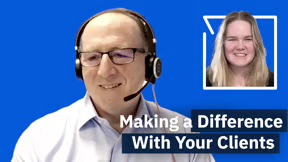
Hey channel insiders, welcome back to channel insider partner POV. I'm your host Katie Pavoso and my guest today is Michael Gray, chief technology officer at Thrive, a Massachusetts-based managed services provider that recently released a new offering called AI managed services. The core pillars of these new services start at finding use cases for AI tools and go all the way to implementing and managing the right ones for client businesses. Mike and I discussed the opportunity these new AI managed services offer customers and how closing AI security gaps at Thrive itself led to an incredible data discovery Mike can now use as a proof of concept.
Welcome, Michael. Great to have you. >> Hey Katie, how you doing? >> I'm good. I'm good. I know you and I are not far from each other in the Massachusetts area. So, I hope that you survived the torrential downpour that we had this morning. >> Pretty exciting. I got to tell you, uh, you know, for people that work from home, a big rainstorm is a big deal. >> I know. Like, woo, what's going outside on the window TV today? >> Yeah. >> Well, thank you so much for being here again.
And I kind of want to kick off by getting to know Thrive a little bit more. for those in the audience that may not have heard of you. As I said, you're a managed service provider based in the Boston area, but I'd say that that's a very brief description of who you are. So, how would you describe what Thrive is and who you are and especially who your clients tend to be? >> Yeah, absolutely. And and thanks for that. Thanks for this opportunity. Thrive is a global organization.
We've been in business for quite some time, over 20 years. The exponential growth we've had started really in 2017 and then on forward. So I always look at it as there's really a tale of two companies uh sort of pre207 and then up till now. Uh but we are a global organization and we have about 1,600 employees. Uh they're all over the place spread across the United States, Philippines, UK, Canada, Singapore, Hong Kong, Australia. So we're in a lot of places.
Um and our customer base uh there's a good portion of it that is focused on financial services but even though financial services and healthcare is a big portion of this we have all kinds of demographics of customers from manufacturing to state and local government just a lot of different kinds of organizations and I would tell you it makes it really interesting for all of our employees me included because you know you sort of go from all these different situations where you're learning about how different organiz organizations are trying to mobilize technology.
It's pretty cool. >> Do you have a vertical that you're currently kind of obsessing over depending on the trends that are allowing you to have a lot of innovation there? >> Well, financial services uh you know, they they they always push us in a really good way. They're always looking for uh competitive edge and using technology in that way. And you know, I should have mentioned as well um when it comes to Thrive, you know, you sort of mentioned a managed service provider.
We look at ourselves as a next generation managed service provider and what that actually means is there are close to 50,000 MSPs in the United States and they all run in a variety of different ways. We're really focused on automation and now AI and how do we bring a really deep experience and valuable engagement to our customers and try to look at everything of I understand we've always done it that way. Is there a better way to do it now that there's some newer technology available to us? >> You said the magic word AI.
So, let's dig into >> when you say that, you know, the ghost of AI appears and we have to keep talking about it. Uh, but for real, there is an exciting opportunity to talk about artificial intelligence that Thrive has introduced only in about the last month uh prior to this recording. So, why don't you tell me about Thrive's new offering that launched earlier this fall, AI managed services? What exactly are these services and what kind of client businesses are these designed for?
That might be a little repetitive, but I'm I'm wondering if you might have financial services specifically in mind or if it goes beyond that. >> Well, it certainly does go beyond that. And by the way, when you go to CTO school, you're issued a list of buzzwords that you need to say each year. And this this year's word is is AI. You can't go through one uh call like this or a meeting or uh webcast without saying that. Here here's what I would tell you.
The reason you know we we see AI applying across our entire client base. Um I don't think the transformational abilities of AI is discriminating against any organization or any demographic or vertical. What I would tell you is there are some some areas that are very ripe for basic AI capabilities like summarization. So if you can imagine someone's working in a private equity organization and they receive a very large document about a potential investment they can make and perhaps some Excel that goes alongside of it supporting data.
Well, it's going to take a couple hours to digest that. And I'm not saying that you're going to cut out the human in that situation, but what if a couple hours of a human could be condensed into 20 minutes to at least give them a quick heads up of here's what you're looking at. Now, they might still need to go do some very deep data analysis, but just getting quicker answers. And in the world of financial services, speed really is everything. Speed to knowledge is super important uh in in that world. doubt.
I guess I would argue that that's another thing that is important in every industry, but we just see it in financial services probably a little bit more than others. >> So, what is the story behind how these services came to be? We talked about it a little bit off camera and I found it really interesting because it's not like you just wake up one day and say, "I have an idea. Let the board decide if we should do this." >> Yeah. Yeah. You know, we talked off camera that I' I've been here a long time, which is not something I really like to talk about, but it's it's sort of the reason that we landed um with this AI managed services release that we did.
We've seen a lot of trends. I've seen a lot of trends just I've been here at Thrive of you sort of start to see a new technology and you wonder how it's going to pan out. And you often sit there and well, we're not sure. I think the example I used you back in in 2008 is everybody going to move their email to the cloud and looking back it seemed to be the most obvious thing in the whole world but it still took quite a while 5 to seven years for everybody to get there and I've looked at a lot of those trends uh while I've been here at Thrive and I certainly am not one to make this all about me but when I started to see you know two years ago I I started to see what chat GPT could do it was pretty obvious this is the next big wave of technology and what the best thing I can do for this organization is not to miss that wave.
And to be transparent with you, we've missed some waves before. Uh I've personally missed some waves before and it's my whole job to make sure I'm ahead of those. And I I I went back to the business and um fortunately we have a unbelievable team here. Uh I'm far from being on my own and I said, I think this is a really really uh big deal and I think we should um invest in it. and we put a really strong business plan together. Um, we're very fortunate to have some investment available to us and our investors agreed that that business plan about helping organizations adopt AI and enable their employees to maybe have a little bit easier job or be a little bit more productive was a smart move.
And so this has been the largest product release if you want to call it that service release at least since I've been here uh which is an awfully long time and we are really proud of it uh because we thought through all of this a a lot of people in our space a lot of organizations our space say uh there's a lot of meto services oh this company's doing security I'm going to do security and I didn't want that to happen with AI so we wanted to not quite be on the bleeding edge but but try to lead in this area and get out in front of it as opposed to, you know, maybe customers getting frustrated.
Well, I really needed all this help with AI and you weren't there to help me. So, I need to go in a different direction. And as it turns out, getting investment and hiring a team has made a world of difference in advance. You know, we don't have someone running our AI team who's also responsible for five other things. This is a fully dedicated team who very carefully picked to run the team and lead the team so that we really can put the full weight of this very large and powerful organization into helping our customers with this technology.
So to kind of dig more into the AI managed services because just the name of that right there intrigued me right away because you have so many MSPs and service providers across the channel trying to figure out how exactly to offer managed services in relation to AI and this is the first time that I actually heard it put into practice. One of the pillars that are included in the service is use cases. So Thrive will actually help customers identify use cases. how and can you give me an example of one? >> Sure.
Sure. Sure. Absolutely. So, I'm smiling because if you take 10 steps back and remove the AI buzz from things, >> what you actually see is what what our what I believe our customers need, what we do every day, AI aside, is we connect our customers to technology to make their business run more efficient or decrease risk or a number of benefits. Okay. Now, put AI back in that conversation. So they need access to technology to make themselves more efficient.
They need that technology to work. So that's a very simple way I try to tell our team, you know, maybe people that aren't super comfortable with AI and sort of the traditional Thrive world is this is about technology to customers to value. It's not any different than anything we do today. It's much more complicated. It's a little more sophisticated, a little more exciting, but it's still a managed service. So yes, our our offering is both software SAS software, but also helping with the human element and the process element.
And it feels a little bit cliche that we want to make sure we keep the humans in this loop. But we actually thrive as a company can't actually help you with AI technology if we're not engaging with your humans. So uh we do have I say non-technical they are they are technical but not just a developer that we throw uh at these environments. We have a consultant role that's more focused on adoption and use case development and let's go sit with that person in finance so they can explain to us how that process works so then we can translate that use case into something that we can build and actually gain that efficiency because Katie there's no shortage of tools out there.
There's no shortage. There's a million tools, but if you don't understand how all this stuff works, I mean, how are you really going to get me value? So, on the use case development side, we really do try to sus out, okay, well, tell me about some of the and and this is a this is a term from a tech CEO. Uh what what soul crushing work do you have that we could automate and uh just try and try and start, but that's even that's hard for people, right?
Uh well, I don't know where to start. So the one of the examples and we have I'd say five to seven that we talk through other customers. The truth of the magic Katie we only need one or two and then we can get them thinking. So a really good example is uh creating job descriptions. Just about every company in the world hires new employees. I think um there's some out there that might only hire them maybe in once every 10 years. And step one, you want to hire somebody new.
Well, do we have the job description? Well, no, because it's a net new ad. Okay, great. So, then what happens is the manager needs to find some time to go write this job description. Most people end up doing that at night because they don't have time and they're kind of rushing through it because what they really want is that that person hired and they want that help. They want that extra 40 hours a week. An example would be we internally take a we took a business plan.
We loaded it into a model and then we took some sample job descriptions that we already had and we have a uh GPT create job descriptions for us. And I would tell you it's it's it's such an easy thing and it's something that almost every end user every customer of Thrive can say okay I can I can use that. And it's because they do have the old job descriptions. They have business plans or they have documentation about what they're trying to accomplish.
And I would tell you that that use case example, almost everybody we talk to, it's yes, I have that use case. Let's just go do that. It's very easy. And now they start thinking like, okay, what other things are really just that simple? And you know, maybe it goes from one week to turn around a job description to one day. Well, that means you're starting to interview a week faster and maybe you're starting to hire a week faster and getting to onboard a week faster.
And I think people in the business world lose a week without even blinking. I'll get back to you next week. Think about that. What if everything happened just one week in advance and that's it. You know, I just think that is is is such a powerful use case. >> It really is. And I mean, you're talking about giving people time back. And you mentioned at one point even if it was just an hour that you're getting back uh earlier you talked about that I still think an hour getting back in my day even in my week makes a difference.
That means that there are things that I can go and do earlier than what I was planning to before. Maybe it means on a on a Friday I can knock off an hour earlier and spend more time with my family. It's an important thing when we talk about time and and use that as a currency. So when you get into a week that's a whole different that that's like my heart palpitates. That's a lot of time to be able to get back especially for the employment department.
What's been the reaction like like what have people it's very very new so I don't know if you have any sort of measurement to be able to say this is a success story over the last month but how what's the interest been like at least in the services? >> So we did some um I I do have a couple interesting I mean everybody wants to talk about this um and the fact that we had a dedicated team prior to release uh made a world of difference. So we went talked to customers.
So, I'll share with you one statistic. Our team had 27 conversations in 22 days. Um, >> wow. >> And so, that's that's 27 customers. Now, hey, is that is that a ton? Well, just think about how long it takes to book a meeting and are you available? And you know, people are making time for this. Um, which is really great. We've done uh quite a few pilots now, which is also very interesting because but these are more test cases uh for our product to a degree.
What I will tell you is I see a lot of people trying to build AI use cases or AI solutions on the edge of their desk >> and they're really struggling. So if I say what's going on with you know what's going on with your AI right now which are current strategist well we bought a couple licenses of name a brand of of AI tools um which by the way we're we're interested in all AI right we don't we don't just go to one product but um you know it's like a thing I'm working on at night like I I play around with it myself we bought the CFO a license and he's playing around with it there's not a lot of real strategy or even what I would say traditional project planning which is what we want to help with.
We've been through this internally. We've been through it with customers there. We have a methodology that we go through that includes discovery and it includes evaluation and deployment and uh ongoing measurement. we could show you what what things are working because a lot of these are they're almost like fads internally like look what I can do like yes you can absolutely summarize that email and you can do a thousand times more than just summarize that email and let's let's give everybody in the company superpowers not just the two executives you bought the license for. >> Yeah, really good point on that end.
Um, and I I have some more questions about that going on, especially handling AI internally. But something that I really want to get into is that obviously you're a seasoned managed security services provider. So, how do these AI managed services dovetail into your security services that you offer? How does the combination of the two really differentiate Thrive? >> Well, I I will tell you when we looked at a lot of uh AI platforms, we saw a lot of, hey, you know what? we could just slap a cost on this and go sell it to customers.
Not not what I wanted to do. Um I wanted to find and and this obviously is part of our strategy. What what differentiates us? So the solutions that we offer fully integrate into the rest of our security stack. Uh because if I come along and hand you an AI solution and as we're going through all this this all this use case stuff, all this stuff is awesome. It might thrive. Is it secure? Oh, I don't I don't know. we have to talk about that. So what our solutions do and we we offer this it's not something where we say my way or the highway but if you are using our security services all of our security services plug into our AI solution.
Thrive's always been very much of let's talk to the customer about what they want and need, not just forcing our solutions upon them. But we will make the recommendation when we're uh deploying a private AI solution that you should absolutely lock down all the other providers that you are that you are not deemed as the corporate solution so that they all now go through this same private AI channel. It seems like a small thing. It's hard to get right because you'll actually lose out on a lot of visibility if you don't lock down those other paths and stop people from using, you know, shadow AI and things like that.
So, all the user login, the perimeter networking, all the security solutions that Thrive has that um we're very proud of our security suite, it all plugs into the AI tooling right alongside of it. But neither side is required. If you want to you want advice on how to secure our private AI solution, we're happy to give you that as well. >> Something that we spoke about off camerara that I found really interesting though when we talked about the use of AI in the workplace.
Is there something that you see I hesitate to use to use the word going wrong, but do you typically see employees of of your customers not using AI to the best of their advantage or or even I'll use the word wrong, doing it incorrectly, using it incorrectly or using it in a way that's not safe for the company. And how do you kind of start from that point and then work backwards to a good known state with them? >> Yeah. Well, incorrectly, you know, I certainly see that and that's more around data leakage. you're uploading a file to, you know, public chat GPT, whether you have a paid subscription or not.
I would also argue uploading documents to any public website, whether it's an AI model or not, I is is obviously very dangerous. There's also a lot of people that just don't know how to write a good prompt. Um, so I would say, you know, that's incorrect as well. I I think I'm looking at prompt quality all the time, but if you there's certainly been more than enough people where you know either your personal life or in your professional life, they don't even know what a prompt is, right?
So, and I actually noticed that happens. Um I guess if I could criticize CTO's, I I do feel like we talk over people's heads sometimes. Um and I'm I'm sure I do it too of you're you're talking about something very complicated. we can't even get to the B. There are other people that aren't even at the baseline knowledge. And so education is a huge part of are they using it correctly or using it incorrectly. And so yeah, I' I've certainly seen plenty of emails generated with AI where it was painfully obvious that you generated that with AI.
Did you even proofread it? Things like that. I think sometimes people want to save all 15 minutes instead of maybe just trying to save 14 minutes, meaning that last minute you could you could you could proofread it. You're still way ahead of the game at that point. >> That is a good point. I I'm curious to know as the chief technology officer at Thrive, how you're bringing some of those safety precautions, guard rails, if you will, practicing what you preach and bringing that internally to Thrive.
When it comes to AI specifically, >> we've blocked um access to all models. You know, there's certainly a very small pocket of people that we we need it for R&D purposes, but that's done in a controlled manner. And something really interesting happened when we when we blocked all those um you we blocked them on the endpoint. There's a lot in our security stack. And there's there's more coming actually from a sec from a security standpoint that we're going to be able to offer around um you know screening entries, screening chats in and out.
Um you know we talked off camera a little bit about the usage statistics that we can pull and that's the really interesting part to this story. We blocked it because a it was good practice. We do not want our data leaked on the internet. We have a lot of technology focused people that work here. of course they need access to these tools. But one thing that I did not predict that was really really interesting is we started to get so many more use case so much more use case cultivation than we had before because now everyone was writing their prompts into a central place and we can see that usage data and uh while there may be some privacy concerns here I mean it is a Thrive system with a big Thrive logo uh no different than people using their emails.
We could now see usage across departments. We could now see quality of responses from our models and most importantly we could run generative AI analysis across all the props and so we could ask a model what is the whole company using AI for give me five sentences and that ability um and again it started with closing a security gap and it led to some amazing analysis about well here's what you think you're using it for but here's what actually using it for and here's where people are struggling and here's where the model's giving bad answers and that is something that we uh bring to our customers with our private AI solution which is that analysis uh of those chats and I think that's once you get past the is this a big brother scenario and you start to realize how powerful it could be you can get very comfortable with it very quickly because people sign off on acceptable use and handbooks and all these things it's just it it it's very cool stuff.
Katie, >> I really love that. I think that is so cool. And I love thinking about how you saw this incredible thing happen where more people were engaging with the AI tool that you had because it was one, it was the option for them to use and two, the company was probably like, "This is safe. You can use this." And we don't get in the outside world just kind of being around all these AI tools, you don't get a lot of people telling you this is the one to use because it's safe.
And I think we we just kind of either don't touch it because we're afraid or we start just kind of using a myriad of ones and we don't really know which one is going to be the best one to use. So when you're told by the CTO and by the people that you trust that this is the tool to use, I think that makes it a lot easier to start putting that into your workflow. >> We did not think it would turn into what it turned into. Again, we were we're trying to resolve a security issue and and I will share this with you, Katie.
Last week I saw Bill, our CEO, and he's like, "Hey, our internal AI model that we use." Yes. Uh I want my context window to be longer. I want to use it more. And I was the fact that he said this and knew what he would and that just got so exciting to me, right? Like he's like, I'm frustrated that it that it's too short. It's not often that, you know, executives or, you know, especially in in business roles go down to that level about one piece of technology.
And I'm say I'm I'm actually saying like he wasn't frustrated. He was interested, right? It's one thing of, hey, I sent this email and it bounced back and I'm very frustrated about this. This was I am using it a lot and I want to use it even more. And like that is just a such a positive vote of confidence in the solution. >> I love that. I love that. everything from the vote of confidence like you said from the highest level that it can be from to the data that you're able to collect from it to make your company and business run smarter and better.
I think that's so cool. I'm curious because earlier in the episode, and I didn't want to ask about it then, but I want to ask about it now. You talked about the AI team that you specifically developed to be able to handle these services and everyone is having a difficult time hiring AI executives, AI focused employees because it's new and because they cost a lot of money. I mean, we hear it from all the way up to the level of meta having a hard time being able to recruit talent like that.
I don't necessarily think that's something you have to worry about to that extent, but I'd love to know what is your hiring philosophy in the age of AI? Are experts hired or are they built from within for you? >> Well, for us it's both. Um, but what I will tell you is being an MSP for such a long time and me being here for such a long time, we wanted some fresh blood and some fresh thoughts around all of this. When you're an organization for as long has been around as long as we have, you get a little bit worried about group think.
So uh the team was actually born out of uh hiring people who are not traditional managed service provider uh personnel. It was people who worked in Apple retail, people who worked at very large media companies who helped them, a lot of technologists because we know how to run a service provider. If we don't know how to do that, that you know that that's a whole other story. So what we wanted was people who are I I will tell you out of the gate just enthusiastic about AI.
You know that was sort of the number one thing. Do you have energy to go out there and really get excited about this because we need you getting our customers excited about this? getting them excited about use case development and just having a lot of energy because with AI being just such a fast-paced transformation right now and I tell people it changes every day. I realized I told you something a month ago that's totally different now. That's the way things are working.
You you really need to be able to keep up with this and you got to have a a a big hunger to keep up with it. And so the team is is is made up more of AI technologists. And to be totally transparent, Katie, we're not developing new models here at Thrive. We're not trying to compete with anthropic or perplex. We're not doing any of those things. We have access to tools. I said, there's no shortage of tools. We just need people in the middle that can connect customers who who may not know the technology as well with the technology.
We're really good at that. Um, and we just want to do that same thing with AI. So, it's a pretty diverse team. And then we we brought existing Thrive people into the mix who know how to run a service and just couple these two people together. I'd even say it's almost half and half, right? A half from the outside that are AI enthusiasts and then another half that have been brought over from service teams who already exist to thrive. >> I love to hear that.
I think that the enthusiastic part is definitely something that you into any role that you're hiring into. if somebody is enthusiastic, I I personally would want to work with them over somebody that's been doing it for years and has kind of lost interest in it, but is really good at it. So, I really love hearing about that philosophy that goes into your hiring practice for that. I'd also love to hear a general success story from you that you think really exemplifies Thrive.
And I realize we've been talking about AI. This does does not have to be about AI specifically, but going back to just the general way that you serve your customers, is there a a customer success story that comes to mind that you go, "This is why we do what we do." >> One of the things we're really successful at, and I can point to plenty examples, is we run into uh private equity situations where a company is being carved out of another larger organization.
And these are very complex uh because if you don't meet some dates or you don't have the right technology in place, a very large uh private equity deal can fall apart. And our team's ability, especially when there's a date to hit and there's a lot of people whose day-to-day work lives are, I would say, hanging in the balance. What I mean is they need access to their email to do their jobs. And if we if they don't have access to that email now, they're effectively working for a new company but can't get their job done because the technology is not there.
And I would say that's one of the areas, Katie, where we really shine where if we are giving a deadline to meet this date and here are your requirements, we can I heard this phrase the other day around a project, we can raise an army for you in, you know, roughly 60 days so that you can meet some of these agreements. And I see us move mountains and I've seen us do that before. And I think it it happens so often that we we don't even notice that we did it.
And we'll get, you know, kudos emails from customers. Uh I cannot believe you did all of this in 30 days. You set up a brand new company that already had 400 employees in 60 days. But those are the types of things that we do. And you know, we have some just rockstar uh uh members from our deployment team and our project management teams that can just get a lot done in a very short amount of time. And it's really cool every time I see it. I've been a part of some of them.
I wish I was part of more of them now. But when you when you notice that you can accomplish these things and help one of our customers be successful or meet a goal, that's the whole reason we're in business. >> I love to hear that. I love to hear it. And since I get to the privilege today to speak to the CTO, I'm wondering if maybe you'll you'll be transparent with this question because a lot of people are like, "Well, just go to our site and look at our partners." But for you, for the vendors that you love working with lately, are there any vendors that you would shout out based on whether they're just a great partner to work with, their technology offerings are stellar, are there any that you would highlight at this time to say, "This is somebody that I really enjoy working with because of XYZ." >> Okay.
Well, Katie, anybody that knows me, um, is like I know what he's about to say. So, um, Service Now is above and beyond one of the most important parts of our technology stack. We are huge Service Now fans. Uh, by the way, I was not a Service Now person when I received the management of it. So, a recommendation was made to us and, uh, I sort of said, "What's this?" And, um, I I couldn't be happier. their entire platform runs on Service Now on the back end from an automation standpoint um just from a day-to-day tasking and now a lot of their AI tooling.
So again, it's probably no surprise. There are a lot of other vendors, some that I could talk about and some that I that I can't, but uh yeah, that's really if if I was going to say one that that's probably one of the biggest I I'm thinking now there's a lot of other vendors. Well, I just talked to Mike last week and he seemed happy with me. Um, but no, I mean the the other one I I I think I would mention is Horizon 3, which might not be as much of a household name, but they run our autonomous penetration testing. >> Um, and we we've sort of met them when they were just starting out and they had a you know, real revolutionary idea and they have just been a tremendous partner um for us over the years.
So again, now I'm thinking like, oh, I got to start listing all the vendors. But I would say those two because one more platform that's sort of ubiquitous to Thrive and then one one that's real specific to our to our security offering and to our pen testing. >> Thank you. That is really cool. I definitely have Horizon 3 is one that I'm going to look into a bit more after this, but yes, I'm very familiar with Service Now and it's exciting to hear about the work that you're all doing together.
Michael, as we start to wrap up here, a question that in I feel bad because in the beginning you said you don't like to talk about how long you've been with Thrive, but to me that's such a badge of honor. You've been with the company nearly two decades, over 18 years, and in our industry, as I've spoken to you about that, that's that's different. I I hear a lot of people jumping around two to three years at companies in the technology industry, and that's the norm.
So, when I get to talk to somebody that stayed with the same company for 18 years and really invested in them, I'd love to know how have they invested in you? What's why do you continue uh with Thrive and continue to grow with them? What's something about them that really just makes you addicted to the work? >> Yeah. Well, Katie, I got to be careful I don't get choked up here. So, I have a tremendous amount of pride in this company and we are not a perfect organization.
I h I tell people who I interview, just so you're aware, I have not had a non busy day in 18 and a half years. It's always busy. There's always something going on. The key to thrive is people. They all do genuinely care. They're human beings. They make mistakes. But we really will run through walls. We will do everything we can to make this a successful company. Now, as far as being here a long time, you sort of get to 10 years. And by the way, I'm not a founder, so this isn't like, well, I founded it, so I'm going to stay here forever.
You get to 10 years and you sort of say like, is it worth it? And each year, you know, I sort of look at it like, yeah, it's still worth it. It's still fun. There's there's something new happening every day. We have access to unbelievable technology. Uh, but if you really boil it all down, it's the people that I work with day in and day out that make just such a world of difference. And I will tell you, new people come into Thrive all the time and they say to me, "Hey, I remember you interviewed me or we talked before I got hired and you told me what a great company this was." Then they're they're here 2 3 6 months and they say to me, "This really is an unbelievable company to work with." So, I would say I don't know why I keep going.
It it's I do know why. It's fun. Like, I still like it. like I get frustrated of course, but uh I do genuinely enjoy the work and I think my co-workers enjoy the work as well and and that makes everything easier. >> I love to hear that and you know that's that's a common thread that I do hear from folks that I I get to ask that question to on occasion. So definitely seeing that if I were to run if I were to run a chat GBT or or an LLM through the data points, that would be the top one where they say it's fun coming to work.
That's what they say each time. >> You know what, Katie? I just I just thought of a prompt for our our internal model of you know people do people enjoy working at Thrive and see what the model says about us. I could I could go run that right after this. >> I am very excited. Keep me updated on what that says. >> Okay. >> So as we wrap up, Mike, where are we going in 2025 and beyond? I mean, we're we're almost done with 2025. So does Thrive have any upcoming plans for the rest of the year and into 2026? >> Yeah, absolutely.
Um I I should have said this earlier. talking about AI, but the the mantra right now for me around AI is if our customers want to have an AI conversation, we want to be there. Even if you're having it with somebody else, we would we would just be very interested to know what you're up to. So, uh we plan to do uh a lot of agent as a service. We can do some of it night right now. Uh but more autonomous agent as a service uh is really the big thing that's coming.
We're also adding additional AI, private AI or semi-private AI solutions. Some of the investment that our private AI solution takes is a little bit too much. So, uh we have other options that might be a little bit more palatable. And then also additional AI, what I would call screening solutions or just think of a firewall but for all of your AI, your generative AI interactions with your people. That's all coming. We also um you know continuing to develop on the traditional MSP side.
One item in particular that that's on the way is um something called Dex digital experience monitoring. We want to revolutionize how a help desk works. If you're having trouble connecting to Teams, in theory, we could connect that with software before you have to pick up the phone uh and call us. And we want to fix that problem. I heard an interesting statistic the other day. An end user will experience an error or an annoyance six times before they bother to fix it. >> I don't that stinks, but that's probably right.
What if we could engage with them the first time? What if we could make it not happen um and just get resolved in the background? So, next year, that's that's really an area that we uh we have some big plans to focus on and we're really excited to fix it. There's not a lot of product development in the help desk space. >> That's for sure. >> And I think it's time. I think it's time. >> Keep me updated about that. I want to have you back on to talk about that. >> Sure. >> Mike, it's been such a pleasure getting to speak with you today and I so appreciate your time.
If we've got viewers who are like, I absolutely want to reach out and learn more about Thrive. Where can they go to learn more and get started? >> Yeah, our website is thriveextgen.com. Nexgen.com. We do actually have a mini AI bot on the site. It's a summarized version of our of our website in a GPT bot, excuse me, that you can use. I'm also pretty easy to find on LinkedIn as well. I'm happy to chat. You can tell I'm interested in all of this, whether it's Thrive or AI and otherwise.
So, yeah. No, I would start with our website 100% and uh LinkedIn for both Thrive and and me shortly after that. >> Mike, this has been so much fun. I mean it. Thank you so much for such a great conversation today and for taking the time to talk to me. >> Absolutely. Thank you. >> Thanks so much to Mike for joining me today and thank you for watching or listening. You can check out every episode of Channel Insider Partner POV channelinsider.com or watch us on YouTube at youtube.com/ channelinssider_news and trends.
You can also listen to us as a podcast wherever you get your podcasts from. Don't forget to like, subscribe, and follow us on social media, including LinkedIn and X, so you never miss an episode. Once again, I'm Katie Bavoso, and I'll see you next time.
This transcript was generated automatically from the
video's captions and may contain errors.