



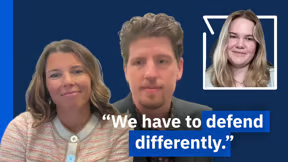








TekStream is expanding its student-staffed security operations center (SOC) program nationwide, positioning the model as a dual solution to cybersecurity talent shortages and rising demand for U.S.-based managed security services.
We spoke with TekStream CEO Rob Jansen about how the provider continues to build on the program’s early success with LSU.
Inside TekStream’s public-private SOC partnerships across the U.S.
TekStream offers a variety of managed security services to clients across North America and leverages its student SOC program with higher education clients.
Through the program, TekStream works alongside Splunk, AWS, and university IT and security teams to establish co-managed, student-powered SOCs that deliver real-world protection while developing the next generation of cybersecurity talent.
Students gain hands-on experience while working in a live environment, leveraging cloud-native infrastructure, AI, and advanced security analytics to support threat detection, incident response and observability initiatives.
“With around two years in our program, students graduate with the skillset of a cybersecurity professional around three to five years in their career,” Jansen said, adding that the program has seen every graduate land a job in the field of cybersecurity.
Student-run SOC program expands beyond LSU to new universities
We covered the program last year, when it was established at Louisiana State University (LSU) and several other colleges in the state.
Now, the program has expanded to include students working in SOCs at Auburn’s McCrary Institute, the University of Alabama, Rutgers, Kennesaw State, and the New Jersey Institute of Technology, which partnered with TekStream in late 2025 to open a SOC.
“This program was built to scale and grow and be improved by others on different campuses, so it’s incredibly exciting to see that come to life now,” Jansen said. “It’s been very fulfilling to see this model expanding around the country.”
“When we worked with TekStream to develop the LONI SOC, the first in this program, we knew the cybersecurity industry needed change,” said Craig Woolley, CIO at Louisiana State University.
“Not only do public institutions need a cybersecurity model that provides quality, affordable management in the face of rising complexity and increased threats, but students also need access to next-level training that gives them the hands-on experience they need to be successful in the industry right out of the gate. TekStream’s co-managed SOC model offers a solution that checks those boxes; it is an absolute win-win for this program.”
Jansen and Woolley joined Channel Insider: Partner POV in 2025 to discuss how the program works on LSU’s campus.
Why SLED organizations need new cybersecurity delivery models
Jansen told Channel Insider he sees public sector and education clients as a unique opportunity to provide valuable services at a time when they are more vulnerable than ever.
“Higher education, as well as government agencies and others in the public sector, these organizations are under attack constantly now,” Jansen said. “They hold a ton of very sensitive information, from financial records to grades and other data, just to use education as the example.”
That need, though, is not necessarily matched by the budgets that enterprises can provide to security professionals. TekStream’s student SOCs are a path to elevating security postures, keeping costs manageable, and building the next generation of security professionals.
“The experience that students gain through the program is truly invaluable,” said Sharon Kelley, CISO at New Jersey Institute of Technology. “It makes sense that more institutions are implementing the model, improving their own security posture while also providing students with the experience they need to succeed as professionals.”
Students build AI-era cybersecurity skills through hands-on SOC work
That next generation, Jansen argues, will need to be knowledgeable enough about complex security matters not just to address them but to work alongside the AI tooling being deployed throughout security workflows.
Jansen told Channel Insider that the program’s curriculum has evolved significantly over the past year to include hands-on guidance across a variety of environments, elevating the skill set students graduate with and deepening their understanding of how AI is impacting the security landscape.
“In our world, there is always a human in the loop, and I think that will remain true for a while to come. We absolutely need to leverage AI as a force multiplier, but we’ve needed to progress students deeper in their knowledge so they can determine whether the AI output is credible or not,” Jansen said.
“We’re going to have to continue to do that, I think, because we need to build those skills in the next generation of talent,” he added.
As cyber threats intensify across the public sector and demand for skilled practitioners continues to outpace supply, TekStream’s model reflects a broader shift toward alternative talent pipelines and hybrid service delivery.
By combining hands-on training, AI-enabled security workflows, and co-managed SOC environments, the program aims to produce job-ready professionals while helping organizations modernize their security posture—an approach likely to gain traction as both workforce and budget pressures persist.