-
Channel Business -
Security -
AI -
Infrastructure -
- Lists & Awards
- Resources Resource HubsFeatured ResourcesLink to Video: Why Most AI Projects Fail According to Spyglass MTG CEO
 Video: Why Most AI Projects Fail According to Spyglass MTG CEO
Spyglass MTG CEO Dori Albert explains how organizations can build secure and data-driven AI platforms that deliver real business value.
Link to Video: Harbor IT on NENS Acquisition and Why the Generalist MSP Model Is Dying Video: Harbor IT on NENS Acquisition and Why the Generalist MSP Model Is Dying
Leaders from Harbor IT explain why the traditional generalist MSP model is fading and how specialization, cybersecurity expertise, and vertical industry focus are shaping the future of managed services.
Link to Video: Hype, Bubble, or Breakthrough? Talking All Things AI with The Neuron Video: Hype, Bubble, or Breakthrough? Talking All Things AI with The Neuron
In this Channel Insider crossover, the hosts of The Neuron break down the AI race, the bubble debate, and what today’s tools really mean for businesses and everyday users.
Link to Video: SurePath AI CEO Secure GenAI Adoption with Zero Trust Video: SurePath AI CEO Secure GenAI Adoption with Zero Trust
SurePath AI CEO Casey Bleeker explains how organizations can accelerate generative AI adoption using zero trust principles and AWS guardrails without increasing security and compliance risk.
Link to Video: How Netskope and Optiv Fight Shadow AI Video: How Netskope and Optiv Fight Shadow AI
Industry experts from Netskope and Optiv explain how their partnership helps organizations secure cloud and AI adoption while balancing innovation governance and real world security outcomes.
Link to Video: Integris CEO and CRO on AI, Acquisitions, and How To Be an Irreplaceable MSP Video: Integris CEO and CRO on AI, Acquisitions, and How To Be an Irreplaceable MSP
Integris CEO Glenn Mathis and CRO Kyle Wewe share how AI along with verticalization and acquisitions are shaping the future of MSPs in 2026.
- About About
- Events Events
Copilot and Claude Signal a New AI Services Market
Microsoft and Anthropic are introducing AI “coworkers” to automate workflows. Here’s what Copilot Cowork and Claude Cowork mean for MSPs and IT partners.


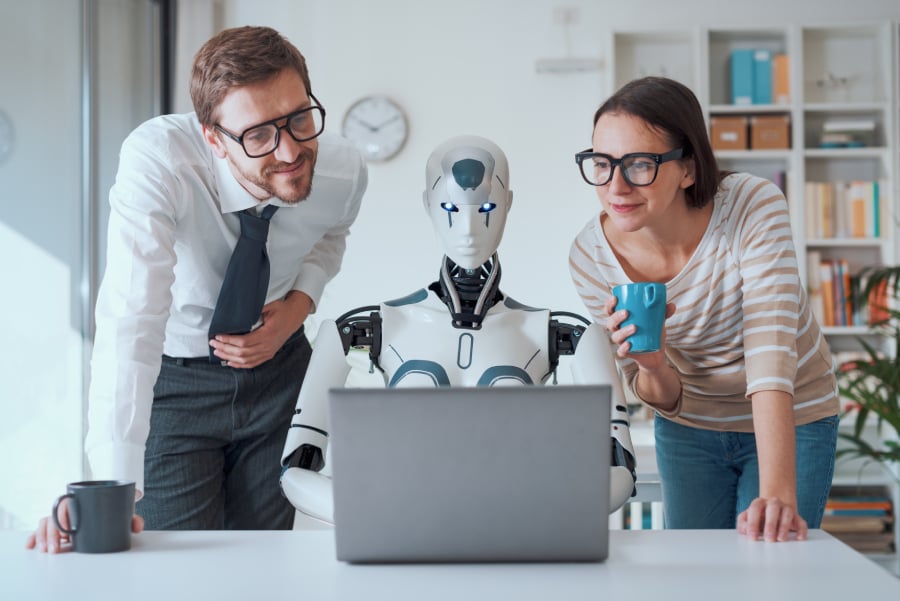
In 2026, the conversation around AI coworkers has become a key talking point in the enterprise industry. Anthropic introduced its Claude Cowork program earlier this year, a solution that transcends traditional AI chatbots and appears capable of doing real, task-driven work on its own.
Not long after, Microsoft announced its own take on an agentic AI colleague with Microsoft Copilot Cowork, adding further momentum to the coworker space, especially given its broad enterprise reach.
While both solutions are still in early stages, it’s clear that agentic AI and these so-called “AI coworkers” are set to change IT operations as we know them.
In this article, we explore how Copilot and Claude are paving the way for a new, AI-driven services market in the channel.
What do Claude Cowork and Microsoft Copilot Cowork actually do?
In January, Anthropic officially launched its Claude Cowork solution.
Described as “Claude Code for the rest of your work,” it brings agentic capabilities to the desktop, giving Claude access to local files and your browser so it can execute complex tasks on your behalf.
Below are some of its key capabilities, according to eWeek:
- AI operating directly on the desktop: Unlike the standard web interface, Cowork lives on your desktop and acts as a “doer” rather than just a chatter. It can access local folders, rename files, and organize documents.
- Browser access: For research tasks, Cowork can open a browser window, search Google or X, scroll through results, and synthesize findings while you focus on other work.
- Code execution: It includes a data analysis sandbox similar to ChatGPT’s, enabling it to generate graphs or format spreadsheets instantly.
Soon after, Microsoft unveiled Microsoft Copilot Cowork. Built in collaboration with Anthropic, the program provides similar “coworking” power to the Microsoft 365 suite. This means developing agentic capabilities across enterprise tools such as Outlook, Teams, and Excel.
Some of its key capabilities include:
- Calendar management in Outlook: Copilot Cowork can review schedules, identify conflicts or low-priority meetings, and propose adjustments.
- End-to-end meeting preparation: It can gather relevant emails, files, and prior conversations tied to an upcoming meeting, then generate a briefing document or presentation deck as needed.
- Company research: It can compile insights from both web and internal sources, including financial filings, news coverage, and earnings reports, to create executive summaries of companies or potential partners.
- Launch planning and competitive analysis: Copilot Cowork can generate competitive comparisons during product launches and create customer-ready pitch materials to support go-to-market efforts.
From AI-driven tools to “AI coworkers”
While advancements in AI tech are nothing new, the shift toward “AI coworkers” signals more than just a simple upgrade.
This new wave of AI offers not just improved intelligence, but a fundamental change in how AI is used. Rather than simply responding to prompts, these systems are increasingly capable of executing tasks and acting with a degree of autonomy.
We saw the impact of this shift firsthand when Anthropic first introduced Claude Cowork, causing technology stocks to dip amid concerns that this level of automation could wipe out or heavily change the SaaS business model as we know it today.
The concept of an AI coworker, now that Anthropic and Microsoft seem to offer realistic versions, is poised to reveal a few key trends in how AI will be used in the workplace.
An evolution beyond chat-based AI
While Claude Cowork and Microsoft Copilot Cowork differ in key ways, such as Claude being desktop-based and Copilot operating in the cloud, both point to an important shift.
Organizations are moving away from chat-based workflows toward task-driven AI that can execute work with minimal human intervention.
In both Claude and Copilot, there’s an emphasis on having AI be one step ahead, acting as a proactive assistant rather than a tool that merely reacts to a prompt or instruction.
These tools are now designed to perform multi-step tasks with minimal user input, surfacing results for review rather than requiring constant direction from the end user.
Delegating Tasks to AI as a “Team Member”
As a result, AI is beginning to resemble more of a colleague or “coworker” than a tool waiting to be used.
Many of the tasks handled by Claude and Copilot fall into the category of routine or repetitive work that would typically be assigned to junior staff.
Speaking with Channel Insider last year, R Systems VP for Data & AI Neeraj Abhyankar framed this next phase as the “AI Workforce of the Future,” a vision that Anthropic and Microsoft now appear to be bringing closer to reality.
“The next phase of AI transformation will hinge on specialized roles as AI evolves from a tool into autonomous agents acting as digital co-workers with defined responsibilities and KPIs,” Abhyankar said. “In 2026, expect to see more AI integration architects who will be essential in embedding agentic workflows into enterprise systems.”
The Neuron’s Grant Harvey even described Claude Cowork as “the AI intern that runs your desktop,” a comparison that captures both its utility and its envisioned role in modern workflows.
WATCH MORE: Grant Harvey and co-host Corey Noles recently joined Channel Insider: PPOV host Katie Bavoso and Managing Editor Victoria Durgin to share their insights on the AI market and the opportunities ahead in 2026.
AI colleague working across apps and data sources
Finally, both solutions point to a future where AI can operate across multiple data sources, including files, emails, calendar events, enterprise platforms, and the broader web.
While LLMs could be configured with context, this generation of agentic AI can actively retrieve and connect relevant data from the outset. The result is less siloed information and a more context-aware AI coworker.
Rather than being confined to a single interface, AI is becoming deeply integrated into the tools and systems where work actually happens.
What MSPs can do in the age of AI coworkers
With this shift on the horizon, managed service providers (MSPs) may be wondering how to prepare for what comes next.
Is it about integrating AI coworking solutions into their existing portfolios? Or does it mean evolving into a more strategic advisory role, helping clients determine which platforms best fit their needs?
In reality, it is likely a combination of both. As AI coworkers gain traction, MSPs have an opportunity to expand their role and deliver new forms of value. Below are several key areas where MSPs can focus.
Transition into AI orchestrators
First and foremost, MSPs are well-positioned to transition into the role of “AI orchestrators.” In this capacity, they would act as coordinators across AI models, agents, tools, and workflows, ensuring these systems work together effectively.
MSPs can help clients evaluate which Cowork solutions and agentic capabilities best align with their specific business goals and pain points.
This includes understanding which agents are best suited to different industries, how to maximize each model’s capabilities, and which best practices should be implemented to ensure a smooth deployment.
In addition, orchestration involves integrating Cowork tools with existing enterprise systems, ensuring data flows seamlessly between platforms without disrupting performance.
MSPs that can manage these interconnected environments will be key to helping organizations fully realize the value of “AI coworkers.”
Design ‘Cowork’ use cases for clients
Building on orchestration, MSPs can take the lead in designing practical Cowork use cases and workflow frameworks that deliver value.
At this early stage, many SMBs and enterprises are still figuring out how to fully leverage AI coworker capabilities. MSPs can use this opportunity to develop repeatable “AI coworker stacks” or frameworks that can be tailored and deployed across specific industries, such as law, marketing, and finance.
MSPs that can translate these tools into clear business outcomes will be best positioned to differentiate themselves in the market.
Dig deep into governance, security, and oversight
As with most AI solutions, security and governance are a major area of focus.
This will become especially true with Claude Cowork and Microsoft Copilot Cowork, as these solutions gain direct access to sensitive data, including local files, enterprise systems, and browser activity.
This presents security risks that are fundamentally higher than most AI tools, even those already operating at an enterprise level.
Cowork systems amplify existing AI-related security concerns around data exposure, permission sprawl, and unintended execution.
With this, there’s a clear opportunity for MSPs to step in as strategic security advisors for businesses interested in the AI coworker experiment.
MSPs can help define access policies, establish boundaries for what AI coworkers can and cannot do, and implement guardrails that prevent misuse or data leakage before issues arise.
Understand how to sell the Microsoft Copilot Cowork vision
By focusing specifically on Microsoft Copilot Cowork, MSPs can deepen their understanding of its value proposition. Given Microsoft’s dominance in the enterprise space, MSPs will need to know how to position and sell Copilot Cowork effectively.
This includes determining which platform best fits a client’s environment, deploying it within Microsoft 365, and measuring return on investment post-implementation. Licensing, packaging, and ongoing support will also play a critical role in driving adoption.
More broadly, this presents an opportunity for MSPs to define how Cowork solutions, along with related services such as orchestration and security, can be packaged into scalable, repeatable offerings.
WATCH MORE: In a recent CI: PPOV interview with Katie Bavoso, Spyglass MTG CEO Dori Albert dives into how her organization helps customers deploy AI securely within their Microsoft ecosystems.
Bottom line: AI Coworkers as a services opportunity
While the extent to which AI Cowork solutions will replace human workers remains to be seen, MSPs should stay ahead of the demand and opportunities these platforms are already creating.
At this stage, MSPs can take the lead in understanding the value that solutions like Claude Cowork and Microsoft Copilot Cowork bring, identifying where their capabilities can deliver meaningful impact, and acting as a bridge between emerging technology and real, tangible business outcomes.
Even as concerns around a potential “SaaS apocalypse” persist, AI coworkers should be viewed as an opportunity, not a threat.
As these tools potentially take on more active roles in daily operations, MSPs that can effectively orchestrate, guide, and implement them will be better positioned to adapt than those that do not.
Luis Millares has extensive experience reviewing virtual private networks (VPNs), password managers, and other security software. He has tested and reviewed numerous forms of tech, covering consumer technology like smartphones and laptops, all the way to enterprise software and cybersecurity products. He has authored over 450 online articles on technology and has worked for the leading tech journalism site in the Philippines, YugaTech.com. He currently contributes to the Daily Tech Insider newsletter, providing well-researched insights and coverage of the latest in technology.