









MSPs looking to build an AI services practice don’t need to start with autonomous agents, complicated workflows, or sophisticated AI architecture. Some of the most accessible opportunities are already sitting in front of them: generative AI tools that help customers write, research, create, and get more done.
Think about it. How much time do your customers spend drafting documents, building presentations, analyzing information, or completing other routine tasks? How much of that time could they get back with a little AI assistance?
And who better than their MSP to help them figure that out?
Level 1: The Assistive Level
Last time we suggested that if your customer sees AI as a huge challenge, the best way to smooth their path to understanding is to break that big challenge down into smaller, more digestible bites.
The goal: If your customer fears AI, show them why they have nothing to fear and everything to gain.
We introduced four levels of AI opportunity and said it’s very possible 80% of them may never get past level one. Today, we’re charting the history of generative AI (the “assistive” layer) to show you how to become customer zero in your own operations.
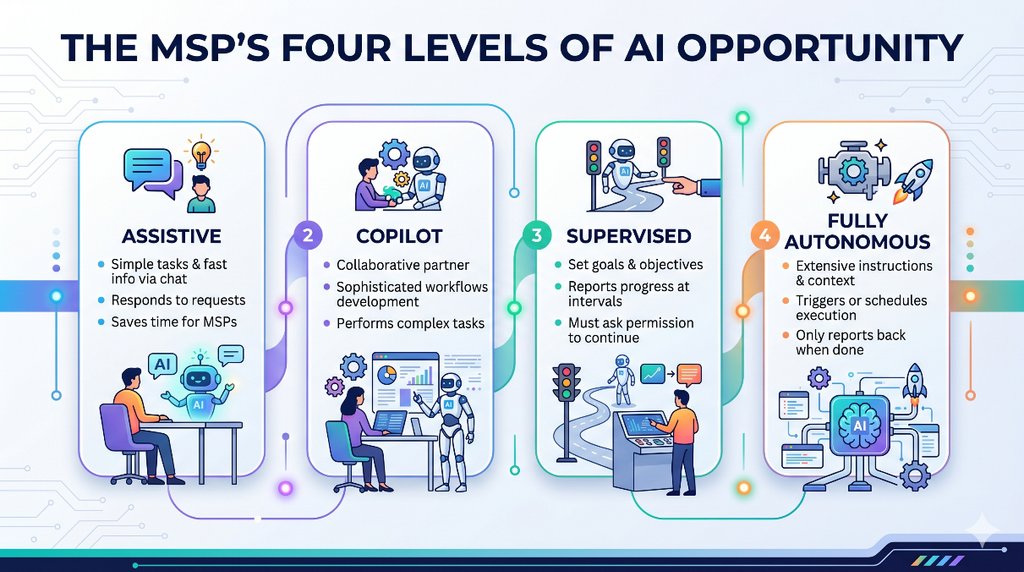
At this level, AI isn’t making decisions or running autonomous processes. It’s helping people accomplish everyday tasks faster and more efficiently. For MSPs, that creates an accessible starting point for helping customers adopt AI while developing new services of their own.
Let’s look at how we got here, what assistive AI can actually do, and where MSPs can turn those capabilities into customer opportunities.
How generative AI created the first level of AI services
Perhaps the first “real” AI application the public encountered was the IBM Deep Blue system that beat world chess champion Garry Kasparov in 1997.
In 2013, IBM announced Watson’s first real commercial application supporting lung cancer treatment decisions at Memorial Sloan Kettering Cancer Center.
In the meantime, quasi-AI personal assistants arrived from Apple (Siri), Amazon (Alexa), Google (Google Now), and Microsoft (Cortana).
In 2017 I was engaged by OpenText to write about the “recommender engine” they had built with their Magellan AI platform.
Then, in November 2022, OpenAI released ChatGPT, and within five days it had a million users. Within two months, 100 million. The word “generative” suddenly meant something to ordinary people: AI that creates.
GPT stands for Generative Pre-trained Transformer. The “generative” part is what matters. Unlike earlier AI systems designed to classify, detect, or predict, generative AI (GenAI) produces new content. It writes. It draws. It composes. It speaks. It codes. And it does all of this in response to a simple text prompt that any adult with an internet connection can type in natural language.
What assistive AI means for MSPs and their customers
The AI isn’t deciding anything. It isn’t running autonomous processes. It isn’t acting on your behalf without you in the room. It’s doing what you ask in a simple chat window, the moment you ask it, in ways that would have taken you significantly longer to accomplish on your own.
When you think about it, roughly 80% of AI users will probably never need more than this. That’s not a limitation.
It’s just like the difference between a do-it-yourselfer using a chisel to scrape off paint versus a sculptor using it to reveal the art underneath the stone. It’s also an enormous opportunity for MSPs to help customers become more comfortable with AI.
AI writing tools for business documents and content
The original ChatGPT was a text machine. You typed a request. It responded. That alone was enough to reshape how people worked.
Today, the text capabilities of assistive AI go far beyond chat. Users compose complete, polished first drafts of emails and proposals. They generate job descriptions, employee handbooks, incident response templates, and security awareness training content. They summarize long documents down to their key points, and so on.
For MSPs, the immediate application is obvious. Every practice area generates documents, and producing good ones takes time that could otherwise go toward revenue-producing work.
AI image generation for marketing and presentations
From DALL-E to Midjourney and more, image generators have arrived alongside text tools, delivering what used to require a graphic designer, a stock photo subscription, and a licensing discussion.
Type a description. Get an image. Revise the description. Get a better one.
MSPs use this to create graphics for client presentations, marketing materials, social posts, website assets, and training slides. Clients use it to produce product mockups, explainer illustrations, and branded content without touching Photoshop or hiring an agency.
The quality is good enough for most business uses. Not photorealistic portraiture, but absolutely sufficient for the professional content an MSP practice or a small business client produces every day.
AI voice and audio tools for business content
Generative AI extended into audio faster than most people expected.
Suno generates original music tracks from a text description. Need background music for a client webinar? A short intro jingle for a podcast? Describe the mood, tempo, and instruments. Done in seconds.
Voice cloning and text-to-speech tools, ElevenLabs being the most prominent, generate natural-sounding narration from a written script. MSPs can produce voiceovers for training videos without hiring voice talent. Write the script. The AI reads it in a professional voice you configure to match your brand. Clone your own voice and maintain a consistent presence across all your content.
All of this, and we’re still just on level one!
AI coding assistants for MSP automation
Assistive AI caught developers off-guard by even writing code well.
GitHub Copilot and Cursor generate functional code from plain-language descriptions. They complete functions, debug errors, translate code between languages, and write documentation for existing codebases.
For MSPs, practical applications include PowerShell and Python scripts for automation, custom platform integrations, and faster development of client-facing tools. Developers using AI coding assistants consistently report 20 to 40 percent productivity gains, and the number is higher for less-experienced team members working in unfamiliar languages.
AI research and analysis for client services
Assistive AI handles information work, not just content creation.
It reads long documents and surfaces key facts. It analyzes spreadsheets and identifies trends. It synthesizes research from multiple sources into organized summaries. It compares vendor offerings, pricing models, and contract terms. It finds gaps in a security policy or inconsistencies in a runbook.
For MSPs who spend significant time on vendor evaluations, compliance documentation, and client assessments, hours can feel like minutes.
How MSPs can turn assistive AI into new services
Every one of these capabilities represents a service worth offering; a service customers want and will benefit from significantly.
Teach a client’s marketing team to use AI image generation for their social content. Help a law firm use AI to draft first passes at routine correspondence. Set up a healthcare practice with AI-assisted documentation tools. Train a manufacturing company’s floor supervisors to write incident reports and shift summaries with AI.
None of this requires sophisticated AI architecture. None of it requires autonomous agents or complex workflows. It just requires knowing a few simple tools, knowing how to teach them, and knowing how to position them for specific client use cases.
The Assistive Level isn’t the most technically impressive tier of AI services. It’s the tier with the broadest reach, the fastest time-to-value, and the clearest path to revenue for MSPs entering the AI market.
The other three levels build on it. Every one of them starts here. Start your customers here. Next time, we’ll step up to the Copilot level and collaborate with our AI friend.
About AgenticMSP
While AIMSP will publish twice monthly on Channel Insider, you can also consult AgenticMSP (http://agenticmsp.news), a Substack that delivers “all the information an MSP needs to build their AI Empire.”
Each issue we’ll talk about strategies, profile experts, discuss new product introductions, show how to best consult to your customers about AI, and more.
I also share my homework! For each issue, we review thousands of recent articles to select a group that will be very relevant and of great interest to MSPs about AI. For each article, you’ll get a summary, an explanation of why it’s so MSP-relevant, an Action List so you can take what you learn and put it to use, and the link to the original article.
The goal is to eliminate the wasted time spent looking for pertinent info so you can focus on the news that is worth your time.
Please reach me at hmc@howardmcohen.com with any questions you may have about AI resources and how MSPs build their AI business.