











Anthropic wants businesses to stop guessing whether their AI investments are paying off, and its latest Claude Enterprise tools aim to give them a clearer picture of spending and results.
The company has made three features generally available to Claude Enterprise customers: Smart Reports, in-app surveys, and pooled group budgets. Together, they help organizations understand how employees use Claude, identify common workflows, and manage AI spending across teams.
The release comes as businesses face growing pressure to justify their AI investments, particularly as AI coding assistants and autonomous agents become more widely used.
Smart reports connect AI spending to business output
The centerpiece of the release is Smart Reports, which analyzes samples of team conversation transcripts to identify the work employees perform with Claude.
Administrators can select a team, reporting period and Claude products to include. The system then organizes activity into workstreams, showing associated spending, completed deliverables and recurring problems, including missing integrations and failed tool calls.
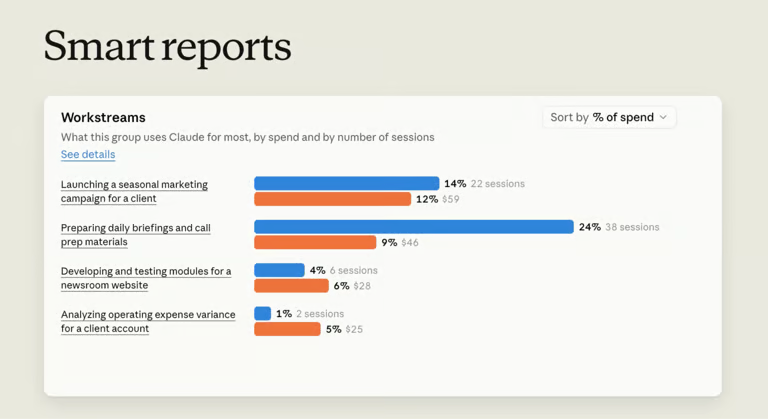
It also recommends ways to improve existing processes, such as turning frequently repeated tasks into reusable skills or adding instructions to code repositories. Administrators can also ask custom questions about usage and costs and save their findings as templates.
Anthropic says the reports are intended to help organizations understand adoption and plan investments, not evaluate individual employees or make employment decisions.
Surveys and shared budgets give teams more control
The other two features address employee feedback and budget management.
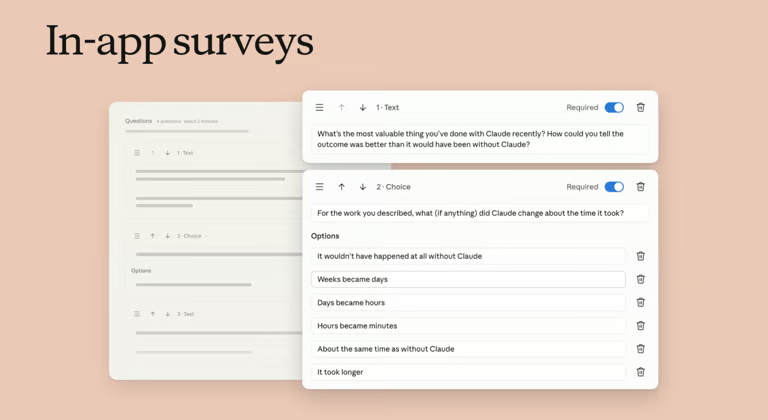
In-app surveys let administrators ask employees which Claude applications provide the most value, how the technology affects task completion times and which workflows colleagues should replicate. Responses appear in the administration console and can be exported to spreadsheets.
Meanwhile, pooled group budgets allow administrators to establish shared monthly spending limits for teams rather than relying exclusively on individual allowances.
Individual limits remain active as additional safeguards. Both limits apply to every request, meaning employees stop when either budget is exhausted. Administrators also receive alerts when group spending reaches 50%, 75%, 95% and 100% of its allocation.
Rising AI bills put pressure on enterprise budgets
Anthropic’s announcement addresses a growing problem for businesses: AI adoption is increasing, but spending doesn’t always come with measurable productivity gains.
TechCrunch reported that Jellyfish’s analysis of 276,000 customers found Claude Code and other Anthropic-powered tools accounted for nearly one-third of proposed code changes submitted for review. Spending on those tools had also increased tenfold since the beginning of 2026, reaching approximately 2% of total engineering costs.
Nicholas Arcolano, Jellyfish’s chief scientist, told TechCrunch: “Even if you’re saying 2% is still small, that 10x growth is growth that most CFOs didn’t plan for.”
The figures illustrate why tracking usage alone is no longer sufficient. Businesses need to understand whether AI-generated work is useful, how much human intervention it requires and whether the resulting productivity gains justify the expense.
What this means for enterprise AI buyers
Anthropic’s new reporting features could influence how enterprises evaluate AI providers, particularly as organizations look for ways to measure spending against business results.
Better visibility into Claude usage may help customers identify valuable workflows, but it could also encourage deeper dependence on Anthropic’s ecosystem. Once businesses build integrations, reusable skills, and established processes around a particular platform, switching providers may require additional development work and employee training.
That makes portability an important consideration for enterprise buyers. Organizations should assess whether their AI workflows and reporting processes can be adapted to other providers without significant disruption.
However, organizations should approach employee-level usage analysis carefully. Although Anthropic explicitly warns against using Smart Reports for performance reviews or employment decisions, businesses will need clear internal policies around data access, employee privacy and how reporting insights inform management decisions.
Anthropic says customer data collected through these features is not used for model training by default. Availability also depends on organizational configurations, including certain HIPAA and encryption settings.
What channel partners and enterprises should watch
For channel partners, the release creates an opportunity to help customers move beyond AI deployment and establish measurable adoption and cost-management strategies.
Partners could also advise customers on governance policies, spending controls, and integration requirements as AI adoption expands across departments. These services may become increasingly valuable as businesses seek clearer evidence that their AI investments are producing worthwhile results.
Enterprises evaluating Claude should consider whether shared budgets and reporting capabilities fit their existing financial controls and procurement processes. The ability to identify expensive workflows, reduce ineffective usage, and replicate successful applications could become increasingly important as AI spreads throughout organizations.
Ultimately, AI providers will face growing pressure to demonstrate not just what their models can do, but what businesses actually get for their money. Anthropic is making that calculation part of its enterprise offering.
Other news: Fortinet has introduced its FortiGuard Inline AI Security Service, bringing cloud-delivered AI threat detection and data protection to existing FortiGate firewalls.